تم الحل ✓
categoryإحصاء
schoolبكالوريوس
event_available2026-07-15
السؤال
Transcribed Image Text:
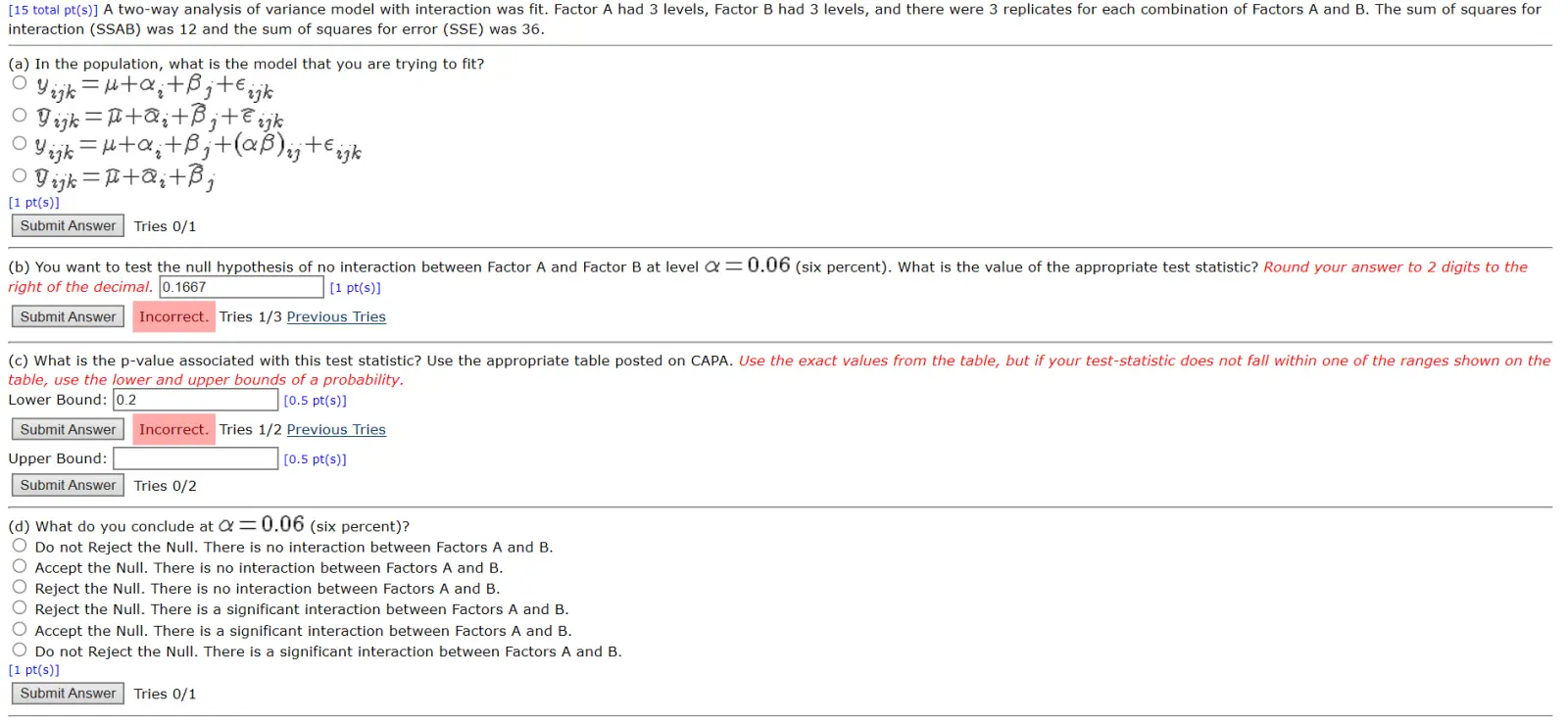
[15 total pt(s)] A two-way analysis of variance model with interaction was fit. Factor A had 3 levels, Factor B had 3 levels, and there were 3 replicates for each combination of Factors A and B. The sum of squares for
interaction (SSAB) was 12 and the sum of squares for error (SSE) was 36.
(a) In the population, what is the model that you are trying to fit?
Yijk = μ +α ; + B j + € i j k
○ I i j k = π +α i+ß j + € i j k
O
Y i j k = μ +α ¿ + B j +
(α ß) i j + € i j k
○ Dijk = π+i+B;
[1 pt(s)]
Submit Answer
Tries 0/1
(b) You want to test the null hypothesis of no interaction between Factor A and Factor B at level = 0.06 (six percent). What is the value of the appropriate test statistic? Round your answer to 2 digits to the
right of the decimal. 0.1667
[1 pt(s)]
Submit Answer
Incorrect. Tries 1/3 Previous Tries
(c) What is the p-value associated with this test statistic? Use the appropriate table posted on CAPA. Use the exact values from the table, but if your test-statistic does not fall within one of the ranges shown on the
table, use the lower and upper bounds of a probability.
Lower Bound: 0.2
[0.5 pt(s)]
Incorrect. Tries 1/2 Previous Tries
Submit Answer
Upper Bound:
Submit Answer
Tries 0/2
[0.5 pt(s)]
(d) What do you conclude at Q = 0.06 (six percent)?
O Do not Reject the Null. There is no interaction between Factors A and B.
Accept the Null. There is no interaction between Factors A and B.
◇ Reject the Null. There is no interaction between Factors A and B.
◇ Reject the Null. There is a significant interaction between Factors A and B.
○ Accept the Null. There is a significant interaction between Factors A and B.
◇ Do not Reject the Null. There is a significant interaction between Factors A and B.
[1 pt(s)]
Submit Answer
Tries 0/1
11
(e) Suppose that = 50, 1 = 5.4, 2=7.2, B₁ = -2.7 and (B), = -0.33. * denotes the estimate of the effect of level i of factor A, B ; denotes the estimate of the effect of level j of factor B,
and (B) is the estimated term associated with the interaction of level i of factor A and level j of factor B. What is the value of 11 under the model with interaction? Round your answer to 2 digits to the right
of the decimal. 50
[1 pt(s)]
Submit Answer Incorrect. Tries 1/3 Previous Tries
(f) with the same values used in part (e), what is the value of 3. corresponding to level 3 of factor A? Enter 2 digits to the right of the decimal point. Round your answer to 2 digits to the right of the decimal.
[2 pt(s)]
Submit Answer Tries 0/3
(g) The model above was fit with interaction. What would be the error degrees of freedom, the error sum of square (SSE) and the error mean square (MSE) if you were to fit the additive model without interaction
to the same data? Round your answers for SSE and MSE to 2 digits to the right of the decimal.
Degrees of Freedom:
Submit Answer Tries 0/2
SSE:
Submit Answer Tries 0/2
MSE:
Submit Answer Tries 0/2
[1 pt(s)]
[1 pt(s)]
[1 pt(s)]
(h) Assume that in the model with interaction the main effect for Factor A was significant (p-value < 0.06) and the main effect for Factor B was also significant (p-value < 0.06), but the interaction was not
significant. 1 = 5.4 and 2 = 7.2. You are interested in testing if there is a significant difference between α₁ and α 2. In your calculations, use the MSE from the model with interaction. See parts (a) and
(b). What is the absolute value of the test statistic that will allow comparing a 1 to 2? Round your answer to 2 digits to the right of the decimal.
Submit Answer
Tries 0/3
[2 pt(s)]
(i) What is the unadjusted (not corrected for multiple tests) p-value associated with this test statistic? Use the appropriate table. Use the exact values from the table, but if your test-statistic does not fall within one
of the ranges shown on the table, use the lower and upper bounds of a probability.
Lower Bound:
Submit Answer Tries 0/2
Upper Bound:
Submit Answer Tries 0/2
[0.5 pt(s)]
[0.5 pt(s)]
(j) What is the adjusted (corrected for multiple tests) * that you need to compare your raw p-value to in order to maintain the experiment-wise type I error rate at 0.06? Round your answer to 2 digits to the
right of the decimal. 0.02
[1 pt(s)]
Submit Answer Incorrect. Tries 1/3 Previous Tries
(k) What is your conclusion about 1 and 2?
Do not reject the null. 1 is significantly different from 2.
Do not reject the null. α 1 is not different from 2.
◇ Reject the null.
₁ is significantly different from X2.
◇ Reject the null.
1 is not different from 2.
[1 pt(s)]
Submit Answer Tries 0/1
Threaded View Chronological View Other Views ...
Export
NEW
Charlotte Lue (Tue Aug 11 05:10:05 pm 2020 (ADT))
My general preferences on what is marked as NEW
Mark NEW posts no longer new
check_circle الجواب — حل مفصل خطوة بخطوة
hourglass_top
🔒
الحل الكامل متاح للمشتركين
اشترك في أرشيف الأسئلة لعرض هذا الحل وآلاف الحلول المفصلة خطوة بخطوة من معلمين معتمدين.