تم الحل ✓
categoryالفيزياء
schoolبكالوريوس
event_available2026-07-15
السؤال
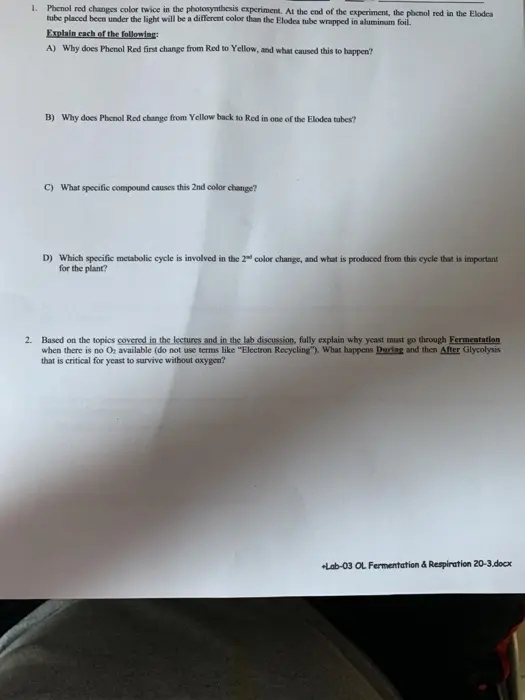
Transcribed Image Text:
1. Phenol red changes color twice in the photosynthesis experiment. At the end of the experiment, the phenol red in the Elodea
tube placed been under the light will be a different color than the Elodea tube wrapped in aluminum foil.
Explain each of the following:
A) Why does Phenol Red first change from Red to Yellow, and what caused this to happen?
B) Why does Phenol Red change from Yellow back to Red in one of the Elodea tubes?
C) What specific compound causes this 2nd color change?
D) Which specific metabolic cycle is involved in the 2 color change, and what is produced from this cycle that is important
for the plant?
2. Based on the topics covered in the lectures and in the lab discussion, fully explain why yeast must go through Fermentation
when there is no O: available (do not use terms like "Electron Recycling"). What happens During and then After Glycolysis
that is critical for yeast to survive without oxygen?
+Lab-03 OL Fermentation & Respiration 20-3.docx
3. Alcohol is made in sealed containers (no O). BRIEFLY discuss how Energy is created in EACH of the Three Cycles that
would occur if the yeast containers were left open to air for the entire experiment. Do Not explain it using terms like "Aero-
bic/Anaerobic" or "Cellular Respiration/Fermentation". Do not explain fermentation or discuss what yeast "Would Not Do".
4. Why does it take more drops of NaOH to neutralize the solution when you breath into the water After Exercising, than it does
Before Exercising?
5. During the lab, there were gas bubbles created in several of the six compounds. Without a detailed explanation of Fermentation,
Explain in simple terms:
A) Why ARE yeast able to produce CO; from Sucrose?
B) Why are yeast NOT able to produce CO; from Lactose?
+Lab-03 OL Fermentation & Respiration 20-3.docx
==== Discussion ===
Anaerobic Fermentation
During glycolysis NAD picks up two electrons, converting it to
NADH. If oxygen is available, that NADH is processed in the
mitochondria. If Oz is not available, the ETS cannot continue,
and the available NAD' will be used up during glycolysis.
CYTOPLASM
Glycolysis
Anaerobic
H-
NAD → NADH
Becomes oxidized
Q-0+2H
NADH
Acetyl CoA
CA
Pynl
(TCA)
Cycle
MADH FACH
ETS
Oxidative
Phosphorylation
Becomes reduced
NAD +2H
+ 20
NADH+H
(carries
2 electrons)
NAD is restored anaerobically through fermentation. This
converts Pyruvate to Lactic Acid in Animal cells, or to CO; &
Ethyl Alcohol (Ethanol) in Yeast.
ATP is not directly produced during fermentation, but it allows
glycolysis to continue by regenerating NAD'. Cells can produce
some ATP through fermentation, but not nearly as much as they
would using Oz in aerobic respiration.
Glucose
H-C-OH
CH₂
2 Ethanol
2 ADP 2
2 ATP
2 NAD
2 NADH
+21
c-o
сн
2 Pyruvate
CH,
2 Acetaldehyde
This experiment will test whether or not yeast have specific en-
zymes to ferment certain mono, di, and polysaccharides. We can
determine if fermentation occurs by observing an increase in the
size of a gas bubble. This allows us to see if CO2 is produced.
If we place a small test tube (filled with solution), into a larger
test tube, and then invert the tubes, we can limit the amount of
oxygen that is available to the yeast.
Aerobic Respiration
Aerobically, glucose is completely oxidized to CO2 and H2O.
CHO + 60 6 CO2 + 6 HO
As we breathe, O; and CO; are exchanged in our lungs. In this
part of this lab we will measure the amount of CO; in your
breath while you are resting, and then again after you have exer-
cised. Exercising should increase your metabolism, and there-
fore increase the amount of CO; in your breath.
Phosphorylation
Phosphorylation
Phosphorylation
When CO: bubbles through water a small amount of carbonic
acid is formed, making the solution acidic. By measuring the
number of drops of NaOH it takes to neutralize the acid, we can
compare the amount of CO: you breathe out while you are calm
vs. the amount of CO2 you breathe out after exercising.
Photosynthesis
Here, we test photosynthesis by adding Elodea to a phenol red
solution, and then placing it under a light, or in a dark setting.
Phenol Red is a pH indicator that is red
in basic solutions and yellow in acidic
solutions. You will breathe into the phe-
nol red solution causing it to become yel-
lowish (because of CO:).
Photosynthesis is essentially the reverse
of cellular respiration. Plants use CO; &
light during photosynthesis to produce
sugars, while giving off oxygen.
After breathing into the phenol red, we
will see if placing Elodea under a bright
light can cause the solution to become more basic.
See the Lectures & PowerPoint slides for complete discus-
sions of the three major cycles in Cellular Respiration, the two
cycles in Photosynthesis, and why cells go through Fermenta-
tion. Understand how each applies to this lab.
LIGHT REACTIONS
NAD
ADP
-B
Photosystem I
Photos
CALVIN CYCLE
COP
NADPH
Lab-03 OL Fermentation & Respiration 20-3.doc
check_circle الجواب — حل مفصل خطوة بخطوة
hourglass_top
🔒
الحل الكامل متاح للمشتركين
اشترك في أرشيف الأسئلة لعرض هذا الحل وآلاف الحلول المفصلة خطوة بخطوة من معلمين معتمدين.