تم الحل ✓
categoryالفيزياء
schoolبكالوريوس
event_available2026-07-15
السؤال
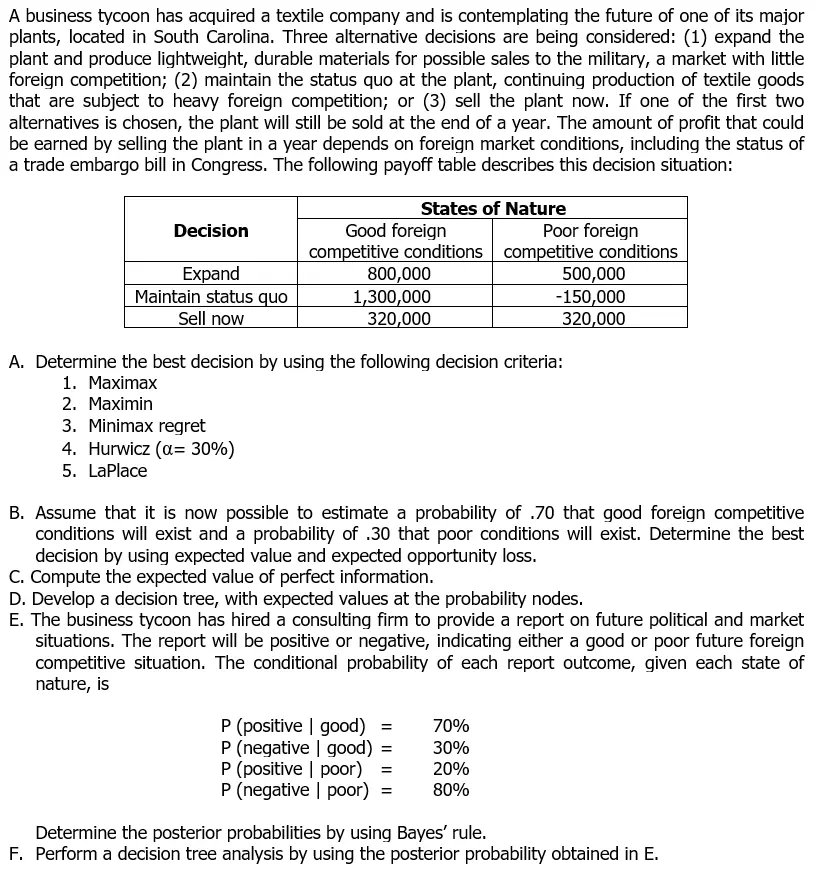
Transcribed Image Text:
A business tycoon has acquired a textile company and is contemplating the future of one of its major
plants, located in South Carolina. Three alternative decisions are being considered: (1) expand the
plant and produce lightweight, durable materials for possible sales to the military, a market with little
foreign competition; (2) maintain the status quo at the plant, continuing production of textile goods
that are subject to heavy foreign competition; or (3) sell the plant now. If one of the first two
alternatives is chosen, the plant will still be sold at the end of a year. The amount of profit that could
be earned by selling the plant in a year depends on foreign market conditions, including the status of
a trade embargo bill in Congress. The following payoff table describes this decision situation:
Decision
States of Nature
Good foreign
competitive conditions
800,000
Maintain status quo
1,300,000
320,000
Poor foreign
competitive conditions
500,000
Expand
Sell now
-150,000
320,000
A. Determine the best decision by using the following decision criteria:
1. Maximax
2. Maximin
3. Minimax regret
4. Hurwicz (a= 30%)
5. LaPlace
B. Assume that it is now possible to estimate a probability of .70 that good foreign competitive
conditions will exist and a probability of .30 that poor conditions will exist. Determine the best
decision by using expected value and expected opportunity loss.
C. Compute the expected value of perfect information.
D. Develop a decision tree, with expected values at the probability nodes.
E. The business tycoon has hired a consulting firm to provide a report on future political and market
situations. The report will be positive or negative, indicating either a good or poor future foreign
competitive situation. The conditional probability of each report outcome, given each state of
nature, is
P (positive good) =
70%
P (negative good) =
30%
P (positive poor) =
20%
P (negative poor) =
80%
Determine the posterior probabilities by using Bayes' rule.
F. Perform a decision tree analysis by using the posterior probability obtained in E.
check_circle الجواب — حل مفصل خطوة بخطوة
hourglass_top
🔒
الحل الكامل متاح للمشتركين
اشترك في أرشيف الأسئلة لعرض هذا الحل وآلاف الحلول المفصلة خطوة بخطوة من معلمين معتمدين.