تم الحل ✓
categoryالرياضيات
schoolبكالوريوس
event_available2026-07-15
السؤال
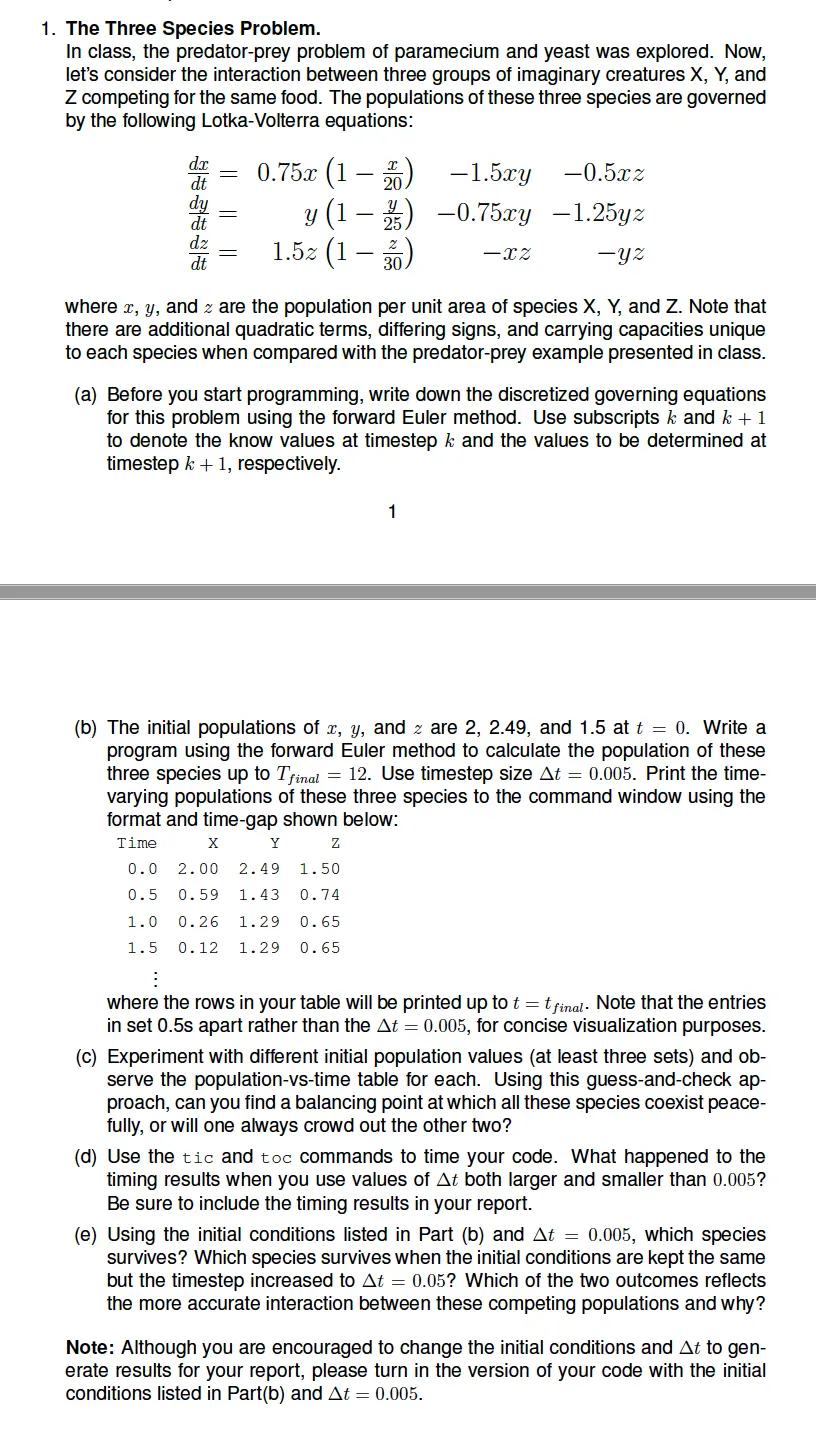
Transcribed Image Text:
1. The Three Species Problem.
In class, the predator-prey problem of paramecium and yeast was explored. Now,
let's consider the interaction between three groups of imaginary creatures X, Y, and
Z competing for the same food. The populations of these three species are governed
by the following Lotka-Volterra equations:
dx
= 0.75x (1
(1-)
y (1
-
-1.5xy -0.5xz
dt
dy
y
-0.75xy -1.25yz
dt
dz
=
dt
1.5z (1
-x2
-yz
30.
where x, y, and z are the population per unit area of species X, Y, and Z. Note that
there are additional quadratic terms, differing signs, and carrying capacities unique
to each species when compared with the predator-prey example presented in class.
(a) Before you start programming, write down the discretized governing equations
for this problem using the forward Euler method. Use subscripts k and k + 1
to denote the know values at timestep k and the values to be determined at
timestepk +1, respectively.
1
(b) The initial populations of x, y, and z are 2, 2.49, and 1.5 at t = 0. Write a
program using the forward Euler method to calculate the population of these
three species up to Tfinal = 12. Use timestep size At = 0.005. Print the time-
varying populations of these three species to the command window using the
format and time-gap shown below:
Time
X
Y
Z
0.0 2.00 2.49 1.50
0.5 0.59 1.43 0.74
1.0 0.26 1.29 0.65
1.5 0.12 1.29 0.65
B
where the rows in your table will be printed up to t = tfinal. Note that the entries
in set 0.5s apart rather than the At = 0.005, for concise visualization purposes.
(c) Experiment with different initial population values (at least three sets) and ob-
serve the population-vs-time table for each. Using this guess-and-check ap-
proach, can you find a balancing point at which all these species coexist peace-
fully, or will one always crowd out the other two?
(d) Use the tic and toc commands to time your code. What happened to the
timing results when you use values of At both larger and smaller than 0.005?
Be sure to include the timing results in your report.
(e) Using the initial conditions listed in Part (b) and At = 0.005, which species
survives? Which species survives when the initial conditions are kept the same
but the timestep increased to At = 0.05? Which of the two outcomes reflects
the more accurate interaction between these competing populations and why?
Note: Although you are encouraged to change the initial conditions and At to gen-
erate results for your report, please turn in the version of your code with the initial
conditions listed in Part(b) and At = 0.005.
check_circle الجواب — حل مفصل خطوة بخطوة
hourglass_top
🔒
الحل الكامل متاح للمشتركين
اشترك في أرشيف الأسئلة لعرض هذا الحل وآلاف الحلول المفصلة خطوة بخطوة من معلمين معتمدين.