تم الحل ✓
categoryالفيزياء
schoolبكالوريوس
event_available2026-07-15
السؤال
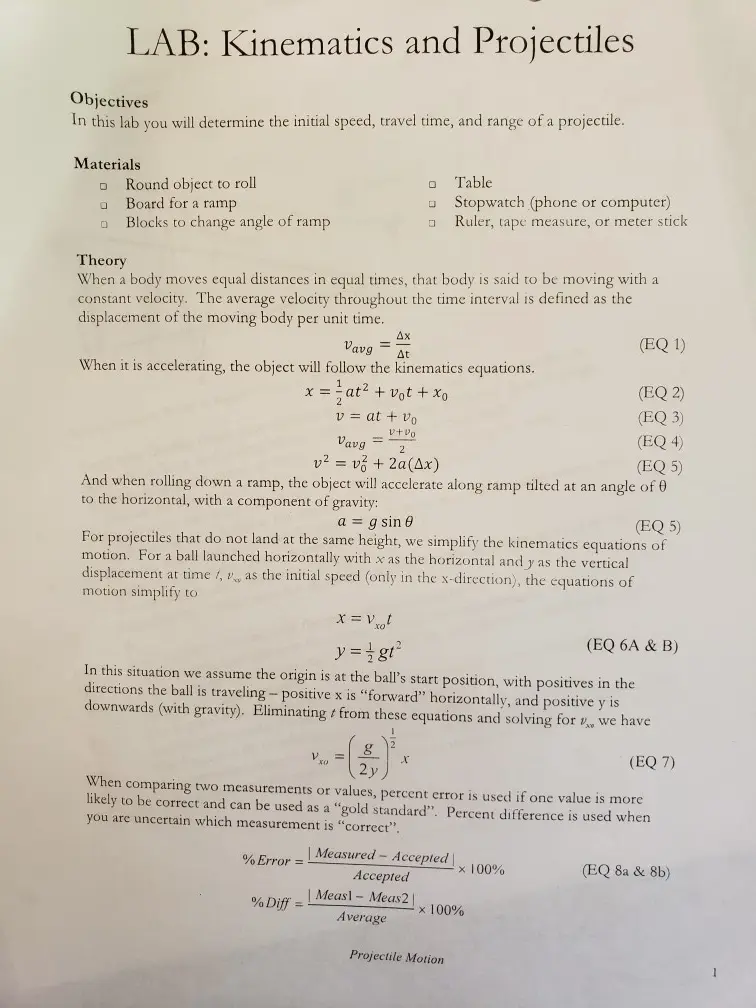
Transcribed Image Text:
LAB: Kinematics and Projectiles
Objectives
In this lab you will determine the initial speed, travel time, and range of a projectile.
Materials
Theory
Round object to roll
Board for a ramp
Blocks to change angle of ramp
Table
Stopwatch (phone or computer)
Ruler, tape measure, or meter stick
When a body moves equal distances in equal times, that body is said to be moving with a
constant velocity. The average velocity throughout the time interval is defined as the
displacement of the moving body per unit time.
Vavg =
ΔΧ
ΔΕ
When it is accelerating, the object will follow the kinematics equations.
x=at² + vot + xo
v = at + vo
v+
Vavg
=
2
(EQ 1)
(EQ 2)
(EQ 3)
(EQ 4)
(EQ 5)
v² = v² + 2a (Ax)
And when rolling down a ramp, the object will accelerate along ramp tilted at an angle of 0
to the horizontal, with a component of gravity:
a = g sin 0
(EQ 5)
For projectiles that do not land at the same height, we simplify the kinematics equations of
motion. For a ball launched horizontally with x as the horizontal and y as the vertical
displacement at time, as the initial speed (only in the x-direction), the equations of
motion simplify to
x = Vot
y=gt²
(EQ 6A & B)
In this situation we assume the origin is at the ball's start position, with positives in the
directions the ball is traveling - positive x is "forward" horizontally, and positive y is
downwards (with gravity). Eliminating from these equations and solving for,, we have
V=
2y
(EQ 7)
When comparing two measurements or values, percent error is used if one value is more
likely to be correct and can be used as a "gold standard". Percent difference is used when
you are uncertain which measurement is "correct".
% Error =
% Diff =
Measured - Accepted
Accepted
| Measl - Meas2|
xX 100%
× 100%
(EQ 8a & 8b)
Average
Projectile Motion
=
B: Sin'"' (22)
Procedure
a = h
Part I: Kinematics
tanb
S=
S = ½½ ah
b
S
a
1.
2.
3.
4.
Place the board on a table.
h
Set one end of the board on a block. This forms a ramp at a small angle.
Measure the diagonal length (L) and vertical height (h) of the board and enter in
Table 1.
Use trigonometry to calculate the angle of the ramp relative to the floor/table, and
record as "calculated angle"..
Oheight
base
③base
ungth
na taneb sine
a+b⋅cose
area:
2
5-ah-46² sin 20
g sin 0
Source for figure: Nolan & Bigliani "Experiments in Phyises", 2nd Edition.
Smell test: Double check your calculated angle by placing your protractor flat on
the table or floor, and sliding left and right until the diagonal length goes through
the zero hole at the center of the circle. Record as "measured angle".
Calculate the component of the acceleration due to gravity along the ramp
(Equation 5), and enter into Table 1 as "predicted acceleration."
Hold the ball or cylinder at the top of the ramp.
Start the stopwatch as you let the object go. Stop the stopwatch as the object gets
to the bottom of the ramp. Record time in Table 1.
Repeat steps 7 and 8 for 2 more trials.
Calculate the average time for the trials for each scenario and enter answer in Table
2.
Use Equation 2 to calculate the measured acceleration.
Use Equation 1 to calculate the average velocity for each scenario.
9.
10.
11.
12.
13.
Use Equation 4 and the average velocity from the step above to calculate the final
velocity for each scenario.
14.
15.
Use Equation 6a to calculate the percent error between the two acceleration
measurements, with the predicted value as "accepted".
Use Equation 6b to calculate the percent difference for the two angle
measurements, since you don't know which one is more likely to be correct. If any
values are over 20%, repeat the experiment to try and eliminate errors.
Part One: Kinematics
Table 1: Constant Acceleration Measurements
Length of ramp:
Trial
0.6541
Height of
Board
25 3/4 10
m
Calculated
(m)
Angle (°)
Measured
Angle (°)
Predicted
Acceleration
Time
(m/s)
(s)
sinx =
.09
,6541
1
.09
x =
1
3
1105
Table 2: Constant Acceleration Calculations
Average
Time
Measured
Acceleration
Average
Velocity
Final
Velocity
Acceleration
Percent
Error
Angle
Percent
Difference
(s)
(m/s²)
(m/s)
(m/s)
Part One: Kinematics
Table 1: Constant Acceleration Measurements
hort distance betw
** the angle in
H =
b
Length of ramp. 541
25 3/4 10
m
Trial
Height of
Board
Calculated
Angle (")
Measured
Angle (
1
(m)
0.1143
QAB
Predicted.
Acceleration
(m/s)
Time
(s)
Sinx
D
25°
0.1143
2
25°
0
01143
3
25°
Table 2: Constant Acceleration Calculations
Acceleration Angle
Average
Time
(s)
Measured Average
Acceleration Velocity
(m/s²)
Final
Percent
Percent
Velocity
Error
Difference
(m/s)
(m/s)
(")
(%)
check_circle الجواب — حل مفصل خطوة بخطوة
hourglass_top
🔒
الحل الكامل متاح للمشتركين
اشترك في أرشيف الأسئلة لعرض هذا الحل وآلاف الحلول المفصلة خطوة بخطوة من معلمين معتمدين.