تم الحل ✓
categoryكيمياء
schoolبكالوريوس
event_available2026-07-15
السؤال
Transcribed Image Text:
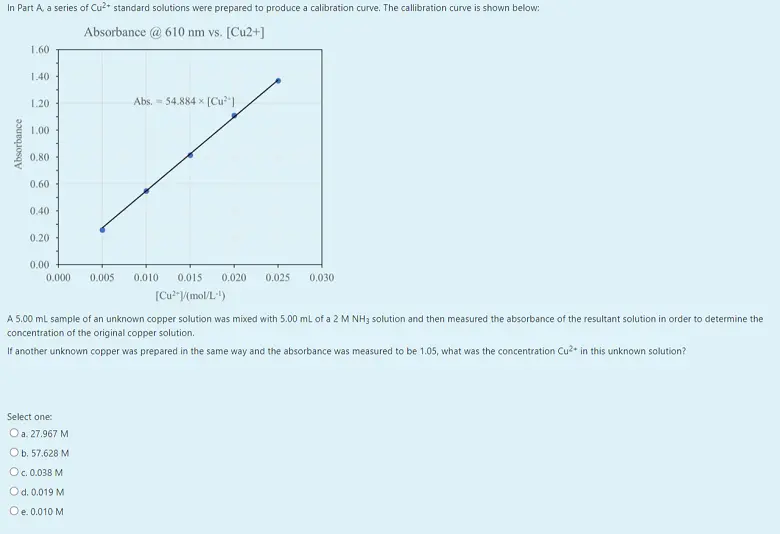
In Part A, a series of Cu2+ standard solutions were prepared to produce a calibration curve. The callibration curve is shown below:
Absorbance @ 610 nm vs. [Cu2+]
Absorbance
1.60
1.40
1.20
Abs. 54.884x [Cu²*]
1.00
0.80
0.60
0.40
0.20
0.00
0.000 0.005 0.010 0.015 0.020 0.025
[Cu²+1/(mol/L-¹)
0.030
A 5.00 mL sample of an unknown copper solution was mixed with 5.00 mL of a 2 M NH3 solution and then measured the absorbance of the resultant solution in order to determine the
concentration of the original copper solution.
If another unknown copper was prepared in the same way and the absorbance was measured to be 1.05, what was the concentration Cu2+ in this unknown solution?
Select one:
O a. 27.967 M
Ob. 57.628 M
O c. 0.038 M
O d. 0.019 M
Oe. 0.010 M
In Part A, a series of different ligands were added to a Cu2+ solution. Beginning with a pale blue Cu²+(aq) solution, first Ammonia was added and the solution turned pale blue and then EDTA was
added to the Cu2+ -ammonia solution and the solution turned sky-blue. What do these observations tell you about the relative stability of Cu(II) complexex with the ligands H₂O, NH3 and EDTA?
Select one:
a. All Cull) complexes formed in these solutions would have the same stability, otherwise they wouldn't form.
b. It is impossible to tell which complex is most stable from these observations alone.
O c. The Cu(II)-H₂O complex is the least stable, but the Cu(II)-EDTA and Cu(II)-NH3 complexes are equally stable.
O d. The Cu(II)-EDTA complex is more stable than the Cu(I)-NH3 complex which is more stable than the Cu(II)-H₂O complex.
O e. The Cu(I)-H2O complex is more stable than the Cu(II)-NH3 complex which is more stable than the Cu(II)-EDTA complex.
In Part A of this experiment, a series test to investigate ligand binding with the Cu2+ ion were performed.
When ammonia was first added to a solution of CuSO4(aq), a precipitate was observed to form. This precipitate then slowly dissolved to give a dark-blue, transparent solution.
Which of the reactions below accurately account for the formation of the precipitate when ammonia is initially added to the solution?
Select one:
Oa. NH3(aq) + H2O(l) → NH4*(aq) + OH¯(aq)
then
SO4(aq) + 2NH4 (aq) + (NH4)2SO4(s)
O b. 2NH3(aq) + H2SO4(1)2NH4(aq) + SO4(aq)
then
Cu2+(aq) + SO4(aq) → CuSO4(s)
O c. Cu²+(aq) + 4NH3(aq) → [Cu(NH3)4]²+(aq)
then
+
[Cu(NH3)4]2+(aq) + SO4(aq) - [Cu(NH3)4]SO4(s)
O d. NH3(aq) + H2O(l) → NH₁*(aq) + OH¯(aq)
then
Cu2+(aq) + 20H(aq) → Cu(OH)2(s)
O e. Cu²+(aq) + 4NH3(aq) + 2H2O(l) → [Cu(NH3)4(H2O)2]2+(aq)
then
[Cu(NH3)4(H2O)2]2+(aq) + SO4(aq) → [Cu(NH3)4(H2O)2]SO4(s)
I
In Part A of this experiment, a series test to investigate ligand binding with the Cu2+ ion were performed.
When ammonia was first added to a solution of CuSO4(aq), a precipitate was observed to form. This precipitate then slowly dissolved as additional ammonia was added to give a dark-blue,
transparent solution.
Which reaction(s) below accurately account for precipitate dissolving after addition of additional ammonia?
Select one:
O a. 2NH3(aq) + H2SO4(1)2NH4 (aq) + S04²¯(aq)
then
Cu(OH)2(s) + SO4(aq) = CuSO4(aq) + 20H¯(aq)
O b. [Cu(H2O)6]SO4(s) + 4NH3(aq) → [Cu(NH3)4(H2O)2]2+(aq) + 4H2O(l) + SO4(aq)
O c. 4NH3(aq) + CuSO4(s) [Cu(NH3)4)²+(aq) + SO4(aq)
O d. Cu(OH)2(s) + 4NH3(aq) + 2H2O(l)
[Cu(NH3)4(H2O)2]2+(aq) + 20H¯(aq)
Oe. [Cu(NH3)4(H2O)2]SO4(s) + 2NH3(aq) = [Cu(NH3)2(aq) +2H2000) + SO4(aq)
In Part A of this experiment, a series test to investigate ligand binding with the Cu2+ ion were performed.
First ammonia was added to a solution of CuSO4(aq), which resulted in a dark-blue, transparent solution (following a precipitate initially forming which dissolved after further addition of ammonia.
Then EDTA was added to the solution, resulting in a transparent dark sky-blue solution forming.
Which reaction(s) below accurately show the reaction occuring upon the addition of EDTA 4-?
Select one:
O a. [Cu(H2O)6]²+(aq) + EDAT (aq) =[Cu-EDTA]²+(aq) + 6H2O(l)
O b. Cu(NH3)4(H2O)2]²+(aq) + EDTA-(aq)=[Cu-EDTA (NH3)2]2(aq) + 2H2O(1)
O c. Cu²+(aq) + EDTA-(aq)=[Cu-EDTA]²-(aq)
O d. [Cu(NH3)4(H2O)2]2+(aq) + EDTA4(aq) =[Cu-EDTA]²(aq) + 4NH3(aq) + H2O(1)
O e. [Cu(NH3)2(H2O)4]²+(aq) + EDTA+(aq)=(Cu(NH3)2]2+(aq) + H4EDTA + 40H¯(aq)
check_circle الجواب — حل مفصل خطوة بخطوة
hourglass_top
🔒
الحل الكامل متاح للمشتركين
اشترك في أرشيف الأسئلة لعرض هذا الحل وآلاف الحلول المفصلة خطوة بخطوة من معلمين معتمدين.