تم الحل ✓
categoryالهندسة الميكانيكية
schoolبكالوريوس
event_available2026-07-15
السؤال
Transcribed Image Text:
Q4. (a) Explain the significance of the transfer function:
w
s² + 23wns + w²/
in determining the nature of the time response of a system. Give examples.
[24 marks]
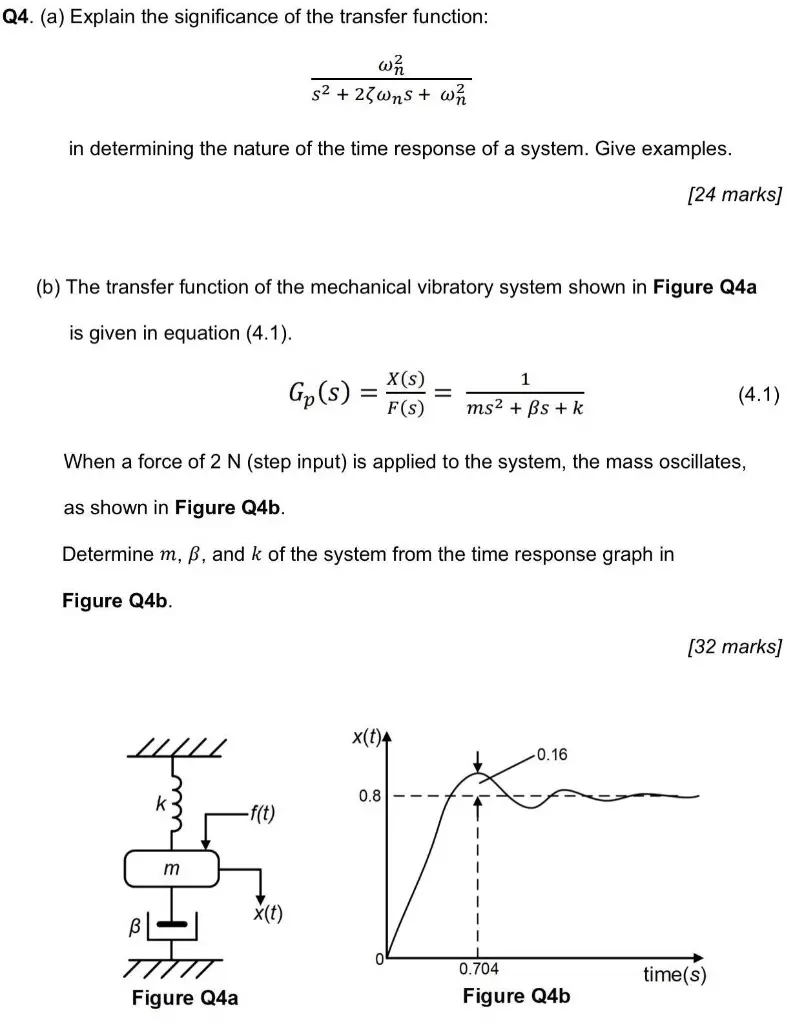
(b) The transfer function of the mechanical vibratory system shown in Figure Q4a
is given in equation (4.1).
Gp(s)
X(s)
1
F(s)
ms² + ẞs + k
When a force of 2 N (step input) is applied to the system, the mass oscillates,
as shown in Figure Q4b.
Determine m, ẞ, and k of the system from the time response graph in
Figure Q4b.
x(t)4
-0.16
0.8
k-
-f(t)
m
x(t)
Figure Q4a
(4.1)
[32 marks]
0.704
time(s)
Figure Q4b
(c) A proportional controller Ge(s) is in cascade with the plant Gp(s) as shown in
Figure Q4c. Assume m = 0.1C kg, ẞ = 0.4D N-s/m and k = 0.5E N/m.
Ge(s)
Gp(s)
✗(s)
X(s)
Kp
ms² + ẞs + k
Figure Q4c
(i) select a controller gain Kp that will give the overall system a damping ratio
of 0.7 (for a step input).
[16 marks]
(ii) if the proportional controller is replaced with a proportional-derivative (PD)
controller of the form G(s) =
KpKDs. Comment on the merit(s) of the
PD controller over the proportional controller.
Suggest suitable values for K, and KD that would give a damping ratio of
0.7 and an undamped natural frequency of 12.F rad/s.
[12 marks]
(iii) compare and comment, on the effect of the proportional and PD
controllers, on the steady-state error of the compensated system.
[16 marks]
check_circle الجواب — حل مفصل خطوة بخطوة
hourglass_top
🔒
الحل الكامل متاح للمشتركين
اشترك في أرشيف الأسئلة لعرض هذا الحل وآلاف الحلول المفصلة خطوة بخطوة من معلمين معتمدين.