تم الحل ✓
categoryأحياء
schoolبكالوريوس
event_available2026-07-15
السؤال
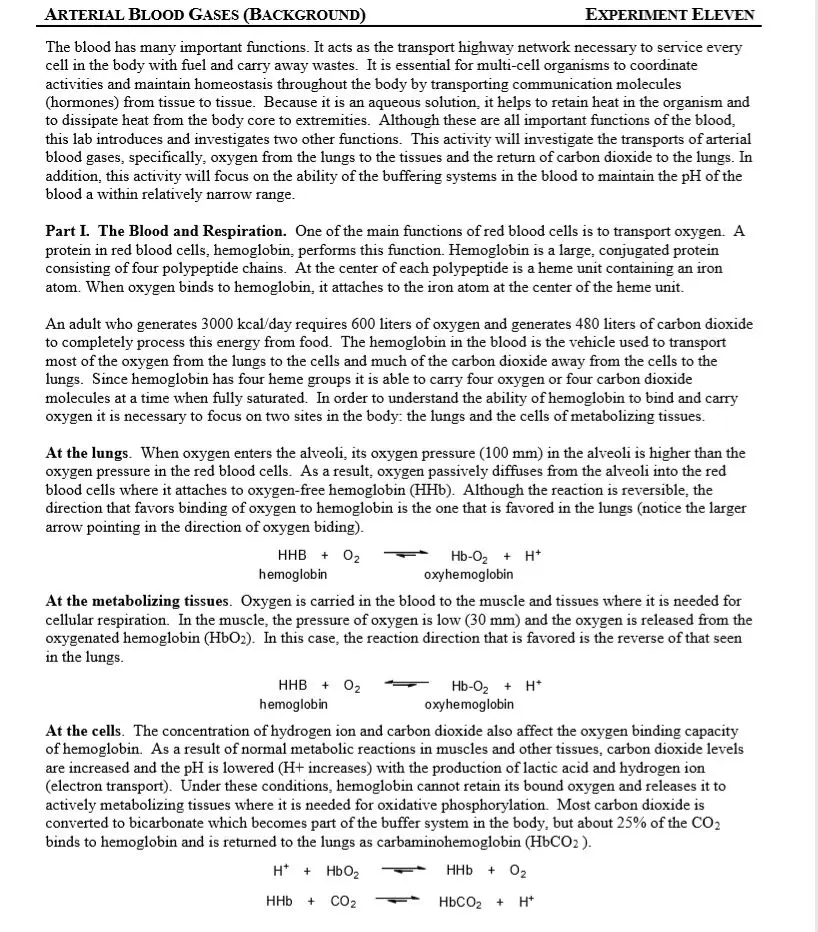
Transcribed Image Text:
ARTERIAL BLOOD GASES (BACKGROUND)
EXPERIMENT ELEVEN
The blood has many important functions. It acts as the transport highway network necessary to service every
cell in the body with fuel and carry away wastes. It is essential for multi-cell organisms to coordinate
activities and maintain homeostasis throughout the body by transporting communication molecules
(hormones) from tissue to tissue. Because it is an aqueous solution, it helps to retain heat in the organism and
to dissipate heat from the body core to extremities. Although these are all important functions of the blood,
this lab introduces and investigates two other functions. This activity will investigate the transports of arterial
blood gases, specifically, oxygen from the lungs to the tissues and the return of carbon dioxide to the lungs. In
addition, this activity will focus on the ability of the buffering systems in the blood to maintain the pH of the
blood a within relatively narrow range.
Part I. The Blood and Respiration. One of the main functions of red blood cells is to transport oxygen. A
protein in red blood cells, hemoglobin, performs this function. Hemoglobin is a large, conjugated protein
consisting of four polypeptide chains. At the center of each polypeptide is a heme unit containing an iron
atom. When oxygen binds to hemoglobin, it attaches to the iron atom at the center of the heme unit.
An adult who generates 3000 kcal/day requires 600 liters of oxygen and generates 480 liters of carbon dioxide
to completely process this energy from food. The hemoglobin in the blood is the vehicle used to transport
most of the oxygen from the lungs to the cells and much of the carbon dioxide away from the cells to the
lungs. Since hemoglobin has four heme groups it is able to carry four oxygen or four carbon dioxide
molecules at a time when fully saturated. In order to understand the ability of hemoglobin to bind and carry
oxygen it is necessary to focus on two sites in the body: the lungs and the cells of metabolizing tissues.
At the lungs. When oxygen enters the alveoli, its oxygen pressure (100 mm) in the alveoli is higher than the
oxygen pressure in the red blood cells. As a result, oxygen passively diffuses from the alveoli into the red
blood cells where it attaches to oxygen-free hemoglobin (HHb). Although the reaction is reversible, the
direction that favors binding of oxygen to hemoglobin is the one that is favored in the lungs (notice the larger
arrow pointing in the direction of oxygen biding).
HHB + Oz
hemoglobin
Hb-O2 + H+
oxyhemoglobin
At the metabolizing tissues. Oxygen is carried in the blood to the muscle and tissues where it is needed for
cellular respiration. In the muscle, the pressure of oxygen is low (30 mm) and the oxygen is released from the
oxygenated hemoglobin (HbO2). In this case, the reaction direction that is favored is the reverse of that seen
in the lungs.
HHB + O2
hemoglobin
Hb-O2 + H*
oxyhemoglobin
At the cells. The concentration of hydrogen ion and carbon dioxide also affect the oxygen binding capacity
of hemoglobin. As a result of normal metabolic reactions in muscles and other tissues, carbon dioxide levels
are increased and the pH is lowered (H+ increases) with the production of lactic acid and hydrogen ion
(electron transport). Under these conditions, hemoglobin cannot retain its bound oxygen and releases it to
actively metabolizing tissues where it is needed for oxidative phosphorylation. Most carbon dioxide is
converted to bicarbonate which becomes part of the buffer system in the body, but about 25% of the CO2
binds to hemoglobin and is returned to the lungs as carbaminohemoglobin (HbCO2).
ННЬ + О2
H* + HbO2
HHb + CO2
HbCO2 + H+
In this way hemoglobin carries oxygen from the lungs to actively metabolizing tissue, where it binds carbon
dioxide and hydrogen ion. Carbaminohemoglobin is recycled to the lungs where it releases carbon dioxide.
In addition, hemoglobin plays a role in maintaining the body's pH by binding hydrogen ions and transporting
them to the lungs where they are neutralized.
Another important function of the blood is to maintain a constant pH in various fluids in the body. In order
for the body to function properly the pH of blood plasma must be maintained within a constant range of
7.35-7.45. The two systems that stabilize the pH of the blood are buffers found in the blood and kidneys. The
slightly alkaline pH is maintained by three buffer systems. The carbonic acid/bicarbonate system is the most
effective in balancing blood pH. A second buffer system is the dihydrogen phosphate/hydrogen phosphate
system. Phosphate ion levels in the blood are low so this system is not as important in the blood, however,
concentrations of these ions are high in intracellular fluids, and this is an important buffer system in the
kidneys. The third buffer system consists of protein molecules whose carboxyl and amino side chains are
capable of neutralizing acid or base. The major buffering system in the blood is based on the dissociation of
carbonic acid.
The major buffering system in the blood is based on the dissociation of carbonic acid.
H2CO3
H* + HCO3
Let us consider this buffer system and how it coordinates with the movement of blood gases in both the lungs
and in actively metabolizing cells.
At the lungs. How does the carbonic acid system act in the lungs? Blood arrives at the lungs carrying the
bicarbonate ion (from actively metabolizing tissue or the kidneys). At the lungs is combines with protons to
make carbonic acid. Oxygen from the alveoli combines with hemoglobin in the red blood cell. The carbonic
acid is broken down by the enzyme carbonic anhydrase to c arbon dioxide and water. This is the reverse of
the reaction we will see in active tissues because the low pressure of carbon dioxide in the lungs pulls the
reaction in the direction of formation of carbon dioxide and water. The pressure of carbon dioxide is high in
the red blood cell but low in the alveoli so the lungs expire the carbon dioxide and some of the water.
An overall view of blood gas exchange at the lungs is diagramed as follows:
Each of the reactions is reversible, but because of the high concentrations of O2 and the low concentration of
CO2 at the lungs, the reactions are overwhelmingly forced in the direction that binds oxygen to hemoglobin
and releases CO2 to diffuse into the lungs and be exhaled.
lung alveolus
capillary
wall
blood
High pO2
inhaled O₂
HHB + 0,
Hb-O2 + H+
H* + HCO3
H2CO3
H2O + CO2
Low pCO2
exhaled CO₂
Hb-CO2 + O2 =
Hb-02 + CO2
At The Metabolizing Cells. When cells metabolize carbon compounds, carbon dioxide and protons are
produced. The concentration of these two products is higher in the tissue than in the red blood cell so they
diffuse into the red blood cell where they promote the release of oxygen from hemoglobin. The gaseous
carbon dioxide can dissolve somewhat in water-based fluids such as blood. The dissolved carbon dioxide is
converted to carbonic acid by carbonic anhydrase. Since the pH of the blood is about one unit greater than
the pK of carbonic acid, most of the acid ionizes into bicarbonate ion. This combination of weak acid and
conjugate base constitutes a buffer system.
An overview of blood gas exchange at the metabolizing tissues is diagramed as follows:
blood
metabolizing tissue
HHb + 0₂
Hb-O2
+ H*
Low 02
Hb-CO2 + O2
Hb-02 + CO₂
H* + HCO3
H2CO3
H2O + CO2
High CO₂
CI-
HCO3
CI-
Notice that the reactions are the same as those occurring in the lungs but because the concentrations of O2 at
metabolizing tissues are low and the concentration of CO2 are high, the reactions are overwhelmingly forced
in the direction that releases O2 from hemoglobin and either binds waste CO2 to hemoglobin or packages it as
bicarbonate (HCO3) to be carried back to the lungs (continue reading about the role of HCO3 below).
ROLE OF THE KIDNEYS. What happens to the protons in the above equation? How are they neutralized
to maintain a normal pH? Some of them combine with hemoglobin, which carries them to the lungs for
neutralization. The major component neutralizing hydrogen ions is the bicarbonate ion, acting as a proton
sponge; however for every proton soaked up, a bicarbonate ion is lost. How does the body maintain a supply
of bicarbonate ions? This is where the kidneys play an important role. The carbon dioxide that has dissolved
in the blood is transported away from the tissues to the kidneys. In the kidneys carbon dioxide is converted to
carbonic acid by carbonic anhydrase. Carbonic acid dissociates into protons and bicarbonate ion. The
kidneys can additionally eliminate the protons into the urine and re-supply the blood with bicarbonate ions.
Can you see how kidney failure would result in metabolic acidosis?
ABNORMAL BLOOD pH. The carbonic acid buffer system is often thought of in terms of the
Henderson-Hasselbach equation:
pH = pKa + log
HCO3
H2CO34
By using the pH of the blood (7.4) and the pKa of carbonic acid, it can be shown that the ratio contains a
greater concentration of conjugate base than weak acid. This is advantageous because there is a greater
demand in the body to neutralize acid from metabolic processes than base.
It is necessary for the body to maintain its pH between 7.35 and 7.45. If the ratio of conjugate base to weak
acid becomes to large, the pH rises and alkalosis results. If the ratio decreases, the pH will drop and acidosis
results. Using medical terms, we can define two categories of acidosis and alkalosis. Respiratory acidosis and
respiratory alkalosis are acid-base imbalances that result from abnormal breathing. Metabolic acidosis and
metabolic alkalosis are acid-base imbalances caused by abnormal metabolism.
Respiratory acidosis and respiratory alkalosis result from changes in CO2 levels, carbon dioxide pressure.
These are controlled by the respiration rate of the lungs.
Respiratory acidosis can be caused by difficulty in breathing such as, lung disease, asthma, anesthesia, heart
failure, or from holding your breath for a long time. The net effect is that not enough carbon dioxide is
exhaled, a condition called hypoventilation. The equilibrium is stressed by increased levels of CO2 which
compels a shift of the following equation to the right with a resulting build-up of both carbonic acid then
smaller amounts of bicarbonate and H+. The [H+] in the blood increases the pH falls.
CO2 + H2O
H2CO3
H* + HCO3
Respiratory alkalosis results from breathing that is too deep and/or at a rate that is too rapid. This is called
hyperventilation. This condition may be caused by a number of different conditions including anxiety,
infection, certain drugs, or pregnancy. Carbon dioxide is blown off and its partial pressure in the lungs drops.
As a result, the following equation shifts to the left with a major loss of carbonic acid, bicarbonate and
hydrogen ion. The [H+] in the blood decreases the pH raises.
CO2 + H2O
H2CO3
H* + HCO3
Metabolic acidosis and metabolic alkalosis are caused by alterations in metabolic or physiological processes.
The key-in determining if acidosis or alkalosis is due to metabolic imbalances, as opposed to respiratory is the
bicarbonate level. If the bicarbonate level is not within the normal range, the problem is metabolic.
Metabolic acidosis can result from a number of physiological conditions including kidney failure, diabetes,
starvation or fasting, and heavy exercise. Low levels of bicarbonate ions stress the equilibrium in the
following equation thus have the effect of increasing [H+] in the blood because the equation below to shifts to
the right in an attempt to relieve the stress. The protons levels rise, resulting drop in pH.
CO2 + H2O
H2CO3
H* + HCO3
Metabolic alkalosis is less common but can be caused by vomiting with loss of stomach acid, ingestion of
drugs or large amount of bicarbonate. As bicarbonate levels increase the pH increases.
The Body's Response. Compensation: In response to acidosis and alkalosis the body can make its own
compensating changes. To re-establish and maintain the body's acid-base balance, changes occur either at the
lungs or in the kidneys. The response in the lungs is immediate, while the response in the kidneys is much
more gradual (2-3 days).
With acidosis there is an excess of hydrogen ions, which results in a decrease of bicarbonate ion and an
increase in carbonic acid. As long as the lungs did not cause the problem, the lungs can compensate by
hyperventilating, blowing off CO2 and thereby decreasing carbonic acid levels. On the other hand, the
kidneys can compensate for a lung problem by changing the bicarbonate levels in the blood and excreting
acidic urine. A possible treatment for metabolic acidosis is the administration of sodium bicarbonate.
With alkalosis there is an excess of bicarbonate ions. As long as the lungs did not cause the problem, they can
respond by decreasing the rate of breathing. Carbon dioxide is retained, the level of carbonic acid increases
with a resulting decrease in pH. The kidneys compensate, changing the levels of bicarbonate by excreting
bicarbonate ion.
Thus the body compensates for acidosis and alkalosis. The body's immediate response to change in pH is
controlled by the rate of breathing. After strenuous exercise, for example, hydrogen ion concentration
increases quickly. The rate of breathing becomes deeper and faster expelling carbon dioxide. The carbonic
acid level decreases and the pH returns to normal. If acidosis is the result of a long-term condition such as
diabetes or starvation, the kidneys will reabsorb bicarbonate ions and excrete hydrogen ions, but this may take
several hours to a few days.
1. The carbonic acid/bicarbonate buffer system maintains a relatively small pH range when the blood has an
influx of base or acid.
H2O + CO2 H2CO3 - H* + HCO3
a) Discuss what happens to the equilibrium of the equation AND the hydrogen ion concentration when there
is a low concentration of bicarbonate?
b) Does a low concentration of bicarbonate cause the pH to increase or decrease?
c) Discuss what happens to the equilibrium of the equation AND the hydrogen ion concentration when there
is a low concentration of carbon dioxide?
d) Does a low concentration of carbon dioxide cause the pH to increase or decrease?
4a. Which organ controls CO2 levels in blood?
4b. Which organ controls HCO3 levels in blood?
5. Define hyperventilation. Discuss how hyperventilation affects the equilibrium of the equation shown
above and, ultimately, how it affects blood pH.
check_circle الجواب — حل مفصل خطوة بخطوة
hourglass_top
🔒
الحل الكامل متاح للمشتركين
اشترك في أرشيف الأسئلة لعرض هذا الحل وآلاف الحلول المفصلة خطوة بخطوة من معلمين معتمدين.