تم الحل ✓
categoryرياضيات
schoolبكالوريوس
event_available2026-07-15
السؤال
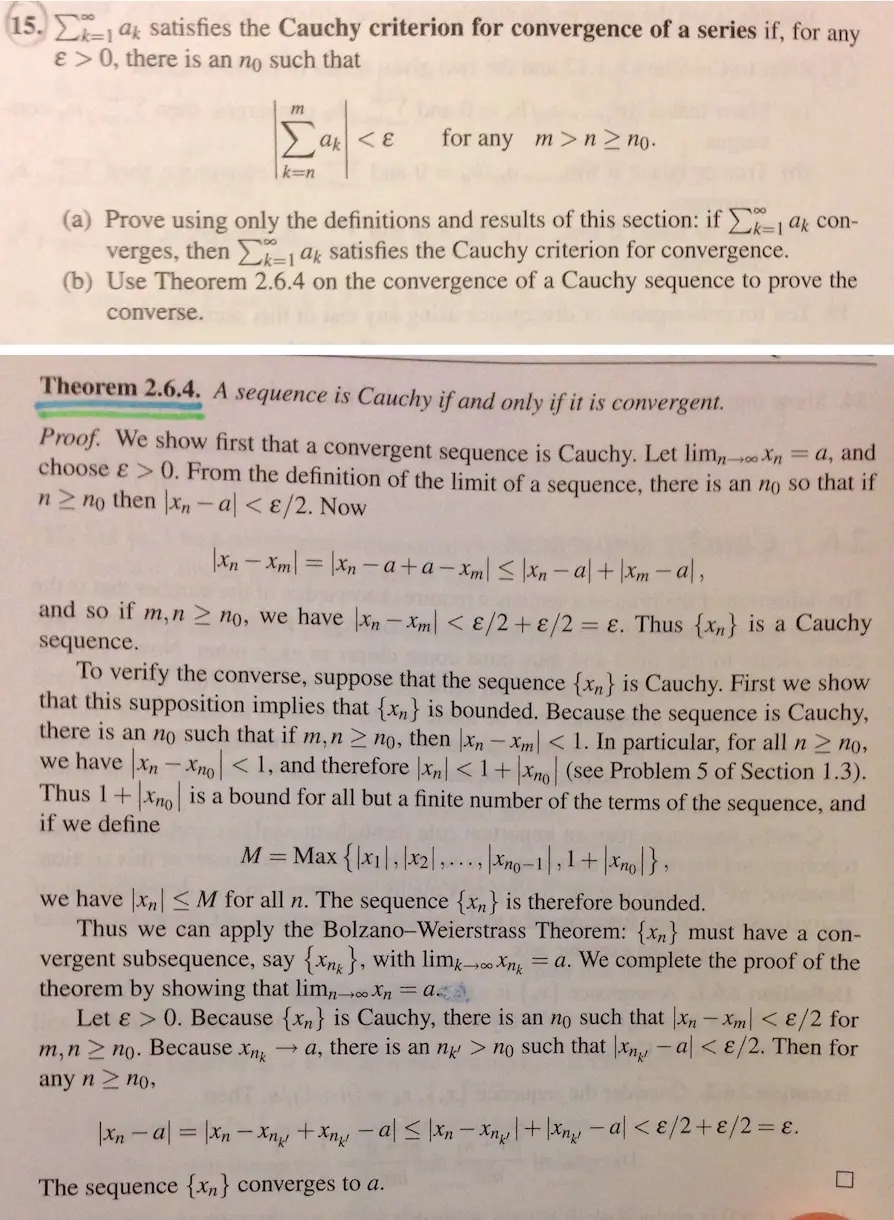
Transcribed Image Text:
15.
a satisfies the Cauchy criterion for convergence of a series if, for any
ε > 0, there is an no such that
m
Σακε for any m>n> no.
k=n
(a) Prove using only the definitions and results of this section: if k-1 ak con-
verges, then ak satisfies the Cauchy criterion for convergence.
(b) Use Theorem 2.6.4 on the convergence of a Cauchy sequence to prove the
converse.
Theorem 2.6.4. A sequence is Cauchy if and only if it is convergent.
Proof. We show first that a convergent sequence is Cauchy. Let lim xn = a, and
choose & > 0. From the definition of the limit of a sequence, there is an no so that if
n≥ no then xn-al< ε/2. Now
xn-xml=xn-a+a-xml≤xn-a|+|xm-al,
and so if m,n≥ no, we have xn-xm| <ε/2+/2 = ε. Thus {x} is a Cauchy
sequence.
To verify the converse, suppose that the sequence {x} is Cauchy. First we show
that this supposition implies that {x} is bounded. Because the sequence is Cauchy,
there is an no such that if m, n ≥ no, then xn-xm| < 1. In particular, for all n ≥ no,
we have xnxno <1, and therefore |xn| <1+|xo| (see Problem 5 of Section 1.3).
Thus 1+xno is a bound for all but a finite number of the terms of the sequence, and
if we define
M = Max {x1, x2,...,xno-1,1+xnol},
we have |xn|M for all n. The sequence {x} is therefore bounded.
Thus we can apply the Bolzano-Weierstrass Theorem: {x} must have a con-
vergent subsequence, say {n}, with limk-> Xnk = a. We complete the proof of the
theorem by showing that lim∞ Xn = a.
Let & > 0. Because {x} is Cauchy, there is an no such that xn-xml<e/2 for
m,n no. Because xnk → a, there is an n > no such that xn-al<e/2. Then for
any n≥ no,
xn-a=xnxnx + xnx - a≤ xnxn|+|xn-al<e/2+ε/2= ε.
The sequence {x} converges to a.
☐
check_circle الجواب — حل مفصل خطوة بخطوة
hourglass_top
🔒
الحل الكامل متاح للمشتركين
اشترك في أرشيف الأسئلة لعرض هذا الحل وآلاف الحلول المفصلة خطوة بخطوة من معلمين معتمدين.