تم الحل ✓
categoryفيزياء
schoolبكالوريوس
event_available2026-07-15
السؤال
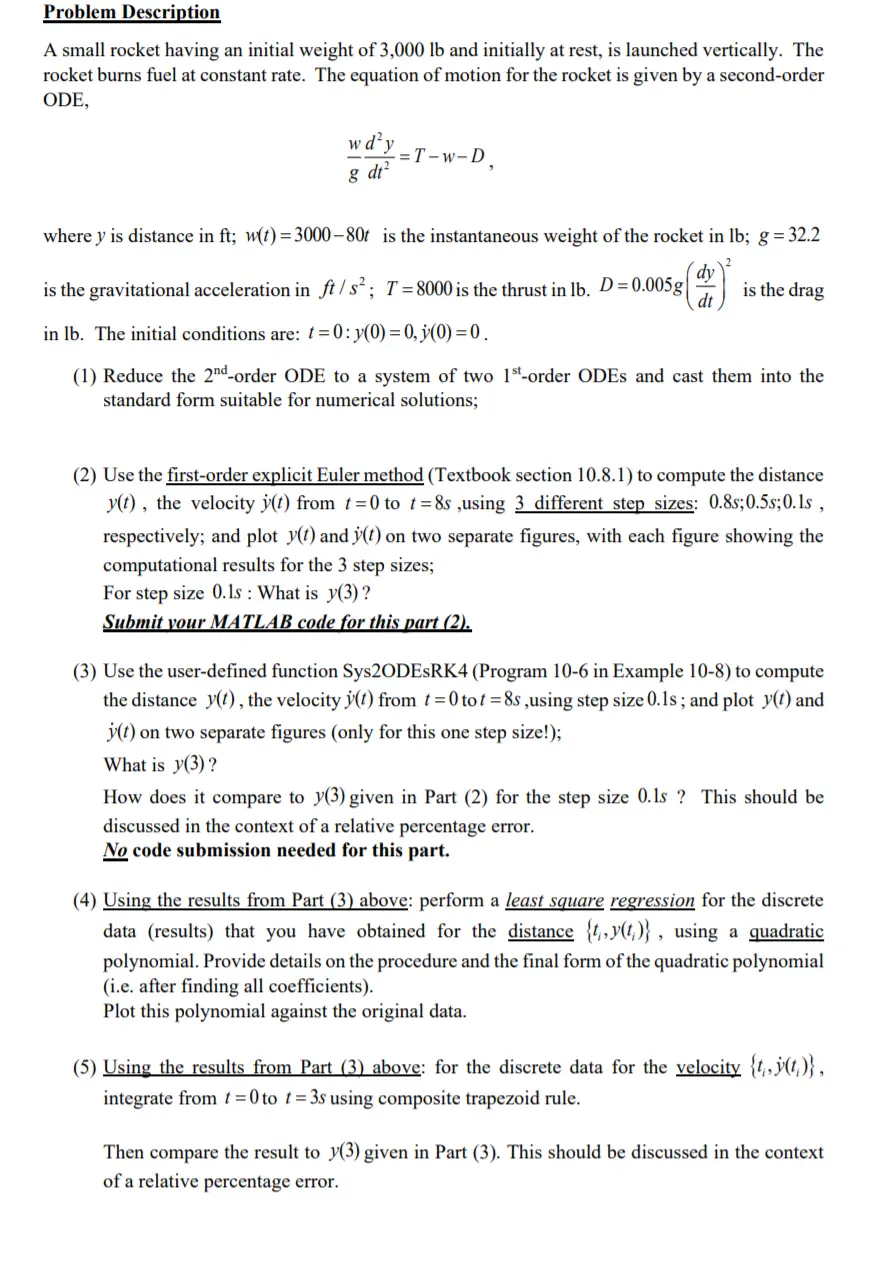
Transcribed Image Text:
Problem Description
A small rocket having an initial weight of 3,000 lb and initially at rest, is launched vertically. The
rocket burns fuel at constant rate. The equation of motion for the rocket is given by a second-order
ODE,
wd'y
8 dt²
=T-w-D,
where y is distance in ft; w(t) = 3000-80t is the instantaneous weight of the rocket in lb; g = 32.2
dy
is the gravitational acceleration in ft/s²; T-8000 is the thrust in lb. D=0.005g|
in lb. The initial conditions are: 1=0: y(0)=0,5(0)=0.
is the drag
dt
(1) Reduce the 2nd-order ODE to a system of two 1st-order ODEs and cast them into the
standard form suitable for numerical solutions;
(2) Use the first-order explicit Euler method (Textbook section 10.8.1) to compute the distance
y(t), the velocity (t) from t=0 to 1=8s,using 3 different step sizes: 0.8s;0.5s;0.1s,
respectively; and plot y(t) and y(t) on two separate figures, with each figure showing the
computational results for the 3 step sizes;
For step size 0.1s: What is y(3)?
Submit your MATLAB code for this part (2).
(3) Use the user-defined function Sys2ODESRK4 (Program 10-6 in Example 10-8) to compute
the distance y(t), the velocity i(t) from 1-0 tot 8s,using step size 0.1s; and plot y(t) and
(f) on two separate figures (only for this one step size!);
What is y(3)?
How does it compare to y(3) given in Part (2) for the step size 0.1s ? This should be
discussed in the context of a relative percentage error.
No code submission needed for this part.
(4) Using the results from Part (3) above: perform a least square regression for the discrete
data (results) that you have obtained for the distance (.y(), using a quadratic
polynomial. Provide details on the procedure and the final form of the quadratic polynomial
(i.e. after finding all coefficients).
Plot this polynomial against the original data.
(5) Using the results from Part (3) above: for the discrete data for the velocity (t,(t)).
integrate from 0 to 1-3s using composite trapezoid rule.
Then compare the result to y(3) given in Part (3). This should be discussed in the context
of a relative percentage error.
check_circle الجواب — حل مفصل خطوة بخطوة
hourglass_top
🔒
الحل الكامل متاح للمشتركين
اشترك في أرشيف الأسئلة لعرض هذا الحل وآلاف الحلول المفصلة خطوة بخطوة من معلمين معتمدين.