تم الحل ✓
categoryهندسة صناعية وإنتاج
schoolبكالوريوس
event_available2026-07-15
السؤال
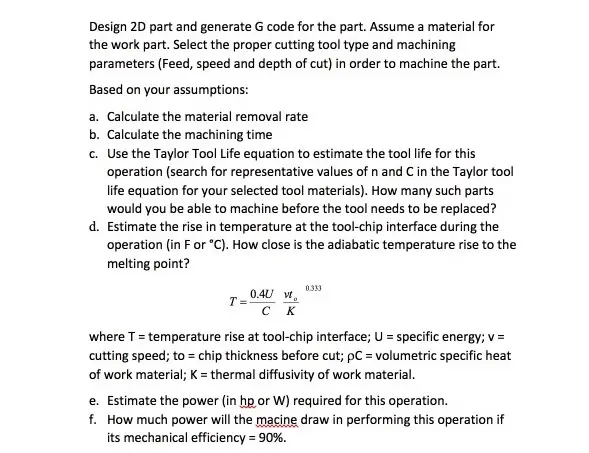
Transcribed Image Text:
Design 2D part and generate G code for the part. Assume a material for
the work part. Select the proper cutting tool type and machining
parameters (Feed, speed and depth of cut) in order to machine the part.
Based on your assumptions:
a. Calculate the material removal rate
b. Calculate the machining time
c. Use the Taylor Tool Life equation to estimate the tool life for this
operation (search for representative values of n and C in the Taylor tool
life equation for your selected tool materials). How many such parts
would you be able to machine before the tool needs to be replaced?
d. Estimate the rise in temperature at the tool-chip interface during the
operation (in F or °C). How close is the adiabatic temperature rise to the
melting point?
T=
0.4U vt
ск
0.333
where T = temperature rise at tool-chip interface; U = specific energy; v =
cutting speed; to = chip thickness before cut; pc = volumetric specific heat
of work material; K = thermal diffusivity of work material.
e. Estimate the power (in hp or W) required for this operation.
f. How much power will the macine draw in performing this operation if
its mechanical efficiency = 90%.
The specific energy requirements in cutting operations are listed in table
below:
Approximate specific-energy requirements
MATERIAL
SPECIFIC ENERGY
J/mm³
hp-min/in³
Al alloys
0.4-1.1
0.15-0.4
Cast irons
1.6-5.5
0.6-2.0
Copper alloys
1.4-3.3
0.5-1.2
High-Temp alloys
3.3-8.5
1.2-3.1
Mg alloys
0.4-0.6
0.15-0.2
Ni alloys
4.9-6.8
1.8-2.5
Refractory alloys
3.8-9.6
1.1-3.5
Stainless steels
3.0-5.2
1.1-1.9
Steels
2.7-9.3
1.0-3.4
Titanium alloys
3.0-4.1
1.1-1.5
check_circle الجواب — حل مفصل خطوة بخطوة
hourglass_top
🔒
الحل الكامل متاح للمشتركين
اشترك في أرشيف الأسئلة لعرض هذا الحل وآلاف الحلول المفصلة خطوة بخطوة من معلمين معتمدين.