تم الحل ✓
categoryالفيزياء
schoolبكالوريوس
event_available2026-07-15
السؤال
Transcribed Image Text:
Guided Project 65: Kepler's laws
Topics and skills: Vectors, polar coordinates, derivatives
Based on the observations of the Danish astronomer Tycho Brahe (1546-1601), Kepler's laws of planetary
motion were formulated by the German astronomer Johannes Kepler in 1609. They remained empirical laws
(based on observations) until 1687, when Sir Isaac Newton derived Kepler's laws from his Law of Gravity, thus
providing a theoretical foundation for planetary motion. This derivation was one of the earliest and is still one
of the greatest triumphs of calculus.
Preliminaries
Kepler's Laws state that
1. A planet revolves around the Sun in an elliptical orbit with the Sun at one focus.
2. The line connecting the Sun to the planet sweeps out equal areas in equal times.
3. If 7 is the period of revolution of a planet (the length of a year) and 2a is the length of the major axis of
its orbit, then 72=ca, where c is a constant; that is, the square of the period is proportional to the
cube of the length of the major axis.
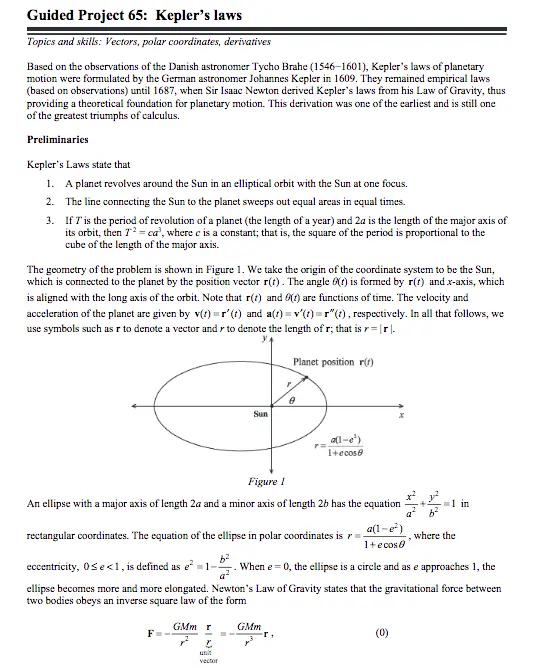
The geometry of the problem is shown in Figure 1. We take the origin of the coordinate system to be the Sun,
which is connected to the planet by the position vector r(t). The angle (r) is formed by r(r) and x-axis, which
is aligned with the long axis of the orbit. Note that r(t) and (t) are functions of time. The velocity and
acceleration of the planet are given by v(r) =r'(r) and a(r) = v(t)=r"(t), respectively. In all that follows, we
use symbols such as r to denote a vector and r to denote the length of r; that is 7= |r|.
Planet position r(r)
Sun
в
a(1-e)
1+ecose
Figure 1
An ellipse with a major axis of length 2a and a minor axis of length 2b has the equation
rectangular coordinates. The equation of the ellipse in polar coordinates is =
b²
eccentricity, 05e<1, is defined as e² 1-5
a(1-e²)
1+ecos
1 in
where the
When e 0, the ellipse is a circle and as e approaches 1, the
ellipse becomes more and more elongated. Newton's Law of Gravity states that the gravitational force between
two bodies obeys an inverse square law of the form
GMm r
GMm
-
vector
(0)
Derivation of the First Law
The hard work is in deriving the first law. The second and third laws follow quickly. In all that follows, use
vector notation carefully, notice which variables are vectors and which are scalars, and notice which quantities
are constants and which are functions of time.
1. Newton's Second Law of Motion states that the force applied to an object equals its mass times its
acceleration, or F=ma =mr"(t). Substitute the gravitational force given by (0) into F ma to show that
where = GM.
r"(c)=-r,
(1)
2. Take the cross product of r with both sides of (1) to show that r(r) xr"(t) = 0 for all times. What can you
conclude about the direction of r and a?
d
3. Show that (rxv)=rxr" and conclude from Step 2 that rxv=h for all times, where h is a constant
4.
vector. Explain carefully why this result implies that the orbit of the planet lies in a plane.
Take the cross product of the constant vector h=rxv from Step 3 with both sides of (1) and show that
r(r.v)
r"xh u
(2)
You will need the expansion for the triple vector product ax(bxe) to do this calculation.
5. By expanding in components, show that r-v in (2) can be written r(t) v(t)=r(r)r(r). (Recall that is a
scalar and note that (r) is not the speed |v|).
6. Combine the result of Step 5 with (2) to show that
r" xh u
dr
dt
d
(3)
7. Verify that the left side of (3) can be written r" xh = 1 (vxh), from which it follows that
dt
vxh
-+e
(4)
where e is a constant of integration.
8. Let's stop for a moment and organize all these vectors. Make a rough sketch of the relationship among r, v,
e, and h. Explain why e lies in the plane of the orbit and why h is orthogonal to that plane.
9. Now take the scalar product of r with both sides of (4). You will need the properties of the triple scalar
product a (bxc) to simplify this expression. Conclude that hur(1+ecos 0), where 0 is the angle
between e and r.
158
Guided Projects
10. Show that this relationship between and can be written as the equation of an ellipse in polar coordinates
a(1-e²)
1+ ecos
Find the relationships among a, e, h, and u.
11. The perihelion of a planetary orbit is the point at which the planet is closest to the Sun. Show that the
perihelion corresponds to 0=0. What is the distance between the planet and the Sun at this point?
Derivation of the Second Law
12. We now let r(t)=(x(t), y(t),0) = (r(t) cos(t),(t) sin(t),0), so that the orbital plane is the xy-plane.
Expand the cross product to show that
rxv=2
do
dt
13. Recall that the area of a region enclosed by a polar curve rf(0') between 0' = 0 and 0'=0 is
8
A(0)=
0
do. Noting that (r) is a function of time, show that
dA 1 de
1
dt
2 dt
2
(5)
14. Interpret the result in (5) as Kepler's second law.
Derivation of the Third Law
15. Recall that the area of an ellipse is ab, where 2a and 2b are the lengths of the major and minor axes,
respectively. Let T be the period of the orbit (time to complete one revolution). Integrate both sides of (5)
with respect to r to show that zab=hT/2.
16. Express b and h in terms of a, e, and u to conclude that 72=ca, where c is a constant, which is Kepler's
third law.
17. Show that the constant c is independent of the planet.
check_circle الجواب — حل مفصل خطوة بخطوة
hourglass_top
🔒
الحل الكامل متاح للمشتركين
اشترك في أرشيف الأسئلة لعرض هذا الحل وآلاف الحلول المفصلة خطوة بخطوة من معلمين معتمدين.