تم الحل ✓
categoryالفيزياء
schoolبكالوريوس
event_available2026-07-15
السؤال
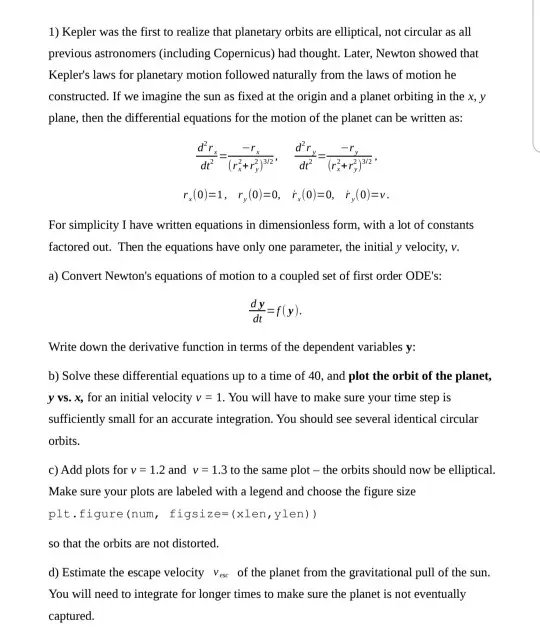
Transcribed Image Text:
1) Kepler was the first to realize that planetary orbits are elliptical, not circular as all
previous astronomers (including Copernicus) had thought. Later, Newton showed that
Kepler's laws for planetary motion followed naturally from the laws of motion he
constructed. If we imagine the sun as fixed at the origin and a planet orbiting in the x, y
plane, then the differential equations for the motion of the planet can be written as:
dry -ry
dr² (+)
dr² (r+r)
r,(0)=1, r,(0)=0, +,(0) = 0, r,(0)=v.
For simplicity I have written equations in dimensionless form, with a lot of constants
factored out. Then the equations have only one parameter, the initial y velocity, v.
a) Convert Newton's equations of motion to a coupled set of first order ODE's:
Σ= f(y).
dt
Write down the derivative function in terms of the dependent variables y:
b) Solve these differential equations up to a time of 40, and plot the orbit of the planet,
y vs. x, for an initial velocity v = 1. You will have to make sure your time step is
sufficiently small for an accurate integration. You should see several identical circular
orbits.
c) Add plots for v = 1.2 and v = 1.3 to the same plot - the orbits should now be elliptical.
Make sure your plots are labeled with a legend and choose the figure size
plt.figure(num, figsize=(xlen, ylen))
so that the orbits are not distorted.
d) Estimate the escape velocity of the planet from the gravitational pull of the sun.
You will need to integrate for longer times to make sure the planet is not eventually
captured.
check_circle الجواب — حل مفصل خطوة بخطوة
hourglass_top
🔒
الحل الكامل متاح للمشتركين
اشترك في أرشيف الأسئلة لعرض هذا الحل وآلاف الحلول المفصلة خطوة بخطوة من معلمين معتمدين.