تم الحل ✓
categoryعلوم الحاسوب
schoolبكالوريوس
event_available2026-07-15
السؤال
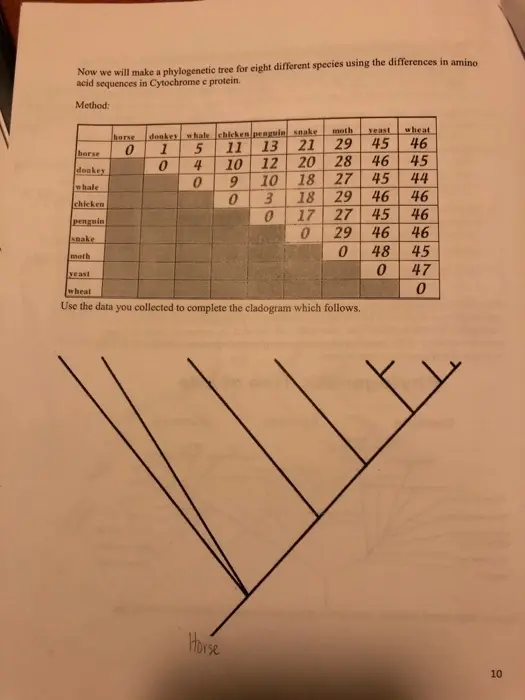
Transcribed Image Text:
Now we will make a phylogenetic tree for eight different species using the differences in amino
acid sequences in Cytochrome c protein.
Method:
horse
horse
0
0
donkey
whale
chicken
penguin
snake
moth
yeast
donkey whale chicken penguin snake
11 13 21
540
96
32030
moth yeast
29 45
m222
156
₤4444444
wheat
46
10 12 20
10
28 46
45
18
18
88
27
45
44
29
46
46
17
27 45
46
0
29
46
46
0
48
45
0
47
0
wheat
Use the data you collected to complete the cladogram which follows.
Horse
10
10. Use the information provided to assist you in answering the questions on
the following page.
THE NUMBER OF AMINO ACID DIFFERENCES IN CYTOCHROME C
AMONG VARIOUS ORGANISMS
Horse
Donkey
Horse
Chicken
Penguin
Snake
0
1
Donkey
11
13
21
0
10
12
20
Chicken
0
3
18
Penguin
0
17
Snake
0
Phylogeny is the evolutionary history of a species.
(a) The evolution of a species is dependent on changes in the genome of the species.
Identify TWO mechanisms of genetic change, and explain how each affects
genetic variation.
(b) Based on the data in the table below, draw a phylogenetic tree that reflects the
evolutionary relationships of the organisms based on the differences in their
cytochrome c amino-acid sequences and explain the relationships of the organisms.
Based on the data, identify which organism is most closely related to the chicken
and explain your choice.
(c) Describe TWO types of evidence other than the comparison of proteins that can be used
to determine the phylogeny of organisms. Discuss one strength of each type of evidence
you described.
(d) Explain why more closely related organisms have more similar Cytochrome C.
(e) What is the main difference between a cladogram and a phylogenetic tree?
(f) List four characteristic of the universal common ancestor
check_circle الجواب — حل مفصل خطوة بخطوة
hourglass_top
🔒
الحل الكامل متاح للمشتركين
اشترك في أرشيف الأسئلة لعرض هذا الحل وآلاف الحلول المفصلة خطوة بخطوة من معلمين معتمدين.