تم الحل ✓
categoryالرياضيات
schoolبكالوريوس
event_available2026-07-15
السؤال
Transcribed Image Text:
1.3.1 Statistical Regularity
In order to be useful, a model must enable us to make predictions about the future be-
havior of a system, and in order to be predictable, a phenomenon must exhibit regu-
larity in its behavior. Many probability models in engineering are based on the fact
that averages obtained in long sequences of repetitions (trials) of random experi-
ments consistently yield approximately the same value. This property is called
statistical regularity.
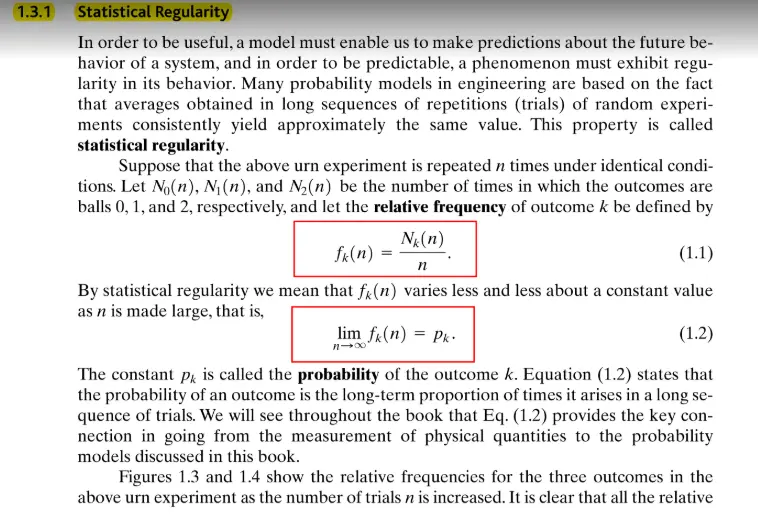
Suppose that the above urn experiment is repeated n times under identical condi-
tions. Let No(n), N₁(n), and N₂(n) be the number of times in which the outcomes are
balls 0, 1, and 2, respectively, and let the relative frequency of outcome k be defined by
Nk(n)
fk(n) =
n
(1.1)
By statistical regularity we mean that f(n) varies less and less about a constant value
as n is made large, that is,
lim fk(n) = Pk.
(1.2)
The constant pk is called the probability of the outcome k. Equation (1.2) states that
the probability of an outcome is the long-term proportion of times it arises in a long se-
quence of trials. We will see throughout the book that Eq. (1.2) provides the key con-
nection in going from the measurement of physical quantities to the probability
models discussed in this book.
Figures 1.3 and 1.4 show the relative frequencies for the three outcomes in the
above urn experiment as the number of trials n is increased. It is clear that all the relative
Relative frequency
0.9
0.8
0.7
□0 Outcome
1 Outcome
◇ 2 Outcome
0.6
0.5
0.4
0.3
13
0.2
10
0.1
000006
10
20
30
40
50
Number of trials
Relative frequency
1
0.9
0.8
0.7
0 Outcome
1
Outcome
2 Outcome
0.6
0.5
04
e
0.3
0.2
22
0.1
11
обоюв
10
20
30
40
50
fk(n)
Nk(n)
n
check_circle الجواب — حل مفصل خطوة بخطوة
hourglass_top
🔒
الحل الكامل متاح للمشتركين
اشترك في أرشيف الأسئلة لعرض هذا الحل وآلاف الحلول المفصلة خطوة بخطوة من معلمين معتمدين.