تم الحل ✓
categoryكيمياء
schoolبكالوريوس
event_available2026-07-15
السؤال
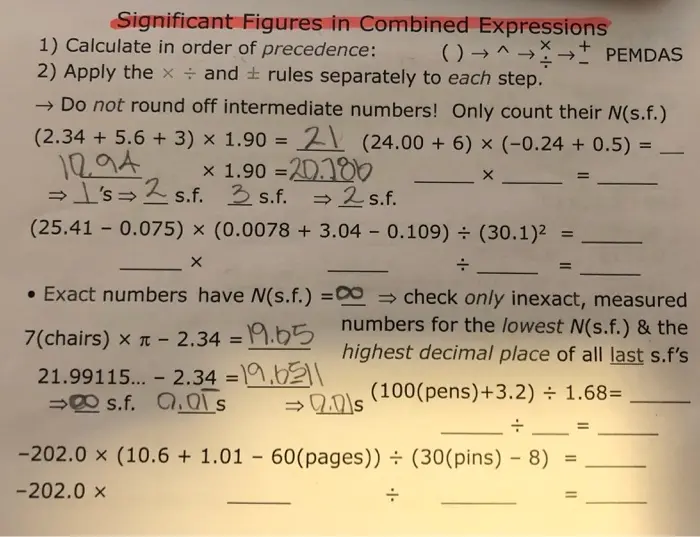
Transcribed Image Text:
Significant Figures in Combined Expressions
1) Calculate in order of precedence:
()→→→ PEMDAS
2) Apply the x and ± rules separately to each step.
→ Do not round off intermediate numbers! Only count their N(s.f.)
(2.34 + 5.6 + 3) x 1.90 = 21 (24.00 +6) x (-0.24 + 0.5) =
1294
× 1.90 =20.186
=\'s 2 s.f.
's2s.f.
3 s.f.
2s.f.
(25.41 0.075) x (0.0078 +3.04 -0.109) ÷ (30.1) 2
X
• Exact numbers have N(s.f.) =00
7(chairs) x π- 2.34 = 19.65
21.99115... - 2.34 =19.611
s.f. 0.0\s
÷
==
=
check only inexact, measured
numbers for the lowest N(s.f.) & the
highest decimal place of all last s.f's
→0.0\s
(100(pens)+3.2) ÷ 1.68=
÷
-202.0 x (10.6 + 1.01 60(pages)) ÷ (30(pins) - 8)
=
-202.0 x
[Decimal] = [NSN]
To convert decimal → NSN:
Same Number
o Ways
...now the figure
1) Shift decimal point to follow the first non-0 digit
is in [1;10)
2) Compensate with a x10" term to keep the value the same:
x10+ left [to undo decimal point shift by N places] right>>> x10-N
Multiply NSN back out to decimal to check the sign & number of N.
3) Check trailing zeros in the [1;10) figure: drop if they become Ø,
zeros of scale in the decimal. Count N(s.f.): must stay the same!
57000 = 5.1 x10 0.0020 = 2.0x10-200 =
4) To fix general scientific notation into NSN, update x 10" term:
46697.0 x 103 = 4.66970x103 x 104 = 4.66970 x10
0.00930 x 10-2 =
-730.4 x 101 =
To convert NSN decimal, multiply out the NSN product.
→
1.34 x 10-2 = 0.0134 7.50 x 103 =1500 3.04 x 103 =
Show zeros of scale as needed. Count N(s.f.): must stay the same!
SFN Arithmetic in NSN calculator rounded decimal
NSN
4.30×10-1.1.761×10-2=0.0015123 0.00151 3 s.f. 1.51x10
20. 4×10-2=418.848 400 1 s.f. 4x10²
•
20. 4×10⁻²
1.91x10-3
=
2.01x10² 4x 10-2 =
5.004x10⁵
140 2.13x10¹
.
=
1.91e-3
1.44×10-2x 5(pens)
0.0219
8.20x10-2
=
1.16x10³ - 4.762x103=-3b02 -3000
0.01 sx103 0.00sx103 10s
=>
→ 12s
=_s
590 7.1x10-29.103x 10² =
-
_S S
-
s.f.
s.f.
s.f.
s.f.
s.f.
⇒ _S
1.03×101 + 2.1x10⁴ + 68 = 203.898
>>0.1_s
167.2
_s
=125598 2s.f._s
s.f.
: N(§.f.) i
count N(s.f.) in each
3
area
A = 1.1
length²
1 m
volume
V = 1.1.1
length³
speed
v = //t
length/time
acceleration
a
=S/2
Aspeed/time
force
F
= m.a
mass acceleration
pressure
P
= F/A
force/area
N/m²
mx3=m²
1mmxmx M = m³
M/S
m/s² = m/s/s
2 = N
= Pa
=-kg
energy
Ek = 1/2m-v2 1/2 mass.speed2
kg.2 = Nm = J
2
molarity
c = n/V
moles/volume
mol/
density
P = m/V
/= 5 x 10³ m = 5 mA(square) = /x/ = 5 km x 5 km =30km²
m = 0.371 g
V = 0.03 mL
P.V= n.R.T
?
⇒ p=
= 0.371 q = 10a=1 g/mL
m
V 0.03 mL
⇒n= PV=
RT
n =
mL
0.082057 atm.mol-1-1.273
3.04.5.6
(0.082057-273)
3.04 at 5.62
mol =
mol
1.89×10³ min = ? h = 1.89×10³ min x h = 31.5-3.15x10 h
60min
50 lb = kg = 50 lb x
0.048 L= ? qt
= 0.048 L x
kg
qt
6700 oz = ? ton = 6700 oz x
•Can multiply together as many conversion factors as you need:
11x04536x 1 ton=0.1899
116 103 kg
->
ton
10%
2.0 qt = 2 mL = 2.0 qt x-gal x-
Lx mL
qt
0.0340 mi? dm=0.0340 mi x
gal
Must write conversion factors with units first- then the numbers:
==
L
mL
km x
mi
mx dm =
km
m
dm
11 cm = 2 ft = 11 cm x 2.54 cm
1 i
12
=
1 X
... Check the result in o.m.:
ft
...X
1 ft ~ 30 cm
12 in.
_ft
• May switch in place ones of old units for their values in new units:
0.75 d x?s= 0.75-24 60.60s
S
1 d = 24 h d = 24 h
1 h = 60 min h = 60 min
1 min = 60 s
onvert
s) power, plan for the plain units...
then raise the plain conversion factors you know to that power:
1.39×104 μm² = 2 cm² = 1.39×10⁴
\cm²
1 μm = 10 m
1 cm = 102 m
2×10²
1492
X
=
10412
(1 μm)2 = (10m)2
(1 cm)2 = (102 m)2
1 um² = 102m²
1 cm² = 10 m²
->
cm²
= 0.000139x
950 ft2 = ? m² = 950 pt2 x A in.2 2.54 cm² 10-4 m²
1 ft = 12 in.
950×144×2,542
(1 ft)2(12 in.)2
1 ft2=144 in.2
ft in.
X1X10-4
1 in. = 2.54 cm
=1
=
1 cm²
m²
1 cm = 102 m
(1 in.)2 = (2.54 cm)2 (1 cm)2 = (102 m)2
1 in.2 = 2.54 2 cm² 1 cm² = 10 m²
30000 dL = ? ft3 = 30000 dtx 10xx Im
1 ft = 30.48 cm
(1 ft)3 = (30.48 cm)³
=
X
ft3
mx cm³
103 mL 30.48 cm³
1dL 103
==
30000 x10/(1 x 10-3)/(3048°)
1 ft3 = 30.483 cm³ 1 mL = 1 cm³
• To convert units ratios: unit/unit, (unit)-1, write ir
g fractions:
430 L/km = ? L/m = 430 x 1 km = 0.43 ± 30m
Km ID3m
m
→ Conversion factors work on units in denominators just as well!
30 mol/qt=? mol/pint = 30 molx qt x
qt gal
2.90x10⁵ h = ? Hz = 2.90×10⁵ 1x
gal
pint
\x\min=
=
mol
pint
mol/pint
1
K bomin 60 s
S
1 Hz= 1 s²=
->
Hz
120 ft/s ? m/h
=
X
= 120 ft x 60s bomin 30.48cm 102
m=
X
×
S
\ min
m=
h
h
\ ft
1 cm
m/h
64.0 mm³/kg = ? mL/lb =b4x(1x10-3)3/ (1×10⁻²)3x04536
64.0 mm3x (10-3)-m-x (1 cm)- x 1 mL x 0.4530 kg =
kg
1 mL = 1 cm³
(1 mm) (10-2)-m- \ cm³
\ lb
t
mL
lb
mL/lb
Significant Figures in Combined Expressions
1) Calculate in order of precedence:
()→→→ PEMDAS
2) Apply the x and ± rules separately to each step.
→ Do not round off intermediate numbers! Only count their N(s.f.)
(2.34 + 5.6 + 3) × 1.90 = 21 (24.00 +6) x (-0.24 + 0.5)=
1294
× 1.90 =20.186
's2s.f. 3 s.f. 2s.f.
⇒
(25.41 0.075) x (0.0078 +3.04 -0.109) ÷ (30.1)²
X
• Exact numbers have N(s.f.) =00
7(chairs) x π- 2.34 = 19.65
21.99115... - 2.34 = 19,611
s.f. Q.Q1s
÷
=
=
check only inexact, measured
numbers for the lowest N(s.f.) & the
highest decimal place of all last s.f's
→ 0.01s
(100 (pens)+3.2) ÷ 1.68=
÷
-202.0 x (10.6 + 1.01 60(pages)) ÷ (30(pins) - 8)
=
-202.0 x
check_circle الجواب — حل مفصل خطوة بخطوة
hourglass_top
🔒
الحل الكامل متاح للمشتركين
اشترك في أرشيف الأسئلة لعرض هذا الحل وآلاف الحلول المفصلة خطوة بخطوة من معلمين معتمدين.