تم الحل ✓
categoryالفيزياء
schoolبكالوريوس
event_available2026-07-15
السؤال
Transcribed Image Text:
3.3.1
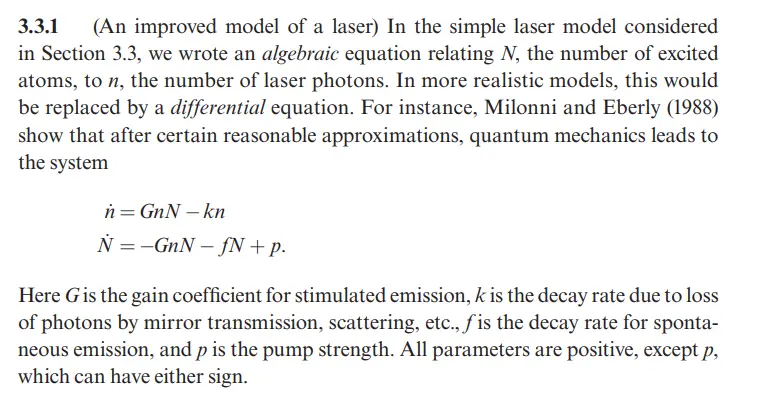
(An improved model of a laser) In the simple laser model considered
in Section 3.3, we wrote an algebraic equation relating N, the number of excited
atoms, to n, the number of laser photons. In more realistic models, this would
be replaced by a differential equation. For instance, Milonni and Eberly (1988)
show that after certain reasonable approximations, quantum mechanics leads to
the system
n = GnN-kn
N=-GnNfN+p.
Here G is the gain coefficient for stimulated emission, k is the decay rate due to loss
of photons by mirror transmission, scattering, etc., fis the decay rate for sponta-
neous emission, and p is the pump strength. All parameters are positive, except p,
which can have either sign.
This two-dimensional system will be analyzed in Exercise 8.1.13. For now, let's
convert it to a one-dimensional system, as follows.
a) Suppose that N relaxes much more rapidly than n. Then we may make the
quasi-static approximation N≈0. Given this approximation, express N(t) in
terms of n(t) and derive a first-order system for n. (This procedure is often
called adiabatic elimination, and one says that the evolution of N(t) is slaved to
that of n(t). See Haken (1983).)
b) Show that n* = 0 becomes unstable for p >p, where p is to be determined.
ePe
c) What type of bifurcation occurs at the laser threshold pr?
d) (Hard question) For what range of parameters is it valid to make the approxi-
mation used in (a)?
check_circle الجواب — حل مفصل خطوة بخطوة
hourglass_top
🔒
الحل الكامل متاح للمشتركين
اشترك في أرشيف الأسئلة لعرض هذا الحل وآلاف الحلول المفصلة خطوة بخطوة من معلمين معتمدين.