تم الحل ✓
categoryالهندسة الكهربائية
schoolبكالوريوس
event_available2026-07-15
السؤال
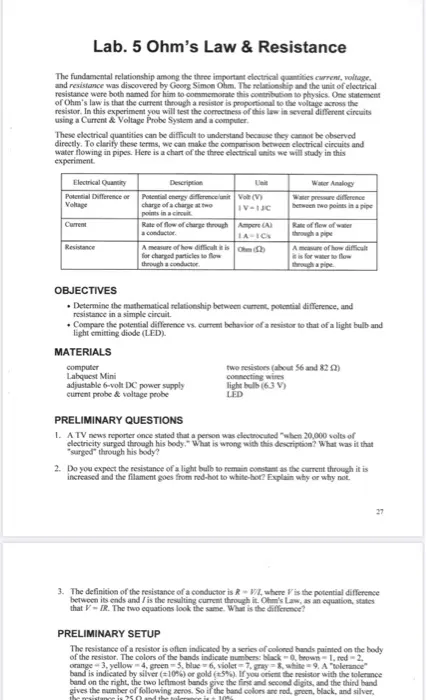
Transcribed Image Text:
Lab. 5 Ohm's Law & Resistance
The fundamental relationship among the three important electrical quantities current, voltage,
and resistance was discovered by Georg Simon Ohm. The relationship and the unit of electrical
resistance were both named for him to commemorate this contribution to physics. One statement
of Ohm's law is that the current through a resistor is proportional to the voltage across the
resistor. In this experiment you will test the correctness of this law in several different circuits
using a Current & Voltage Probe System and a computer.
These electrical quantities can be difficult to understand because they cannot be observed
directly. To clarify these terms, we can make the comparison between electrical circuits and
water flowing in pipes. Here is a chart of the three electrical units we will study in this
experiment.
Electrical Quantity
Potential Difference or
Voltage
Current
Resistance
Description
Potential energy differencelunit Volt (V)
charge of a charge at two
points in a circuit
IV-1JC
Rate of flow of charge through Ampere (A)
a conductor
A measure of how difficult it is
TA-IC
Ohm
Water Analogy
Water pressure difference
between two points in a pipe
Rate of flow of water
through a pipe
Ameasure of how difficult
for charged particles to flow
through a conductor.
through a pipe
OBJECTIVES
Determine the mathematical relationship between current, potential difference, and
resistance in a simple circuit.
Compare the potential difference vs. current behavior of a resistor to that of a light bulb and
light emitting diode (LED).
MATERIALS
computer
Labquest Mini
adjustable 6-volt DC power supply
current probe & voltage probe
PRELIMINARY QUESTIONS
two resistors (about 56 and 82 (2)
connecting wires
light bulb (6.3 V)
LED
1. A TV news reporter once stated that a person was electrocuted "when 20,000 volts of
electricity surged through his body." What is wrong with this description? What was it that
"surged" through his body?
2. Do you expect the resistance of a light bulb to remain constant as the current through it is
increased and the filament goes from red-hot to white-hot? Explain why or why not.
3. The definition of the resistance of a conductor is R-VI, where is the potential difference
between its ends and / is the resulting current through it. Ohm's Law, as an equation, states
that V-IR. The two equations look the same. What is the difference?
PRELIMINARY SETUP
The resistance of a resistor is often indicated by a series of colored bands painted on the body
of the resistor. The colors of the bands indicate numbers: black 0, brown-1, red-2,
orange 3, yellow-4, green 5, blue 6, violet-7, gray-8, white 9. A "tolerance"
band is indicated by silver (10%) or gold (15%). If you orient the resistor with the tolerance
band on the right, the two leftmost bands give the first and second digits, and the third band
gives the number of following zeros. So if the band colors are red, green, black, and silver,
the resistance is 25.0 and the tolerance is + 1055
check_circle الجواب — حل مفصل خطوة بخطوة
hourglass_top
🔒
الحل الكامل متاح للمشتركين
اشترك في أرشيف الأسئلة لعرض هذا الحل وآلاف الحلول المفصلة خطوة بخطوة من معلمين معتمدين.