تم الحل ✓
categoryهندسة كهربائية
schoolبكالوريوس
event_available2026-07-15
السؤال
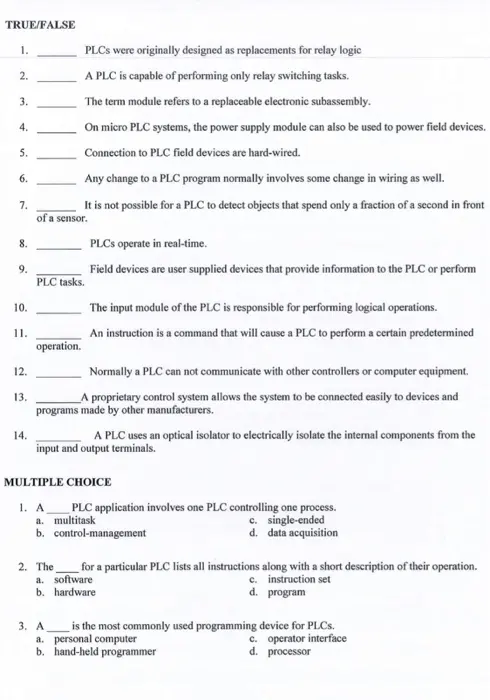
Transcribed Image Text:
1.
TRUE/FALSE
PLCs were originally designed as replacements for relay logic
2.
A PLC is capable of performing only relay switching tasks.
3.
The term module refers to a replaceable electronic subassembly.
4.
5.
6.
7.
8.
9.
10.
1=
11.
12.
23
13.
14.
of a sensor.
PLC tasks.
operation.
On micro PLC systems, the power supply module can also be used to power field devices.
Connection to PLC field devices are hard-wired.
Any change to a PLC program normally involves some change in wiring as well.
It is not possible for a PLC to detect objects that spend only a fraction of a second in front
PLCs operate in real-time.
Field devices are user supplied devices that provide information to the PLC or perform
The input module of the PLC is responsible for performing logical operations.
An instruction is a command that will cause a PLC to perform a certain predetermined
Normally a PLC can not communicate with other controllers or computer equipment.
A proprietary control system allows the system to be connected easily to devices and
programs made by other manufacturers.
A PLC uses an optical isolator to electrically isolate the internal components from the
input and output terminals.
MULTIPLE CHOICE
1. A
PLC application involves one PLC controlling one process.
a. multitask
b. control-management
c. single-ended
d. data acquisition
2. The for a particular PLC lists all instructions along with a short description of their operation.
a. software
b. hardware
3. A
c. instruction set
d. program
is the most commonly used programming device for PLCs.
a. personal computer
b. hand-held programmer
c. operator interface
d. processor
4. In which module of the PLC is the decision making performed?
a.
processor module
b. input module
c. output module
d. power supply module
5. Which of the following is a factor effecting the memory size needed for a PLC installation?
a. voltage rating of field devices
b. number of I/O points
c.
current rating of field devices
d. type of programming device
6. Additional optional PLC components are often available, including:
a. operator interface devices
b. communication adaptors
c. network interfaces
d. all of these
7. Which of the following is a task that a PLC is NOT capable of performing?
a. timing
b. counting
c. directly switching large motors
d. comparing
8. The main advantage of fixed I/O is:
a. lower cost
b. increased flexibility
c.
greater selection of modules
d. faster replacement of I/O modules
9. The processor section of the PLC is where:
a. the program is stored
b. the inputs are connected
c. the outputs are connected
d. the sensors are located
10. The input interface module:
a. allows the user to input a program
b. connects the CPU to signals from the process
c. allows the CPU to input messages to a CRT screen
d. provides inputs to field devices
11. The output interface module:
a. is always a CRT screen device
b. allows the program in memory to be output to the CPU
c. connects the CPU to the process and produces control signals
d. all of these
12. A PLC has no: 1
a. keyboard
b. disk drive
c.
monitor
d.
all of these
13. Which of the following is an advantage of personal-computer-based control systems?
a. Lower initial cost
b. More proprietary
14. In general, Micro PLCs can connect up to about
a. 6
b. 12
c.
Ease of programming
d. All of these
I/O points.
c.
18
d. 32
15. A PLC that uses 8-bit words and has a 6K word capacity has,
a.
8,000
b. 42,000
c. 49,152
d. 52,460
bits of storage capacity.
COMPLETION
1. CPU is an abbreviation for
2. I/O is an abbreviation for
and
3. Modifying relay type process control circuits usually involves changing the circuit
modules.
5. The
4. The
module of the PLC connects to field devices such as pilot lights, motor
starters, and solenoids.
time is the time required for one complete execution of the user
points.
used to control
program.
6. Categorization of PLC size is primarily based on the number of
7. A programmable controller is basically a specialized_
machines and process
8. Typically, the numbers associated with a PLC instruction represents the instruction's
9.
schematic diagram.
10. The
11.
setting of the processor.
removable units.
logic programming is a method of programming a PLC that resembles a relay
is a selected method of operation such as RUN, TEST, or PROGRAM
I/O is typical of small PLCs that come all in one package with no separate,
12. Normally, when a field device contact connected to the input module closes, the associated address is
set to logic
13. Compact,
programming devices are frequently used on the factory floor for
troubleshooting equipment.
Chapter 5-Basics of PLC Programming
TRUE/FALSE
A programmed normally closed contact instruction is examined for an "ON" condition.
1
2
Branch instructions are used to create series paths.
3
4
5
The maximum number of rungs allowed in a program is limited only by the memory size.
Misunderstanding the way the PLC scans a program can cause programming bugs.
Each complete horizontal line of a ladder logic program is generally referred to as a rung.
6
With functional chart programming the program is divided into steps or stages.
7
The input image table file is changed to reflect the current status of input devices during the program
scan phase of operation.
Normally intensified rungs to an instruction on the screen of a display indicates the instruction is true
and has logic continuity.
A ladder logic rung is always true or has logic continuity whenever all input contact instructions are at
logic 1.
The last element to be entered on a ladder logic rung is a contact instruction.
10
11
The memory structure of a ControlLogic controller is fixed and nonflexible.
12
13
14
ControlLogic controllers are based on 16-bit operations.
Arrays allow the grouping of sets of data of the same data type in a block of ControlLogic controller
memory.
Most PLC programming packages operate in the Windows environment.
MULTIPLE CHOICE
1. Which of the following would "not" be classified as a data file?
a. counter
c. subroutine
d. integer
b. timer
2. Typically the address 0:012/15 would be in the
a. output image table file, rack 1, I/O group 2, bit 15
b. output image table file, rack 0, 1/0 group 12, bit 15
c. input image table file, rack 1, I/O group 2, bit 15
d. input image table file, rack 0, I/O group 12, bit 15
3. Typically the address S:015 would address word
of the status file.
a.
S
c.
b. 01
d.
8:01
15
4. If there is no physical outputs wired to a bit address, the address can be used as a (an) storage
point.
a. internal
b. external
c.
temporary
d. permanent
5. An output in a ladder logic program can be controlled by
a. input instructions
c.
input and output instructions
b. output instructions
d.
all of these
6. The term "examine if closed" refers to
a. a normally-closed contact instruction
c.
the status of the CPU
b. a normally-open contact instruction
d.
all of these
7. "Nesting" is defined as
a. horizontal scanning
b. vertical scanning
c. a combination of horizontal and vertical scanning
d. creating a branch within a branch
8. The first digit in an Allen-Bradley I/O address determines
a. the rack number
b. the module number
c. whether the device is an input or output
d. the slot number
9. The scan of a PLC program involves
a. the sequential examination of the ladder logic program
b. the updating of all inputs
c. the updating of all outputs
d. all of these
10. Each memory location in a processor has a/an
a. address
c.
contact
d. coil
b. rung
11. In a ControlLogic controller the ladder logic is stored in a
a. tag
b. routine
c. program
d. task
12. The alias tag of a ControlLogic controller
a. defines the memory location where a data element is stored.
b. references data that comes from another controller.
c. references a memory location that has been defined by another tag.
d. all of these
13. Which of the following would be classified as a structured data type?
a. timer
b. SINT
c.
DINT
d. all of these
14. Which of the following is a standard language as defined by the IEC?
a. Instruction List
b. Ladder Diagram
15. Variations of a PLC test mode can include
c. Structured Text
d. all of these
a. single-step
b. single-scan
COMPLETION
1. The PLC
c.
continuous
d.
all of these
mode of operation is selected to execute the user program.
2. A traditional processor file is the collection of_
files and
created under a particular processor file name.
3. For a PLC 5 and SLC controllers a word consists of 16
or binary digits.
4. The address 1:013/17 would be found in the
image table file.
5. The timer file stores the timer
and timer
6. When you are dealing with numbers that require a decimal point the
file element is used.
-point
7. If the program calls for a specific output to be "OFF", the corresponding bit in the outout image table
file is reset to
8. The
the scan time, the faster the PLC can react to changes in inputs.
9. With functional chart programming instructions, the processor does not
parts of the program that are not active.
10. When the processor finds a
output will become (or remain) true.
path of true input instructions in a rung, the
11. The project for a ControlLogic controller is organized into
and
those
12. ControlLogic processor modules use
controller where data is stored.
13. The three types of structures in a ControlLogix controller are
and
to identify the memory location in the
DP2520 Practice Quiz #1 for sections 1, 2 and 3
TRUE OR FALSE
PLCs were originally designed as replacements for relay logic
A PLC is capable of performing only relay switching tasks.
Connection to PLC field devices are hard-wired.
Any change to a PLC program normally involves some change in wiring as well.
PLCs operate in real-time.
An instruction is a command that will cause a PLC to perform a certain predetermined operation.
The location of a specific input or output field device is identified by the processor by means of its
tag and address.
Status indicators are provided on each output of an output module to indicate that the input
associated with the output is active.
A pushbutton input field device would most likely be used to provide the signal to an analog input
module.
An operator interface device allows process information to be displayed and new control
parameters to be entered.
1. Additional optional PLC components are often available, including:
a. operator interface devices
b. communication adaptors
c. network interfaces
d. all of these
2. Which of the following is a task that a PLC is NOT capable of performing?
a. timing
b. counting
c. directly switching large motors
d. comparing
3. The main advantage of fixed I/O is:
a. lower cost
b. increased flexibility
c. greater selection of modules
d. faster replacement of I/O modules
4. The processor section of the PLC is where:
a. the program is stored
b. the inputs are connected
c. the outputs are connected
d. the sensors are located
5. The input interface module:
a. allows the user to input a program
b. connects the CPU to signals from the process
c. allows the CPU to input messages to a CRT screen
d. provides inputs to field devices
6. The output interface module:
a. is always a CRT screen device
b. allows the program in memory to be output to the CPU
c. connects the CPU to the process and produces control signals
d. all of these
7. PLC memory is:
a. a physical space inside the CPU
b. where program files are stored
c. where data files are stored
d. all of these
8. Which of the following tasks is performed by an input interface module?
a. Sense when a signal is received from the sensor on a machine.
b. Convert the input signal to the correct voltage level for the particular PLC.
c. Send a signal to the processor indicating which sensor originated the signal.
d. all of these.
Short Answer typical type questions
1 List and draw the parts of a typical plc system (hardware)
2 Explain what is a rail and what a rung are...show pics
3 What is the difference between NO and NC contacts...draw them?
4 Draw a relay logic start/stop station with O/L. Show how to convert it to ple ladder
logic.
5 Speak of safety issues using an output instruction to seal in a start command
6 List the benefits of ple's
7 What types of cards used on ple
8 What is a Tag and what types are the 2 most common?
9 What must be done FIRST before you can enter a program on the ple
software RSLogix5000? Why (what would happen if you did not do it)?
10 What is a "seal-in" contact" and draw the setup to help explain?
11 Explain why an XIC (or XIO) instruction can have either an Input, Output, Bit or
Timer type address
12 Completely name the following symbols used in relay logic
13
g
ठ
T° T
01000
Convert the relay circuit to a ple program. Show all inputs, outputs, instructions
and addresses. Use Slot 1 for Inputs, and Slot 2 for outputs. Draw I/O print as
well.
L1
START
START
1
STOP STOP STOP 2L
معلمملممله
-o
START
-° °
M
M
OL
ойн
L2
check_circle الجواب — حل مفصل خطوة بخطوة
hourglass_top
🔒
الحل الكامل متاح للمشتركين
اشترك في أرشيف الأسئلة لعرض هذا الحل وآلاف الحلول المفصلة خطوة بخطوة من معلمين معتمدين.