تم الحل ✓
categoryالرياضيات
schoolبكالوريوس
event_available2026-07-15
السؤال
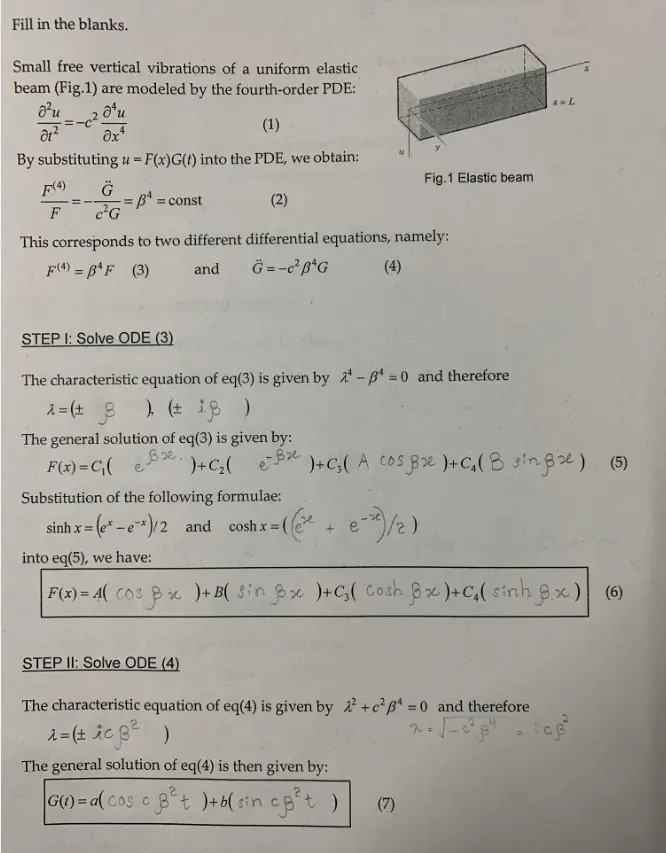
Transcribed Image Text:
Fill in the blanks.
Small free vertical vibrations of a uniform elastic
beam (Fig.1) are modeled by the fourth-order PDE:
20¹u
=-C
ди
at² Ox4
(1)
By substituting u = F(x)G(t) into the PDE, we obtain:
F(4)
F
===
G
G
=
B₁ = const
(2)
Fig.1 Elastic beam
This corresponds to two different differential equations, namely:
F(4) BF (3)
and
G=-c²ẞ²G
(4)
x=L
STEP 1: Solve ODE (3)
The characteristic equation of eq(3) is given by 2-4=0 and therefore
=( 8 ) ( 8 )
The general solution of eq(3) is given by:
еве
F(x)=C(e
)+C₂(
e-B
)+C( A cos x)+C (B sinx) (5)
Substitution of the following formulae:
sinh x = (-e)/2 and cosh x = ((
into eq(5), we have:
=(( + - )/2)
|F(x)=4( cos x)+B( sin 3x ) + C₂( cosh 8x)+C₁(sinh 8.x) (6)
STEP II: Solve ODE (4)
The characteristic equation of eq(4) is given by 22+ c²ß = 0 and therefore
λ=(±ic p² )
The general solution of eq(4) is then given by:
G(t)=a(cos c t )+b(sin cp²t)
(7)
7. =
Now we try to find the general solutions
Unm F(x)G(t) for the simply supported
beam shown in Fig.2 with zero initial
velocity.
The geometrical boundary conditions are
expressed by:
x=0
Fig.2 Simply supported beam
u(0,1)=0, u(L,t)=0 (ends simply supported for all times t)
x = L
(8)
(9)
(0,1)=0, (L1)=0 (zero moments, hence zero curvature at the ends)
and the initial condition is given by
u,(x,0)=0
(zero initial velocity)
(10)
STEP III: Use the boundary condition (8)
From the first B.C. (8) and u = F(x)G(t), we obtain:
u(0,1) F(0)G(t)=0 hence
Therefore from eq.(6),
)
(
)=0
(11)
From the second B.C. (8) and u-F(x)G(t), we obtain:
u(L,t)= F(L)G(t)=0 hence
Therefore from eq.(6),
)
A(
)+ B(
)=0
)=0
)+C₂(
)+C₁₂(
x)=0 (12)
STEP IV: Use the boundary condition (9)
From the first B.C. (9) and u= F(x)G(t), we obtain:
(0,1) = F(0)G(t)=0
hence
F"(0)=0
From eq(6), we have
F"(x)= A(
)+ B(
)-C(
)-C₁(
) (13)
Therefore, we obtain:
F"(0)=(
)=0 hence (
)=0
(14)
From eqs(11) and (13), we obtain:
A=C₁ =0
(15)
Eqs(12) and (14) yields:
B
)+C₁₂(
)=0
From the second B.C. (9) and u-F(x)G(t), we obtain:
(L.) F"(L)G(t)=0 hence
Therefore using eqs(13) and (15), we have:
F"(L)=0
(16)
B(
)-C₁(
)=0
(17)
From eqs(16) and (17),
2B(
)=0 therefore B=0
Eq(16) with B-0 yields:
C₁(
)=0
Since C40, we have (
)=0 and therefore ẞ = (
)
Thus, we obtain:
F(x)=C(
)
(18)
STEP V: Use the boundary condition (9)
From the initial condition (10) and u = F(x)G(t), we obtain:
u,(x,0)= F(x)Ġ(0) = 0
hence
From eq(7), we have:
Ġ(t)=-a(
Therefore
Ġ(0)=0
)+b(
)
Ġ(0)=(
Thus, we obtain:
)=0 hence b=0 since c0 and ẞ0
G(t) = a(
)
(19)
STEP VI: Find the general solutions
From eqs(18) and (19), finally, we obtain the general solutions:
u(x,t) = F(x)G(t) = D(
).
check_circle الجواب — حل مفصل خطوة بخطوة
hourglass_top
🔒
الحل الكامل متاح للمشتركين
اشترك في أرشيف الأسئلة لعرض هذا الحل وآلاف الحلول المفصلة خطوة بخطوة من معلمين معتمدين.