تم الحل ✓
categoryالرياضيات
schoolبكالوريوس
event_available2026-07-15
السؤال
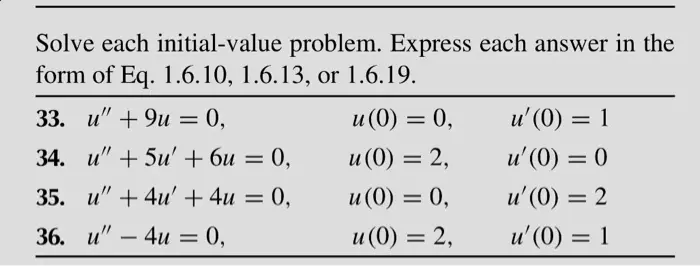
Transcribed Image Text:
Solve each initial-value problem. Express each answer in the
form of Eq. 1.6.10, 1.6.13, or 1.6.19.
33. u" 9u = 0,
u (0) = 0,
u'(0) = 1
34. u" 5u' + 6u =
0,
u (0) = 2,
u'(0) = 0
35. u" +4u' + 4u = 0,
u (0) = 0,
u'(0) = 2
36. u4u = 0,
u(0) = 2,
u'(0) = 1
A general solution is
u(x) = c₁ex/2 + C₂xe¯ax/2 = (c₁ + C2x)e-ax/2
Note that, using u₁ = eax/2 and u₂ = xeax/2, the Wronskian is
(1.6.19)
121
Using the appropriate identities, 12 this solution can be put in the following two equivalent forms:
u(x)=eTax/2[A sinh (Va2 – 4bx) + B cosh (V@2 – 4bx)]
u(x) = cewx/2 sinh (;Va? – 4bx+ca)
(1.6.10)
(1.6.11)
which, with the appropriate identities, 13 can be put in the following two equivalent forms:
u(x)=ex/[A sin (√a² - 4bx) + B cos (½√a² - 4bx)]
u(x)=c3e e-ax/2 cos (√√a²-4bx + c4)
(1.6.13)
(1.6.14)
1.6 HOMOGENEOUS, SECOND-ORDER, LINEAR EQUATIONS WITH CONSTANT COEFFICIENTS 39
Let us consider two cases (a²-4b) > 0 and (a²-4b) <0. If (a-4b) > 0, the solution
takes the form
(1.6.9)
Using the appropriate identities, this solution can be put in the following two equivalent forms:
(x) [A sinh (√a²-4bx)+ B cosh (√a²-4b.x)]
u(x)=cesinh (√a²-4bx+c)
If (a²-4b) < 0, the general solution takes the form, using i = √-I.
(x)=(cie
(1.6.10)
(1.6.11)
(1.6.12)
which, with the appropriate identities, can be put in the following two equivalent forms:
(x)=[A sin (√a-4bx)+ B cos (√a²-4bx)]
u(x)=cyecos (Va²-4bx+cs)
(1.6.13)
(1.6.14)
If a particular form of the solution is not requested, the form of Eq. 1.6.9 is used if (a² - 4b) > 0
and the form of Eq. 1.6.13 is used if (a-4b) <0.
If (a²-4b)=0,mmy and a double root occurs. For this case the solution 1.6.8 no
longer is a general solution. What this means is that the assumption that there are two linearly
independent solutions of Eq. 1.6.1 of the form is false, an obvious conclusion since
W(x)=0. To find a second solution we make the assumption that it is of the form
2(x)=(x)
where m² + am + b = 0. Substitute into Eq. 1.6.1 and we have
(m²+ame + be)+(2me" + a) +
dv
dx
(1.6.15)
=0
dr²
(1.6.16)
The coefficient of v is zero since m²+am+b=0. The coefficient of du/dx is zero since we
are assuming that m² +am+b=0 has equal roots, that is, m = -a/2. Hence,
13The appropriate identities are
The appropriate identities are
d²
=0
dx²
eason 1 + sinh x
sinh(x + y) = sinh x cosh y + sinh y cosh x
cos+isin
costar+B)=cosa cos - sina sin
cos² + sin² = 1
(1.6.17)
check_circle الجواب — حل مفصل خطوة بخطوة
hourglass_top
🔒
الحل الكامل متاح للمشتركين
اشترك في أرشيف الأسئلة لعرض هذا الحل وآلاف الحلول المفصلة خطوة بخطوة من معلمين معتمدين.