تم الحل ✓
categoryهندسة كيميائية
schoolبكالوريوس
event_available2026-07-15
السؤال
Transcribed Image Text:
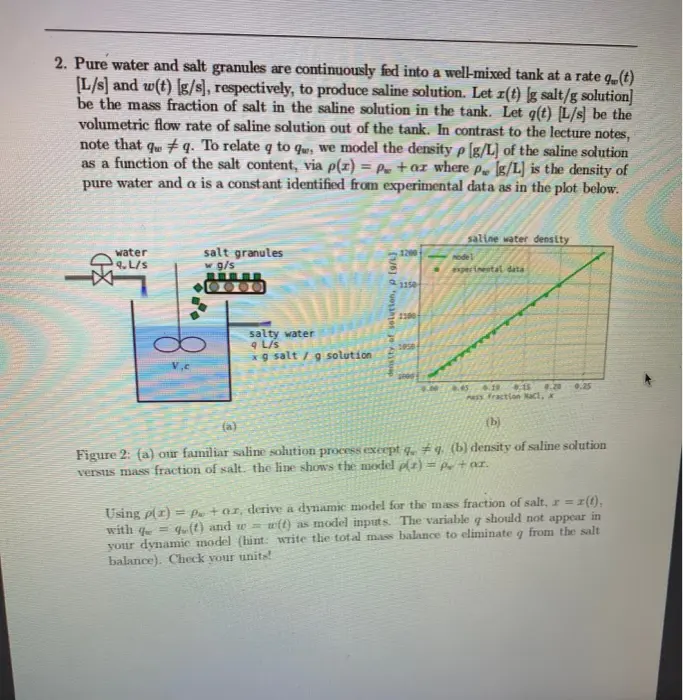
2. Pure water and salt granules are continuously fed into a well-mixed tank at a rate q(t)
[L/s] and w(t) [g/s], respectively, to produce saline solution. Let r(t) [g salt/g solution]
be the mass fraction of salt in the saline solution in the tank. Let q(t) [L/s] be the
volumetric flow rate of saline solution out of the tank. In contrast to the lecture notes,
note that qq. To relate q to qw, we model the density p [g/L] of the saline solution
as a function of the salt content, via p(x) = p + az where p g/L] is the density of
pure water and a is a constant identified from experimental data as in the plot below.
water
4. L/s
salt granules
w.g/s
00000
8
V.c
salty water
q L/s
x9 salt/g solution
density of solution, p [9/L]
1200
1150
saline water density
model
experimental data
1100
1050
(a)
9.16
4.45
4.18 0.15 0.20 0.25
Pass fraction act, x
(b)
Figure 2: (a) our familiar saline solution process except q, q. (b) density of saline solution
versus mass fraction of salt. the line shows the model p(z) = Po +αr.
1(t),
Using p(z) =P + or, derive a dynamic model for the mass fraction of salt, r =
with q
(t) and w w(t) as model inputs. The variable q should not appear in
your dynamic model (hint:
balance). Check your units!
write the total mass balance to eliminate q from the salt
check_circle الجواب — حل مفصل خطوة بخطوة
hourglass_top
🔒
الحل الكامل متاح للمشتركين
اشترك في أرشيف الأسئلة لعرض هذا الحل وآلاف الحلول المفصلة خطوة بخطوة من معلمين معتمدين.