تم الحل ✓
categoryمحاسبة ومراجعة
schoolبكالوريوس
event_available2026-07-15
السؤال
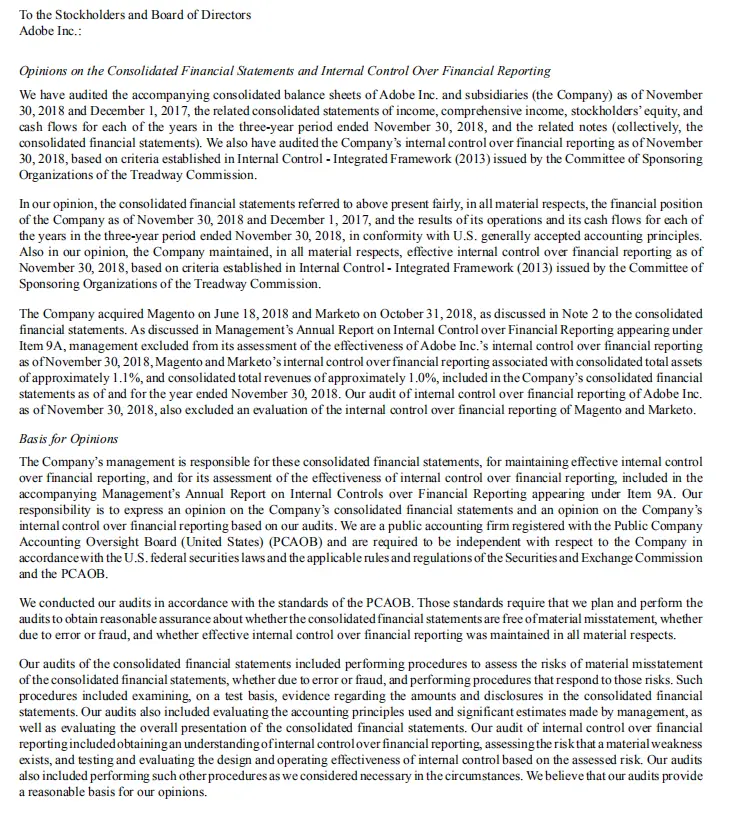
Transcribed Image Text:
To the Stockholders and Board of Directors
Adobe Inc.:
Opinions on the Consolidated Financial Statements and Internal Control Over Financial Reporting
We have audited the accompanying consolidated balance sheets of Adobe Inc. and subsidiaries (the Company) as of November
30, 2018 and December 1, 2017, the related consolidated statements of income, comprehensive income, stockholders' equity, and
cash flows for each of the years in the three-year period ended November 30, 2018, and the related notes (collectively, the
consolidated financial statements). We also have audited the Company's internal control over financial reporting as of November
30, 2018, based on criteria established in Internal Control - Integrated Framework (2013) issued by the Committee of Sponsoring
Organizations of the Treadway Commission.
In our opinion, the consolidated financial statements referred to above present fairly, in all material respects, the financial position
of the Company as of November 30, 2018 and December 1, 2017, and the results of its operations and its cash flows for each of
the years in the three-year period ended November 30, 2018, in conformity with U.S. generally accepted accounting principles.
Also in our opinion, the Company maintained, in all material respects, effective internal control over financial reporting as of
November 30, 2018, based on criteria established in Internal Control - Integrated Framework (2013) issued by the Committee of
Sponsoring Organizations of the Treadway Commission.
The Company acquired Magento on June 18, 2018 and Marketo on October 31, 2018, as discussed in Note 2 to the consolidated
financial statements. As discussed in Management's Annual Report on Internal Control over Financial Reporting appearing under
Item 9A, management excluded from its assessment of the effectiveness of Adobe Inc.'s internal control over financial reporting
as of November 30, 2018, Magento and Marketo's internal control over financial reporting associated with consolidated total assets
of approximately 1.1%, and consolidated total revenues of approximately 1.0%, included in the Company's consolidated financial
statements as of and for the year ended November 30, 2018. Our audit of internal control over financial reporting of Adobe Inc.
as of November 30, 2018, also excluded an evaluation of the internal control over financial reporting of Magento and Marketo.
Basis for Opinions
The Company's management is responsible for these consolidated financial statements, for maintaining effective internal control
over financial reporting, and for its assessment of the effectiveness of internal control over financial reporting, included in the
accompanying Management's Annual Report on Internal Controls over Financial Reporting appearing under Item 9A. Our
responsibility is to express an opinion on the Company's consolidated financial statements and an opinion on the Company's
internal control over financial reporting based on our audits. We are a public accounting firm registered with the Public Company
Accounting Oversight Board (United States) (PCAOB) and are required to be independent with respect to the Company in
accordance with the U.S. federal securities laws and the applicable rules and regulations of the Securities and Exchange Commission
and the PCAOB.
We conducted our audits in accordance with the standards of the PCAOB. Those standards require that we plan and perform the
audits to obtain reasonable assurance about whether the consolidated financial statements are free of material misstatement, whether
due to error or fraud, and whether effective internal control over financial reporting was maintained in all material respects.
Our audits of the consolidated financial statements included performing procedures to assess the risks of material misstatement
of the consolidated financial statements, whether due to error or fraud, and performing procedures that respond to those risks. Such
procedures included examining, on a test basis, evidence regarding the amounts and disclosures in the consolidated financial
statements. Our audits also included evaluating the accounting principles used and significant estimates made by management, as
well as evaluating the overall presentation of the consolidated financial statements. Our audit of internal control over financial
reporting included obtaining an understanding of internal control over financial reporting, assessing the risk that a material weakness
exists, and testing and evaluating the design and operating effectiveness of internal control based on the assessed risk. Our audits
also included performing such other procedures as we considered necessary in the circumstances. We believe that our audits provide
a reasonable basis for our opinions.
Definition and Limitations of Internal Control Over Financial Reporting
A company's internal control over financial reporting is a process designed to provide reasonable assurance regarding the reliability
of financial reporting and the preparation of financial statements for external purposes in accordance with generally accepted
accounting principles. A company's internal control over financial reporting includes those policies and procedures that (1) pertain
to the maintenance of records that, in reasonable detail, accurately and fairly reflect the transactions and dispositions of the assets.
of the company; (2) provide reasonable assurance that transactions are recorded as necessary to permit preparation of financial
statements in accordance with generally accepted accounting principles, and that receipts and expenditures of the company are
being made only in accordance with authorizations of management and directors of the company; and (3) provide reasonable
assurance regarding prevention or timely detection of unauthorized acquisition, use, or disposition of the company's assets that
could have a material effect on the financial statements.
Because of its inherent limitations, internal control over financial reporting may not prevent or detect misstatements. Also,
projections of any evaluation of effectiveness to future periods are subject to the risk that controls may become inadequate because
of changes in conditions, or that the degree of compliance with the policies or procedures may deteriorate.
(signed) KPMG LLP
We have served as the Company's auditor since 1983.
Santa Clara, California
January 25, 2019
ITEM 9. CHANGES IN AND DISAGREEMENTS WITH ACCOUNTANTS ON ACCOUNTING AND FINANCIAL
DISCLOSURE
None.
ITEM 9A. CONTROLS AND PROCEDURES
Disclosure Controls and Procedures
Our management has evaluated, under the supervision and with the participation of our Chief Executive Officer and Chief
Financial Officer, the effectiveness of our disclosure controls and procedures as of November 30, 2018. Based on their evaluation
as of November 30, 2018, our Chief Executive Officer and Chief Financial Officer have concluded that our disclosure controls
and procedures (as defined in Rules 13a-15(e) and 15d-15(e) under the Securities Exchange Act of 1934, as amended) were
effective at the reasonable assurance level to ensure that the information required to be disclosed by us in this Annual Report on
Form 10-K was (i) recorded, processed, summarized and reported within the time periods specified in the SEC's rules and
regulations and (ii) accumulated and communicated to our management, including our Chief Executive Officer and Chief Financial
Officer, to allow timely decisions regarding required disclosure.
Our management, including our Chief Executive Officer and Chief Financial Officer, does not expect that our disclosure
controls and procedures or our internal controls over financial reporting will prevent all errors and all fraud. A control system, no
matter how well conceived and operated, can provide only reasonable, not absolute, assurance that the objectives of the control
system are met. Further, the design of a control system must reflect the fact that there are resource constraints and the benefits of
controls must be considered relative to their costs. Because of the inherent limitations in all control systems, no evaluation of
controls can provide absolute assurance that all control issues and instances of fraud, if any, within Adobe have been detected.
Management's Annual Report on Internal Control over Financial Reporting
Our management is responsible for establishing and maintaining adequate internal control over financial reporting (as
defined in Rule 13a-15(f) under the Securities Exchange Act of 1934, as amended). Our management assessed the effectiveness
of our internal control over financial reporting as of November 30, 2018. In making this assessment, our management used the
criteria established in Internal Control - Integrated Framework (2013) issued by the COSO. Our management has concluded that,
as of November 30, 2018, our internal control over financial reporting is effective based on these criteria.
We acquired Magento on June 18, 2018 and Marketo on October 31, 2018, as discussed in Note 2 to the Consolidated
Financial Statements. As permitted by the SEC staff's Frequently Asked Question 3 on Management's Report on Internal Control
Over Financial Reporting and Certification of Disclosure in Exchange Act Periodic Reports (revised September 24, 2007), our
management excluded from our assessment of internal control over financial reporting effectiveness as of November 30, 2018,
Magento and Marketo's internal control over financial reporting associated with consolidated total assets of approximately 1.1%,
and consolidated total revenues of approximately 1.0%, included in our Consolidated Financial Statements as of and for the year
ended November 30, 2018. We will include Magento and Marketo in our assessment of the effectiveness of internal control over
financial reporting starting fiscal 2019.
KPMG LLP, the independent registered public accounting firm that audited our financial statements included in this Annual
Report on Form 10-K, has issued an attestation report on our internal control over financial reporting, which is included herein.
Changes in Internal Control over Financial Reporting
There were no changes in our internal control over financial reporting during the quarter ended November 30, 2018 that
have materially affected, or are reasonably likely to materially affect, our internal control over financial reporting.
Report of Independent Registered Public Accounting Firm
To the Shareholders and the Board of Directors of Apple Inc.
Opinion on the Financial Statements
We have audited the accompanying consolidated balance sheets of Apple Inc. as of September 28, 2019 and September 29, 2018, the related consolidated
statements of operations, comprehensive income, shareholders' equity and cash flows for each of the three years in the period ended September 28, 2019, and
the related notes (collectively referred to as the "financial statements"). In our opinion, the financial statements present fairly, in all material respects, the financial
position of Apple Inc. at September 28, 2019 and September 29, 2018, and the results of its operations and its cash flows for each of the three years in the
period ended September 28, 2019, in conformity with U.S. generally accepted accounting principles.
We also have audited, in accordance with the standards of the Public Company Accounting Oversight Board (United States) (the "PCAOB"), Apple Inc.'s internal
control over financial reporting as of September 28, 2019, based on criteria established in Internal Control - Integrated Framework issued by the Committee of
Sponsoring Organizations of the Treadway Commission (2013 framework) and our report dated October 30, 2019 expressed an unqualified opinion thereon.
Basis for Opinion
These financial statements are the responsibility of Apple Inc.'s management. Our responsibility is to express an opinion on Apple Inc.'s financial statements
based on our audits. We are a public accounting firm registered with the PCAOB and are required to be independent with respect to Apple Inc. in accordance
with the U.S. federal securities laws and the applicable rules and regulations of the U.S. Securities and Exchange Commission and the PCAOB.
We conducted our audits in accordance with the standards of the PCAOB. Those standards require that we plan and perform the audit to obtain reasonable
assurance about whether the financial statements are free of material misstatement, whether due to error or fraud. Our audits included performing procedures to
assess the risks of material misstatement of the financial statements, whether due to error or fraud, and performing procedures that respond to those risks. Such
procedures included examining, on a test basis, evidence regarding the amounts and disclosures in the financial statements. Our audits also included evaluating
the accounting principles used and significant estimates made by management, as well as evaluating the overall presentation of the financial statements. We
believe that our audits provide a reasonable basis for our opinion.
Critical Audit Matter
The critical audit matter communicated below is a matter arising from the current period audit of the financial statements that was communicated or required to
be communicated to the audit committee and that: (1) relates to accounts or disclosures that are material to the financial statements and (2) involved our
especially challenging, subjective, or complex judgments. The communication of the critical audit matter does not alter in any way our opinion on the financial
statements, taken as a whole, and we are not, by communicating the critical audit matter below, providing a separate opinion on the critical audit matter or on
the account or disclosure to which it relates.
Description of the Matter
European Commission State Aid Matter Uncertain Tax Position
As discussed in Note 5 of the financial statements, the European Commission ("EC") has announced its decision
that Ireland granted state aid to Apple Inc. by providing tax opinions in 1991 and 2007 conceming the tax
allocation of profits of the Irish branches of two subsidiaries of Apple Inc. The decision ordered Ireland to calculate
and recover additional taxes from Apple Inc. for the period from June 2003 through December 2014. The adjusted
amount indicated by the EC to be recovered is up to €12.9 billion, plus interest.
Auditing management's evaluation of the uncertain tax position stemming from the effects of the EC decision is
complex and highly judgmental due to the inherent uncertainty in predicting the ultimate resolution of the matter.
Apple Inc. | 2019 Form 10-K | 56
How We Addressed the
Matter in Our Audit
We tested controls over the risk of material misstatement relating to the evaluation of the EC state aid matter,
including management's evaluation of the advice of legal counsel, the assessment as to whether Apple Inc.'s
position is more likely than not to be sustained and the development of the related disclosure.
To evaluate Apple Inc.'s assessment of whether sustainment of its position is a more likely than not outcome,
including underlying assumptions, our audit procedures included, among others, reading the EC August 2016
ruling and available correspondence between Apple Inc. and the EC, and the EC and Ireland. We also requested
and received internal and external legal counsel confirmation letters, discussed the allegations with internal and
external legal counsel and Apple Inc. tax personnel and obtained a representation letter from Apple Inc. We
involved our EC and tax subject matter resources in considering the applicable tax laws, the pending appeal, the
current status of legal precedent relevant to that appeal and the proceedings at the court hearing in September
2019. In addition, we evaluated Apple Inc.'s disclosure included in Note 5 in relation to this matter.
/s/ Emst & Young LLP
We have served as Apple Inc.'s auditor since 2009.
San Jose, Califomia
October 30, 2019
Apple Inc. | 2019 Form 10-K | 57
Report of Independent Registered Public Accounting Firm
To the Shareholders and the Board of Directors of Apple Inc.
Opinion on Internal Control Over Financial Reporting
We have audited Apple Inc.'s internal control over financial reporting as of September 28, 2019, based on criteria established in Internal Control - Integrated
Framework issued by the Committee of Sponsoring Organizations of the Treadway Commission (2013 framework) (the "COSO criteria"). In our opinion, Apple
Inc. maintained, in all material respects, effective internal control over financial reporting as of September 28, 2019, based on the COSO criteria.
We also have audited, in accordance with the standards of the Public Company Accounting Oversight Board (United States) (the "PCAOB"), the consolidated
balance sheets of Apple Inc. as of September 28, 2019 and September 29, 2018, the related consolidated statements of operations, comprehensive income,
shareholders' equity and cash flows for each of the three years in the period ended September 28, 2019, and the related notes and our report dated October 30,
2019 expressed an unqualified opinion thereon.
Basis for Opinion
Apple Inc.'s management is responsible for maintaining effective internal control over financial reporting, and for its assessment of the effectiveness of internal
control over financial reporting included in the accompanying Management's Annual Report on Internal Control over Financial Reporting. Our responsibility is to
express an opinion on Apple Inc.'s internal control over financial reporting based on our audit. We are a public accounting firm registered with the PCAOB and
are required to be independent with respect to Apple Inc. in accordance with the U.S. federal securities laws and the applicable rules and regulations of the U.S.
Securities and Exchange Commission and the PCAOB.
We conducted our audit in accordance with the standards of the PCAOB. Those standards require that we plan and perform the audit to obtain reasonable
assurance about whether effective internal control over financial reporting was maintained in all material respects.
Our audit included obtaining an understanding of internal control over financial reporting, assessing the risk that a material weakness exists, testing and
evaluating the design and operating effectiveness of internal control based on the assessed risk, and performing such other procedures as we considered
necessary in the circumstances. We believe that our audit provides a reasonable basis for our opinion.
Definition and Limitations of Internal Control Over Financial Reporting
A company's internal control over financial reporting is a process designed to provide reasonable assurance regarding the reliability of financial reporting and the
preparation of financial statements for external purposes in accordance with U.S. generally accepted accounting principles. A company's internal control over
financial reporting includes those policies and procedures that (1) pertain to the maintenance of records that, in reasonable detail, accurately and fairly reflect
the transactions and dispositions of the assets of the company; (2) provide reasonable assurance that transactions are recorded as necessary to permit
preparation of financial statements in accordance with U.S. generally accepted accounting principles, and that receipts and expenditures of the company are
being made only in accordance with authorizations of management and directors of the company; and (3) provide reasonable assurance regarding prevention or
timely detection of unauthorized acquisition, use, or disposition of the company's assets that could have a material effect on the financial statements.
Because of its inherent limitations, internal control over financial reporting may not prevent or detect misstatements. Also, projections of any evaluation of
effectiveness to future periods are subject to the risk that controls may become inadequate because of changes in conditions, or that the degree of compliance
with the policies or procedures may deteriorate.
/s/ Emst & Young LLP
San Jose, Califomia
October 30, 2019
Apple Inc. | 2019 Form 10-K | 58
Item 9.
None.
Changes in and Disagreements with Accountants on Accounting and Financial Disclosure
Item 9A. Controls and Procedures
Evaluation of Disclosure Controls and Procedures
Based on an evaluation under the supervision and with the participation of the Company's management, the Company's principal executive officer and principal
financial officer have concluded that the Company's disclosure controls and procedures as defined in Rules 13a-15(e) and 15d-15(e) under the Exchange Act
were effective as of September 28, 2019 to provide reasonable assurance that information required to be disclosed by the Company in reports that it files or
submits under the Exchange Act is (i) recorded, processed, summarized and reported within the time periods specified in the SEC rules and forms and
(ii) accumulated and communicated to the Company's management, including its principal executive officer and principal financial officer, as appropriate to allow
timely decisions regarding required disclosure.
Inherent Limitations over Internal Controls
The Company's internal control over financial reporting is designed to provide reasonable assurance regarding the reliability of financial reporting and the
preparation of financial statements for extemal purposes in accordance with U.S. generally accepted accounting principles (GAAP). The Company's internal
control over financial reporting includes those policies and procedures that:
(i)
(ii)
pertain to the maintenance of records that, in reasonable detail, accurately and fairly reflect the transactions and dispositions of the Company's
assets;
provide reasonable assurance that transactions are recorded as necessary to permit preparation of financial statements in accordance with
GAAP, and that the Company's receipts and expenditures are being made only in accordance with authorizations of the Company's
management and directors; and
(iii) provide reasonable assurance regarding prevention or timely detection of unauthorized acquisition, use, or disposition of the Company's assets
that could have a material effect on the financial statements.
Management, including the Company's Chief Executive Officer and Chief Financial Officer, does not expect that the Company's internal controls will prevent or
detect all errors and all fraud. A control system, no matter how well designed and operated, can provide only reasonable, not absolute, assurance that the
objectives of the control system are met. Further, the design of a control system must reflect the fact that there are resource constraints, and the benefits of
controls must be considered relative to their costs. Because of the inherent limitations in all control systems, no evaluation of internal controls can provide
absolute assurance that all control issues and instances of fraud, if any, have been detected. Also, any evaluation of the effectiveness of controls in future
periods are subject to the risk that those internal controls may become inadequate because of changes in business conditions, or that the degree of compliance
with the policies or procedures may deteriorate.
Management's Annual Report on Internal Control over Financial Reporting
The Company's management is responsible for establishing and maintaining adequate internal control over financial reporting (as defined in Rule 13a-15(f)
under the Exchange Act). Management conducted an assessment of the effectiveness of the Company's intemal control over financial reporting based on the
criteria set forth in Internal Control Integrated Framework issued by the Committee of Sponsoring Organizations of the Treadway Commission (2013
framework). Based on the Company's assessment, management has concluded that its internal control over financial reporting was effective as of
September 28, 2019 to provide reasonable assurance regarding the reliability of financial reporting and the preparation of financial statements in accordance
with GAAP. The Company's independent registered public accounting firm, Ernst & Young LLP, has issued an audit report on the Company's internal control
over financial reporting, which appears in Part II, Item 8 of this Form 10-K.
Changes in Internal Control over Financial Reporting
There were no changes in the Company's intemal control over financial reporting during the fourth quarter of 2019, which were identified in connection with
management's evaluation required by paragraph (d) of Rules 13a-15 and 15d-15 under the Exchange Act, that have materially affected, or are reasonably likely
to materially affect, the Company's internal control over financial reporting.
Item 9B. Other Information
check_circle الجواب — حل مفصل خطوة بخطوة
hourglass_top
🔒
الحل الكامل متاح للمشتركين
اشترك في أرشيف الأسئلة لعرض هذا الحل وآلاف الحلول المفصلة خطوة بخطوة من معلمين معتمدين.