تم الحل ✓
categoryفيزياء
schoolبكالوريوس
event_available2026-07-15
السؤال
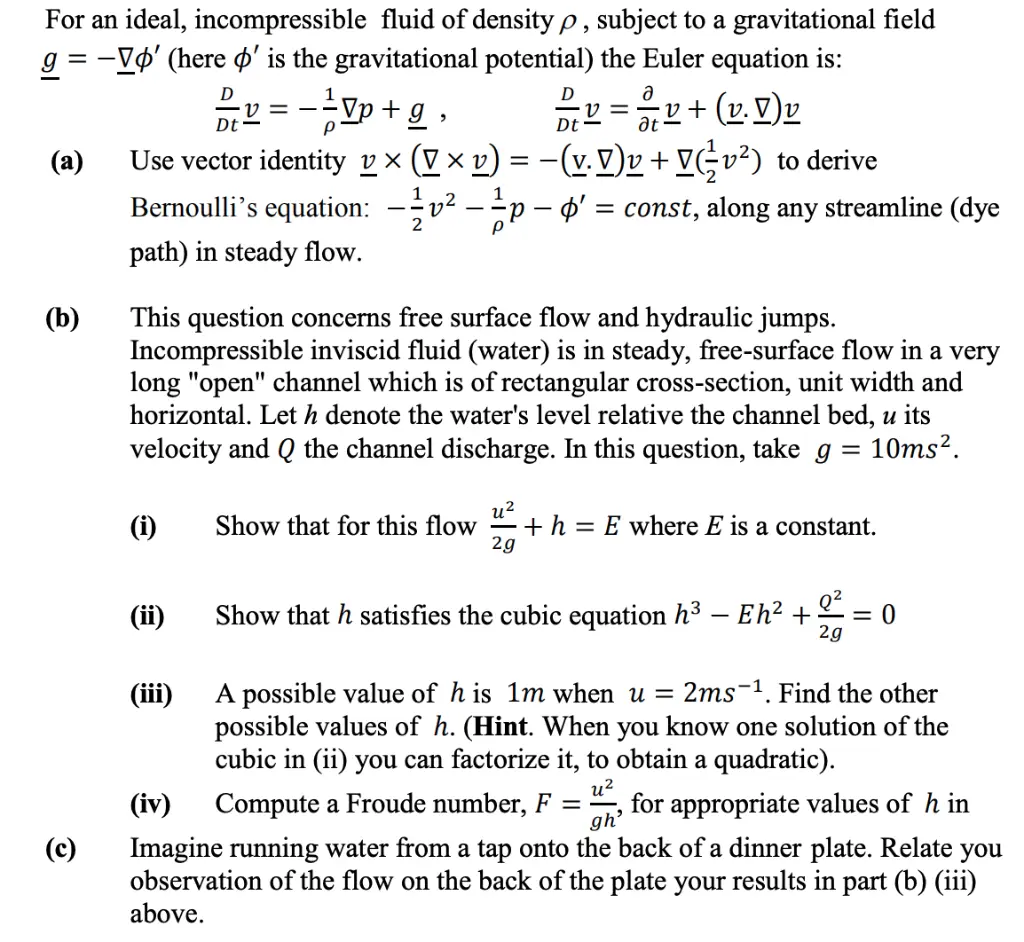
Transcribed Image Text:
For an ideal, incompressible fluid of density p, subject to a gravitational field
g = −√ø' (here p' is the gravitational potential) the Euler equation is:
(a)
(b)
Ꭰ
Dv = − 1 Vp +g,
Ꭰ
Dt
at
Dv=v + (v. v)v
Use vector identity v × (V × v) = −(v. V)v + V(±²²) to derive
Bernoulli's equation: -½v² — — —½— p − 0' =
path) in steady flow.
-
= const, along any streamline (dye
This question concerns free surface flow and hydraulic jumps.
Incompressible inviscid fluid (water) is in steady, free-surface flow in a very
long "open" channel which is of rectangular cross-section, unit width and
horizontal. Let h denote the water's level relative the channel bed, u its
velocity and Q the channel discharge. In this question, take g =
10ms².
(i)
Show that for this flow
u2
2g
+hE where E is a constant.
(ii)
Show that h satisfies the cubic equation h³ - Eh² +
02
= 0
2g
(iii)
(c)
(iv)
A possible value of his 1m when u = 2ms 1. Find the other
possible values of h. (Hint. When you know one solution of the
cubic in (ii) you can factorize it, to obtain a quadratic).
u²
Compute a Froude number, F = for appropriate values of h in
gh'
Imagine running water from a tap onto the back of a dinner plate. Relate you
observation of the flow on the back of the plate your results in part (b) (iii)
above.
check_circle الجواب — حل مفصل خطوة بخطوة
hourglass_top
🔒
الحل الكامل متاح للمشتركين
اشترك في أرشيف الأسئلة لعرض هذا الحل وآلاف الحلول المفصلة خطوة بخطوة من معلمين معتمدين.