تم الحل ✓
categoryهندسة كهربائية
schoolبكالوريوس
event_available2026-07-15
السؤال
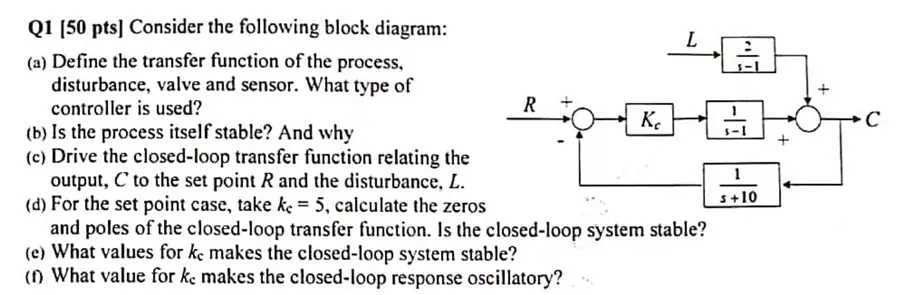
Transcribed Image Text:
Q1 [50 pts] Consider the following block diagram:
(a) Define the transfer function of the process,
disturbance, valve and sensor. What type of
controller is used?
(b) Is the process itself stable? And why
(c) Drive the closed-loop transfer function relating the
output, C to the set point R and the disturbance, L.
(d) For the set point case, take ke = 5, calculate the zeros
R
+
K
Re
L
and poles of the closed-loop transfer function. Is the closed-loop system stable?
(e) What values for ke makes the closed-loop system stable?
(f) What value for ke makes the closed-loop response oscillatory?
s+10
C
91.01
91. C
AC
Q2 [50pt] Consider the mixer shown in figure where two
streams with different flow rate and concetrations are
blnded isothermaly without reaction. It desired to control the
outlet concentration by manipulating 42. PI controller will
be used. The exit concentration is measured by a sensor that
has fast dynamics and emits a signal between 4 and 16 mA
when the concentration is between 2-14 lbmole/ft³. The
penumatic control valve has a negligible dynamic and
receive a signal between 12 and 7 psi to allow for flow rate between 10 and 20 ft³/min. The
process model is given as follows:
AT
93.0
V
dc3(t)
dt
91(t)c₁ +92(t)c₂-93c3(t)
Consider feed concentration to be constant
[a] Develop the transfer function for each control compoenent and substiute numerical values
[b] Draw a block diagram for the composition control system.
[c] Explain why q2 is beter to use as MV than qi.
[d] What are the disturbances
[e] Drive the closed-loop transfer fucntion for set point only. What os the order of the closed-
loop system
[f] What is the value of the overall static gain? Is is bigger than the porcess static gain?
[g] During set point change of 1, c3 showed an overshoot of 23%, what Is the corresponding
value of ke if t₁ = 0.1.
Data: at steady state: V-15 ft³, q=10 ft³/min, q=15 ft³/min. q3=25 ft/min. c₁ = 2 lbmole/ft³,
C2-7 lbmole/ft³, c3-5 lbmole/ft³.
T= period of oscilation =
2πτ
1-32
OS = exp(-
-πζ
11-32°
check_circle الجواب — حل مفصل خطوة بخطوة
hourglass_top
🔒
الحل الكامل متاح للمشتركين
اشترك في أرشيف الأسئلة لعرض هذا الحل وآلاف الحلول المفصلة خطوة بخطوة من معلمين معتمدين.