تم الحل ✓
categoryكيمياء
schoolبكالوريوس
event_available2026-07-13
السؤال
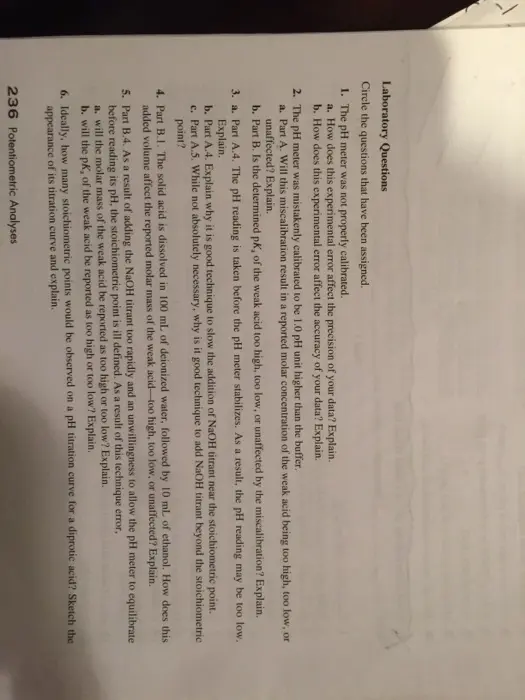
Transcribed Image Text:
Laboratory Questions
Circle the questions that have been assigned.
1. The pH meter was not properly calibrated.
a. How does this experimental error affect the precision of your data? Explain.
b. How does this experimental error affect the accuracy of your data? Explain.
2. The pH meter was mistakenly calibrated to be 1.0 pH unit higher than the buffer.
a. Part A. Will this miscalibration result in a reported molar concentration of the weak acid being too high, too low, or
unaffected? Explain.
b. Part B. Is the determined pK, of the weak acid too high, too low, or unaffected by the miscalibration? Explain.
3. a. Part A.4. The pH reading is taken before the pH meter stabilizes. As a result, the pH reading may be too low.
Explain.
b. Part A.4. Explain why it is good technique to slow the addition of NaOH titrant near the stoichiometric point.
c. Part A.5. While not absolutely necessary, why is it good technique to add NaOH titrant beyond the stoichiometric
point?
4. Part B.1. The solid acid is dissolved in 100 mL of deionized water, followed by 10 mL of ethanol. How does this
added volume affect the reported molar mass of the weak acid-too high, too low, or unaffected? Explain.
5. Part B.4. As a result of adding the NaOH titrant too rapidly and an unwillingness to allow the pH meter to equilibrate
before reading its pH, the stoichiometric point is ill defined. As a result of this technique error,
a. will the molar mass of the weak acid be reported as too high or too low? Explain.
b. will the pK, of the weak acid be reported as too high or too low? Explain.
6. Ideally, how many stoichiometric points would be observed on a pH titration curve for a diprotic acid? Sketch the
appearance of its titration curve and explain.
236 Potentiometric Analyses
check_circle الجواب — حل مفصل خطوة بخطوة
hourglass_top
🔒
الحل الكامل متاح للمشتركين
اشترك في أرشيف الأسئلة لعرض هذا الحل وآلاف الحلول المفصلة خطوة بخطوة من معلمين معتمدين.