تم الحل ✓
categoryهندسة كيميائية
schoolبكالوريوس
event_available2026-07-15
السؤال
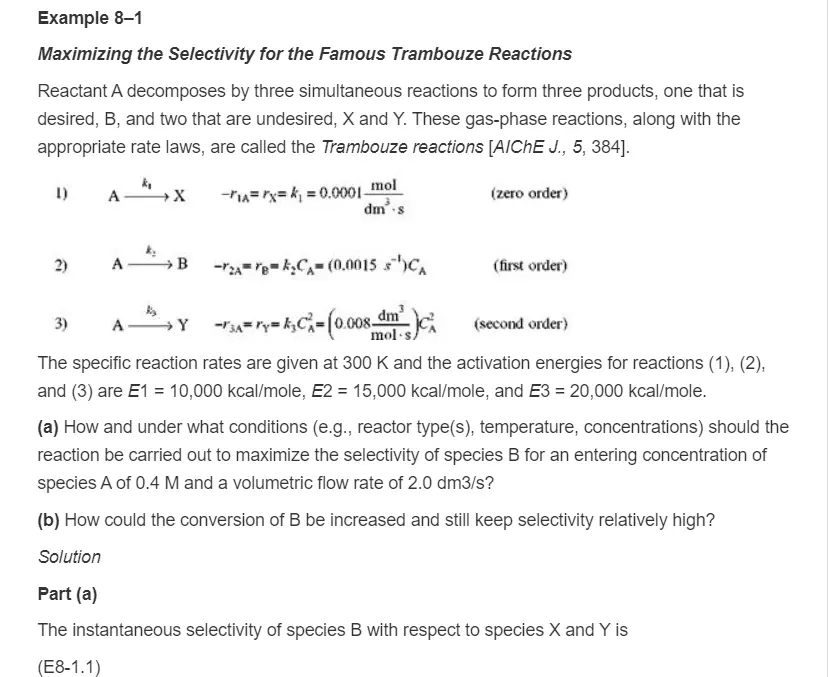
Transcribed Image Text:
Example 8-1
Maximizing the Selectivity for the Famous Trambouze Reactions
Reactant A decomposes by three simultaneous reactions to form three products, one that is
desired, B, and two that are undesired, X and Y. These gas-phase reactions, along with the
appropriate rate laws, are called the Trambouze reactions [AIChE J., 5, 384].
1)
A
-A=x=k₁ = 0.0001-
mol
dm-s
(zero order)
2)
A
B
-AB-C (0.0015 C
(first order)
dm³
mol
(second order)
3)
AY -==₂-(0.008 dms)
The specific reaction rates are given at 300 K and the activation energies for reactions (1), (2),
and (3) are E1 = 10,000 kcal/mole, E2 = 15,000 kcal/mole, and E3 = 20,000 kcal/mole.
(a) How and under what conditions (e.g., reactor type(s), temperature, concentrations) should the
reaction be carried out to maximize the selectivity of species B for an entering concentration of
species A of 0.4 M and a volumetric flow rate of 2.0 dm3/s?
(b) How could the conversion of B be increased and still keep selectivity relatively high?
Solution
Part (a)
The instantaneous selectivity of species B with respect to species X and Y is
(E8-1.1)
(E8-1.1)
Sexy=
B
KCA
=>
rx+ry k₁+kC
Plotting SB/XY vs. CA, we see that there is a maximum, as shown in Figure E8-1.1.
Figure E8-1.1 Selectivity as a function of the concentration of A.
Saxy 10
7.68
6.72
5.00
504
420
Saxy
252
Selectivity: Trambouze Reactions
1.08
084
000
000 00 00 01 020 025 03 ex ox
Ca
As we can see, the selectivity reaches a maximum at a concentration C, we differentiate C.
That is,
(E8-1.2)
dSp/xy,
dCA
[k₁+kC-₂C[2kCA]
[k₁+k]²
Solving for
(E8-1.3)
0.0001( mol/dm-s),
0.112 mol/dm³
0.008 (dm³/mol-s)
(a) Example 8-1. (1) What are CA, Cx, and Cy at CA? (2) What would have been the selectivity
SB/XY and conversion, X, if the reaction had been carried out in a single PFR with the same
volume as the CSTR? (3) How would your answers change if the pressure were increased by a
factor of 100?
(b) Example 8-2. Make a table/list for each reactor shown in Figure 8-2, identifying all the types
of reactions that would be best carried out in this reactor. For example, Figure 8-2(d) Semibatch:
used for (1) highly exothermic reactions and (2) increase selectivity.
(c) Example 8-3. How would topt change if k1 = k2 = 0.25/h at 300 K?
(d) Example 8-4. (1) What are SB/C and YB? What CSTR operating temperature (with T = 0.5s)
would you recommend to maximize B for CAO = 5 mol/dm3, k1 = 0.4 s-1 and k2 = 0.01 s-1 with
E1 = 10 kcal/mol and E2 = 20 kcal/mol ? [Hint: Plot CB versus T.]
A+2BC with the equilibrium constant KC = 0.002 (dm3/mol)2.
check_circle الجواب — حل مفصل خطوة بخطوة
hourglass_top
🔒
الحل الكامل متاح للمشتركين
اشترك في أرشيف الأسئلة لعرض هذا الحل وآلاف الحلول المفصلة خطوة بخطوة من معلمين معتمدين.