تم الحل ✓
categoryالفيزياء
schoolبكالوريوس
event_available2026-07-15
السؤال
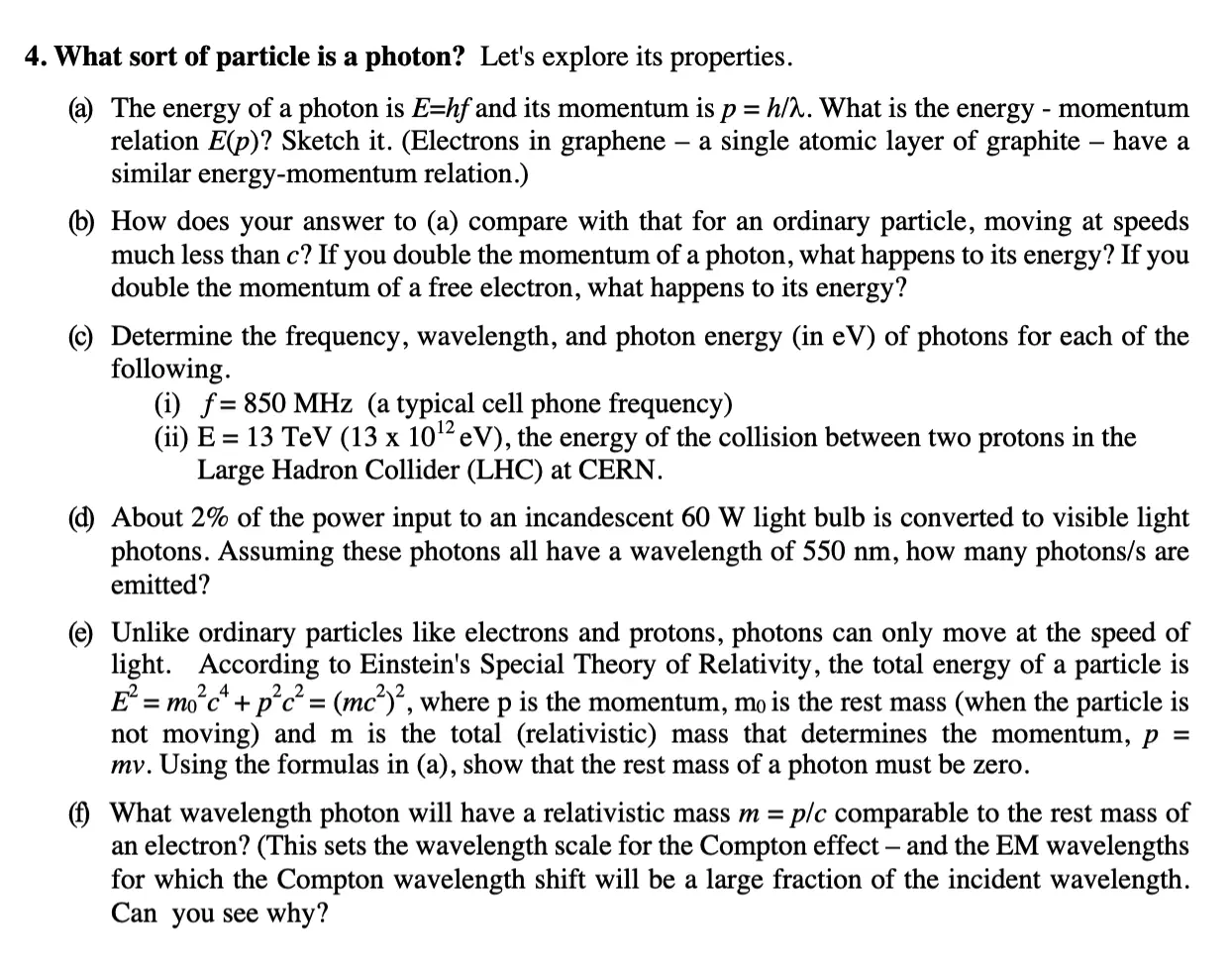
Transcribed Image Text:
4. What sort of particle is a photon? Let's explore its properties.
(a) The energy of a photon is E=hf and its momentum is p = h/λ. What is the energy - momentum
relation E(p)? Sketch it. (Electrons in graphene - a single atomic layer of graphite – have a
similar energy-momentum relation.)
(b) How does your answer to (a) compare with that for an ordinary particle, moving at speeds
much less than c? If you double the momentum of a photon, what happens to its energy? If you
double the momentum of a free electron, what happens to its energy?
(c) Determine the frequency, wavelength, and photon energy (in eV) of photons for each of the
following.
(i) f = 850 MHz (a typical cell phone frequency)
(ii) E 13 TeV (13 x 10¹² eV), the energy of the collision between two protons in the
Large Hadron Collider (LHC) at CERN.
(d) About 2% of the power input to an incandescent 60 W light bulb is converted to visible light
photons. Assuming these photons all have a wavelength of 550 nm, how many photons/s are
emitted?
(e) Unlike ordinary particles like electrons and protons, photons can only move at the speed of
light. According to Einstein's Special Theory of Relativity, the total energy of a particle is
E² = mo²c² + p²c² = (mc²)², where p is the momentum, mo is the rest mass (when the particle is
not moving) and m is the total (relativistic) mass that determines the momentum, p =
mv. Using the formulas in (a), show that the rest mass of a photon must be zero.
(f) What wavelength photon will have a relativistic mass m = p/c comparable to the rest mass of
an electron? (This sets the wavelength scale for the Compton effect - and the EM wavelengths
for which the Compton wavelength shift will be a large fraction of the incident wavelength.
Can you see why?
check_circle الجواب — حل مفصل خطوة بخطوة
hourglass_top
🔒
الحل الكامل متاح للمشتركين
اشترك في أرشيف الأسئلة لعرض هذا الحل وآلاف الحلول المفصلة خطوة بخطوة من معلمين معتمدين.