تم الحل ✓
categoryكيمياء
schoolبكالوريوس
event_available2026-07-13
السؤال
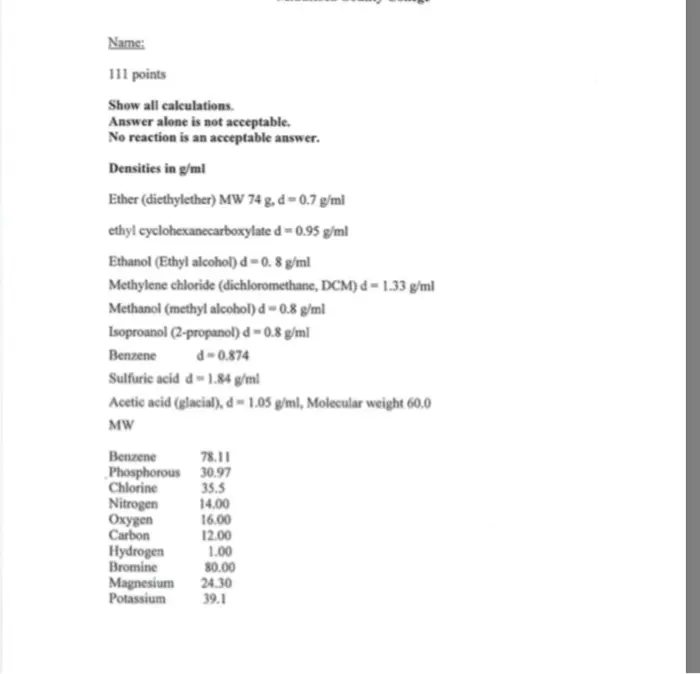
Transcribed Image Text:
Name:
111 points
Show all calculations.
Answer alone is not acceptable.
No reaction is an acceptable answer.
Densities in g/ml
Ether (diethylether) MW 74 g. d=0.7 g/ml
ethyl cyclohexanecarboxylated= 0.95 g/ml
Ethanol (Ethyl alcohol) d=0.8 g/ml
Methylene chloride (dichloromethane, DCM) d-1.33 g/ml
Methanol (methyl alcohol) d=0.8 g/ml
Isoproanol (2-propanol) d=0.8 g/ml
Benzene
d-0.874
Sulfuric acid d-1.84 g/ml
Acetic acid (glacial), d-1.05 g/ml, Molecular weight 60.0
MW
Benzene
78.11
Phosphorous 30.97
Chlorine
35.5
Nitrogen
14.00
Oxygen
16.00
Carbon
12.00
Hydrogen
1.00
Bromine
80.00
Magnesium 24.30
Potassium
39.1
"Novel carboxamide derivatives as HIV inhibitors and their preparation and use in the
treatment of viral mediated diseases."
Reddy, Bandi Parthasaradhi; Krishna, Bandi Vamsi; Sharma, Vedula Manohar; Reddy,
Kura Rathnakar, Reddy, Musku Madhanmohan; Subrahmanyam, Lanka V. L.; Kumar,
Mamnoor Prem. (Hetero Research Foundation, India).
WO 2011061590 (US designated) Filed November 10, 2010 and Published May 26, 2011
The synthesis of ethyl cyclohexanecarboxylate was published in the world application
above.
CH,CH₂OH
.
ethanol
.
H₂O
cyclohexanecarboxylic acid (ethyl alcohol)
ethyl cyclohexanecarboxylate
To cyclohexanecarboxylic acid (10 grams) in ethanol (150 ml), sulfuric acid (8.64 ml)
was added and the reaction refluxed for 6 hours at about 80° C. Upon completion of the
reaction (monitored by TLC), ethanol was evaporated under reduced pressure.
The residue was washed with water, and then neutralized with saturated sodium
bicarbonate. The organic residue was extracted with dichloromethane (DCM) and dried
over sodium sulfate and concentrated under reduced pressure. The resulting residue was
purified by silica gel chromatography using 5% ethyl acetate in hexane as the eluent to
furnish the title compound (12 g) as a light yellow liquid. The proton NMR and mass
spec are consistent for the product.
1. What is the molecular formulae & molecular weight
of cyclohexane carboxylic acid? How many moles of
cyclohexane carboxylic acid were used?
2. What is the molecular formulae & molecular weight
of ethanol? How many moles & grams of ethanol
were used during this reaction?
3. After the removal of ethanol under reduced pressure,
the residue was washed with water. Why was that
done?
4. After the water wash, the residue was neutralized with
sodium bicarbonate. What was being neutralized? Be
specific.
5. What is the formula for sodium bicarbonate? After the
neutralization with sodium bicarbonate, the organic
residue was extracted with dichloromethane (DCM).
In which layer is the product? Top or Bottom? Explain
your reasoning.
6. Why was the organic layer dried over sodium sulfate
used? Did a chemical reaction occur? If so, draw the
chemical reaction. Be specific.
7. If sodium sulfate were not available, would
magnesium sulfate be an acceptable substitute? Why
or why not? What is the molecular formula for sodium
sulfate?
8. What is the molecular weight of the product ethyl
cyclohexanecarboxylate? What is the theoretical yield
of ethyl cyclohexanecarboxylate? What is the
theoretical yield in moles for ethyl
cyclohexanecarboxylate? What is the theoretical yield
in grams for ethyl cyclohexanecarboxylate?
9. The reported yield for this reaction is 12 grams. Find
its actual yield in moles. Find the actual percent yield.
Give the name of the type of reaction this is.
check_circle الجواب — حل مفصل خطوة بخطوة
hourglass_top
🔒
الحل الكامل متاح للمشتركين
اشترك في أرشيف الأسئلة لعرض هذا الحل وآلاف الحلول المفصلة خطوة بخطوة من معلمين معتمدين.