تم الحل ✓
categoryالفيزياء
schoolبكالوريوس
event_available2026-07-15
السؤال
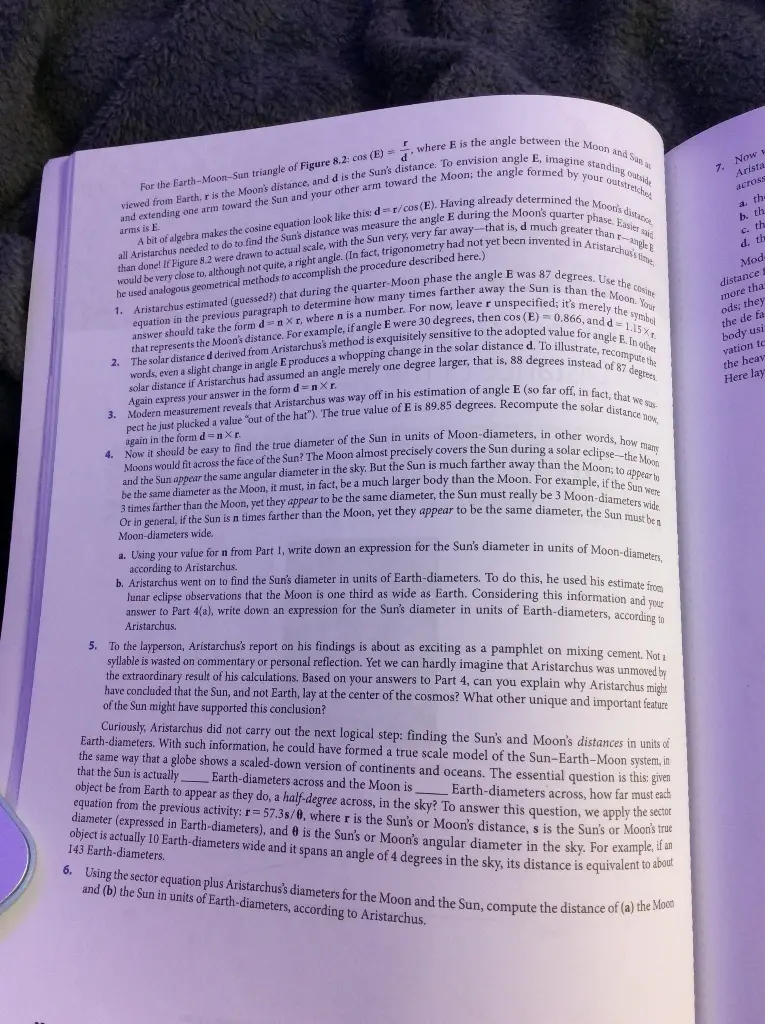
Transcribed Image Text:
arms is E.
For the Earth-Moon-Sun triangle of Figure 8.2: cos (E), where E is the angle between the Moon and Sun a
viewed from Earth, r is the Moon's distance, and d is the Sun's distance. To envision angle E, imagine standing outside
and extending one arm toward the Sun and your other arm toward the Moon; the angle formed by your outstretched
A bit of algebra makes the cosine equation look like this: dr/cos (E). Having already determined the Moon's distance
all Aristarchus needed to do to find the Sun's distance was measure the angle E during the Moon's quarter phase. Easier said
than done! If Figure 8.2 were drawn to actual scale, with the Sun very, very far away-that is, d much greater than r-angle E
would be very close to, although not quite, a right angle. (In fact, trigonometry had not yet been invented in Aristarchus's time,
1. Aristarchus estimated (guessed?) that during the quarter-Moon phase the angle E was 87 degrees. Use the cosine
equation in the previous paragraph to determine how many times farther away the Sun is than the Moon. Your
answer should take the form dnxr, where n is a number. For now, leave r unspecified; it's merely the symbol
2. The solar distance d derived from Aristarchus's method is exquisitely sensitive to the adopted value for angle E. In other
that represents the Moon's distance. For example, if angle E were 30 degrees, then cos (E) 0.866, and d=1.15X
solar distance if Aristarchus had assumed an angle merely one degree larger, that is, 88 degrees instead of 87 degrees
words, even a slight change in angle E produces a whopping change in the solar distance d. To illustrate, recompute the
3. Modern measurement reveals that Aristarchus was way off in his estimation of angle E (so far off, in fact, that we sus
pect he just plucked a value "out of the hat"). The true value of E is 89.85 degrees. Recompute the solar distance now,
4. Now it should be easy to find the true diameter of the Sun in units of Moon-diameters, in other words, how many
and the Sun appear the same angular diameter in the sky. But the Sun is much farther away than the Moon; to appear to
Moons would fit across the face of the Sun? The Moon almost precisely covers the Sun during a solar eclipse-the Moon
be the same diameter as the Moon, it must, in fact, be a much larger body than the Moon. For example, if the Sun were
Or in general, if the Sun is n times farther than the Moon, yet they appear to be the same diameter, the Sun must be a
3 times farther than the Moon, yet they appear to be the same diameter, the Sun must really be 3 Moon-diameters wide.
he used analogous geometrical methods to accomplish the procedure described here.)
Again express your answer in the form d=nXr.
again in the form d=nxr.
Moon-diameters wide.
according to Aristarchus.
a. Using your value for n from Part 1, write down an expression for the Sun's diameter in units of Moon-diameters,
b. Aristarchus went on to find the Sun's diameter in units of Earth-diameters. To do this, he used his estimate from
lunar eclipse observations that the Moon is one third as wide as Earth. Considering this information and
answer to Part 4(a), write down an expression for the Sun's diameter in units of Earth-diameters, according to
Aristarchus.
your
5. To the layperson, Aristarchus's report on his findings is about as exciting as a pamphlet on mixing cement. Not a
syllable is wasted on commentary or personal reflection. Yet we can hardly imagine that Aristarchus was unmoved by
the extraordinary result of his calculations. Based on your answers to Part 4, can you explain why Aristarchus might
have concluded that the Sun, and not Earth, lay at the center of the cosmos? What other unique and important feature
of the Sun might have supported this conclusion?
Curiously, Aristarchus did not carry out the next logical step: finding the Sun's and Moon's distances in units of
Earth-diameters. With such information, he could have formed a true scale model of the Sun-Earth-Moon system, in
the same way that a globe shows a scaled-down version of continents and oceans. The essential question is this: given
that the Sun is actually.
Earth-diameters across and the Moon is
object be from Earth to appear as they do, a half-degree across, in the sky? To answer this question, we apply the sector
Earth-diameters across, how far must each
equation from the previous activity: r=57.3s/0, where r is the Sun's or Moon's distance, s is the Sun's or Moon's true
diameter (expressed in Earth-diameters), and 0 is the Sun's or Moon's angular diameter in the sky. For example, if an
object is actually 10 Earth-diameters wide and it spans an angle of 4 degrees in the sky, its distance is equivalent to about
143 Earth-diameters.
6. Using the sector equation plus Aristarchus's diameters for the Moon and the Sun, compute the distance of (a) the Moon
and (b) the Sun in units of Earth-diameters, according to Aristarchus.
7. Now y
Arista
across
a. th
b. th
c. th
d. th
Mod
distance
more tha
ods; they
the de fa
body usi
vation to
the heav
Here lay
7. Now we're ready to construct the scale model of the Sun-Earth-Moon system, as it might have been envisioned by
Aristarchus more than 2000 years ago. Suppose Earth is represented by a ping-pong ball, which is approximately 1 inch
across. Using your answers to Parts 4 and 6, determine to scale the following measurements:
2.
the diameter (in inches) of a ball representing the Moon
b. the distance (in feet) of that Moon ball from the center of the ping-pong ball "Earth"
c. the diameter (in inches) of a ball representing the Sun
Modern measurements reveal that Aristarchus was not too far off in his determination of the Moon's diameter and
d. the distance (in feet) of that Sun ball from the center of the ping-pong ball "Earth"
distance from Earth. However, he erred significantly in his estimates of the Sun's diameter and distance: the Sun is actually
ods; they were just impossible to carry out reliably in his day. Nevertheless, Aristarchus's erroneous solar distance became
more than 100 Earth-diameters across and 11,000 Earth-diameters distant. There's nothing wrong with Aristarchus's meth-
body using observational data gathered from Earth. In bold strokes, Aristarchus had combined geometry, logic, and obser-
the de facto standard into the Middle Ages. For the first time, someone had calculated the size and distance of a celestial
vation to effectively free himself of his earthly bonds and to show astronomers that it was possible to "lay down a ruler" in
the heavens. He had subjected a small portion of the universe to the most basic kind of scientific scrutiny: measurement.
Here lay the genesis of modern astronomy.
check_circle الجواب — حل مفصل خطوة بخطوة
hourglass_top
🔒
الحل الكامل متاح للمشتركين
اشترك في أرشيف الأسئلة لعرض هذا الحل وآلاف الحلول المفصلة خطوة بخطوة من معلمين معتمدين.