تم الحل ✓
categoryالرياضيات
schoolبكالوريوس
event_available2026-07-15
السؤال
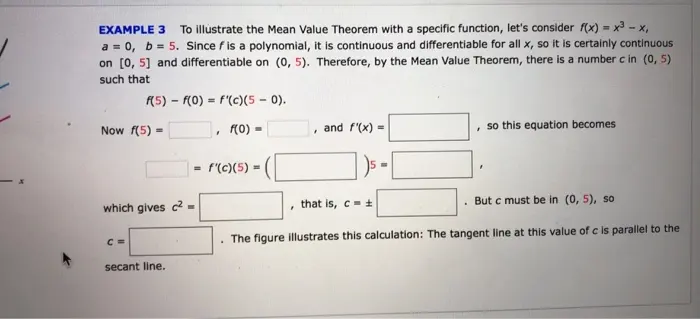
Transcribed Image Text:
EXAMPLE 3 To illustrate the Mean Value Theorem with a specific function, let's consider f(x) = x³-x,
a=0, b 5. Since f is a polynomial, it is continuous and differentiable for all x, so it is certainly continuous
on [0, 5] and differentiable on (0, 5). Therefore, by the Mean Value Theorem, there is a number c in (0,5)
such that
=
f(5) f(0) f'(c)(5-0).
-
Now f(5) =
'
f(0) -
and f'(x)
=
'
so this equation becomes
=
f'(c)(5)=
which gives c²=
C=
that is, c±
But c must be in (0, 5), so
The figure illustrates this calculation: The tangent line at this value of c is parallel to the
secant line.
EXAMPLE 5 Suppose that f(0) -8 and f'(x) S9 for all values of x. How large can (5) possibly be?
SOLUTION
We are given that f is differentiable (and therefore continuous) everywhere. In particular, we can
apply the Mean Value Theorem on the interval [0, 5]. There exists a number c such that
f(5) - f(0) = f(c)(
-
So
f(5) = f(0) +
f'(c) = -8 +
f'(c).
We are given that f'(x) s 9 for all x, so in particular we know that f'(c) s
this inequality by 5, we have
(5)=-8+
5f'(c) s
f(c) s-8+
The largest possible value for f(5) is
So
Multiplying both sides of
check_circle الجواب — حل مفصل خطوة بخطوة
hourglass_top
🔒
الحل الكامل متاح للمشتركين
اشترك في أرشيف الأسئلة لعرض هذا الحل وآلاف الحلول المفصلة خطوة بخطوة من معلمين معتمدين.