تم الحل ✓
categoryهندسة كهربائية
schoolبكالوريوس
event_available2026-07-15
السؤال
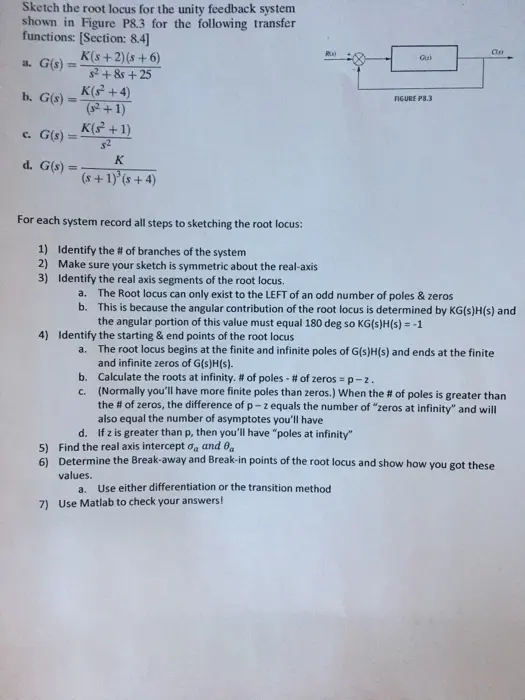
Transcribed Image Text:
Sketch the root locus for the unity feedback system
shown in Figure P8.3 for the following transfer
functions: [Section: 8.4]
K(s+2)(s+6)
a. G(s)=
$2+85+25
K(+4)
b. G(s)=
(32+1)
c. G(s)=-
K(+1)
$2
d. G(s)=
Gi
FIGURE P8.3
K
(s+1)(s+4)
For each system record all steps to sketching the root locus:
1) Identify the # of branches of the system
2) Make sure your sketch is symmetric about the real-axis
3) Identify the real axis segments of the root locus.
a. The Root locus can only exist to the LEFT of an odd number of poles & zeros
b. This is because the angular contribution of the root locus is determined by KG(s)H(s) and
the angular portion of this value must equal 180 deg so KG(s)H(s) = -1
4) Identify the starting & end points of the root locus
a. The root locus begins at the finite and infinite poles of G(s)H(s) and ends at the finite
and infinite zeros of G(s)H(s).
b. Calculate the roots at infinity. # of poles - # of zeros p-z.
c. (Normally you'll have more finite poles than zeros.) When the # of poles is greater than
the # of zeros, the difference of p-z equals the number of "zeros at infinity" and will
also equal the number of asymptotes you'll have
d.
If z is greater than p, then you'll have "poles at infinity"
5) Find the real axis intercept σa and Ba
6) Determine the Break-away and Break-in points of the root locus and show how you got these
values.
a. Use either differentiation or the transition method
7) Use Matlab to check your answers!
check_circle الجواب — حل مفصل خطوة بخطوة
hourglass_top
🔒
الحل الكامل متاح للمشتركين
اشترك في أرشيف الأسئلة لعرض هذا الحل وآلاف الحلول المفصلة خطوة بخطوة من معلمين معتمدين.