تم الحل ✓
categoryطب وبائيات وصحة عامة
schoolبكالوريوس
event_available2026-07-15
السؤال
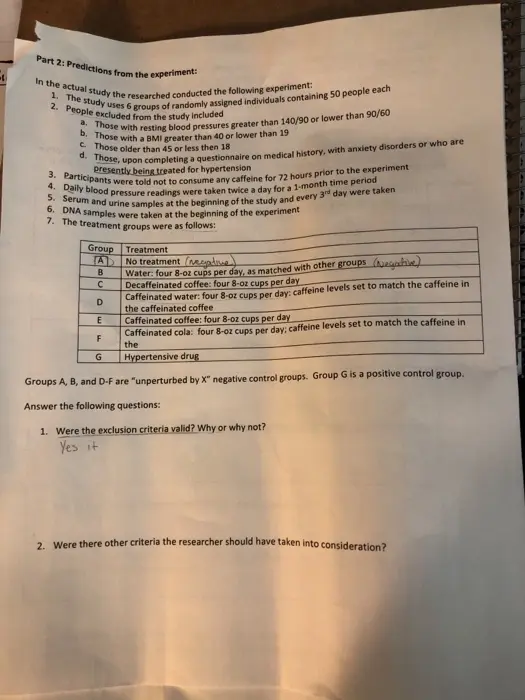
Transcribed Image Text:
Part 2: Predictions from the experiment:
In the actual study the researched conducted the following experiment:
1. The study uses 6 groups of randomly assigned individuals containing 50 people each
2. People excluded from the study included
a. Those with resting blood pressures greater than 140/90 or lower than 90/60
b. Those with a BMI greater than 40 or lower than 19
Those older than 45 or less then 18
d. Those, upon completing a questionnaire on medical history, with anxiety disorders or who are
presently being treated for hypertension
3. Participants were told not to consume any caffeine for 72 hours prior to the experiment
4. Daily blood pressure readings were taken twice a day for a 1-month time period
5. Serum and urine samples at the beginning of the study and every 3rd day were taken
6. DNA samples were taken at the beginning of the experiment
7. The treatment groups were as follows:
Group
A
B
C
D
E
F
G
Treatment
No treatment (negative)
Water: four 8-oz cups per day, as matched with other groups (native)
Decaffeinated coffee: four 8-oz cups per day
Caffeinated water: four 8-oz cups per day: caffeine levels set to match the caffeine in
the caffeinated coffee
Caffeinated coffee: four 8-oz cups per day
Caffeinated cola: four 8-oz cups per day; caffeine levels set to match the caffeine in
the
Hypertensive drug
Groups A, B, and D-F are "unperturbed by X" negative control groups. Group G is a positive control group.
Answer the following questions:
1. Were the exclusion criteria valid? Why or why not?
Yes it
2. Were there other criteria the researcher should have taken into consideration?
3. A placebo effect may play a role in the results of this study. But, thanks to the negative control groups,
this placebo effect is controlled for. Which negative control group acts as a placebo control for
another group (negative control or experimental group)?
4. In summary, what is the purpose of each of the groups? That is, how, except for the caffeinated coffee
group, does it help limit any threats towards internal validity (i.e. control for the experiment)? Fill in
the table below.
Group Each of the groups (except the caffeinated coffee group) establishes an "unperturbed
by X" negative control. What is the explanation of the "X" for each group?
A
B
C
D
w
E
F
G
Let's say the experimenter got the following results:
Decaffeinated coffee
Caffeinated coffee
Caffeinated water
Water
Caffeinated cola
Nothing
Hypertensive drug
10% increase in blood pressure
30% increase in blood pressure
10% increase in blood pressure
5% increase in blood pressure
10% increase in blood pressure
0% increase in blood pressure.
30% increase in blood pressure
5. Did the results show that caffeine increases blood pressure? Which of the groups did you use to draw
this conclusion?
6. Did the results show that something other than caffeine in the coffee increases blood pressure?
Which of the groups did you use to draw this conclusion?
7. Did the "no treatment" (water only) show that there is a "real" water effect or was the increase due to
something like anxiety from the experimental conditions? Which of the groups did you use to draw
this conclusion?
8. If the hypertensive drug group had only a 5% increase in blood pressure, would your conclusions about
this study change?
9. Why didn't the experimenter use a caffeine pill as a positive control?
10. Urine and serum samples were collected during this study. How could they help as a positive control
for the outcome of the experiment?
As you can see from this study, having multiple "unperturbed by X" controls and a positive control allows the
scientist to dissect out multiple variables that could be contributing to the observed outcome.
check_circle الجواب — حل مفصل خطوة بخطوة
hourglass_top
🔒
الحل الكامل متاح للمشتركين
اشترك في أرشيف الأسئلة لعرض هذا الحل وآلاف الحلول المفصلة خطوة بخطوة من معلمين معتمدين.