تم الحل ✓
categoryالكيمياء
schoolبكالوريوس
event_available2026-07-15
السؤال
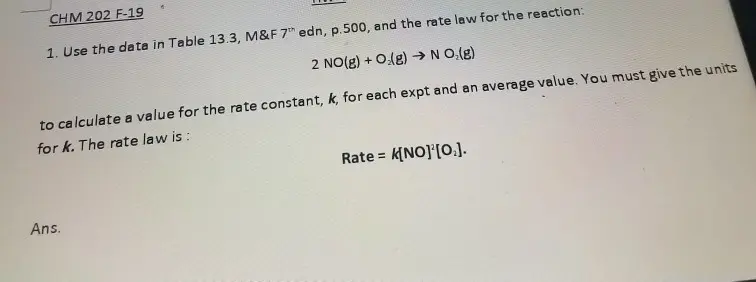
Transcribed Image Text:
CHM 202 F-19
1. Use the data in Table 13.3, M&F 7th edn, p.500, and the rate law for the reaction:
2 NO(g) + O(g) → NO(g)
to calculate a value for the rate constant, k, for each expt and an average value. You must give the units
for k. The rate law is:
Rate [NO][O₂].
Ans.
2. NO ONO
to calculate a value for the mte constant, k. for each ex pt and an average value. You must give the units
for A The rate law
Ans.
2. On what factor ick dependent?
Ans.
Rate Ol
13.3 METHOD OF INITIAL RATES: EXPERIMENTA
DETERMINATION OF A RATE LAW
One method of determining the values of the exponents in a rate low-the mak
rates-is to carry out a series of experiments in which the initial rate of way
as a function of different sets of initial concentrations. Take, for example, he us
nitric oxide in air, one of the reactions that contributes to the formation of wh F
-
250/2)
2 NO(g) + O(z)
Some initial rate data are collected in TABLE 13.3
TABLE 13.3 Initial Concentration and Rate Date for the are
2 NO(g) + O(g)
2 NO(g)
Experiment
Initial [NO]
Initial (O₂)
(4/9)
Initial Reaction
0.015
0.015
0.026
1
0.030
0.015
0096
2
0.015
0.030
0.048
3
0.030
0.030
0.192
4
Note that pairs of experiments are designed to investigate the change in initiate
occurs when the initial concentration of a single reactant is changed. In the fira says
ments, for example, the concentration of NO is doubled from 0.015 M to 0.039 M velet
concentration of O, is held constant. The initial rate increases by a factor of 4, from 9
to 0.096 M/s, indicating that the rate depends on the concentration of NO squa
When [NO] is held constant and [02] is doubled (experiments 1 and 3), the initial
bles from 0.024 M/s to 0.048 M/s, indicating that the rate depends on the concent
O, to the first power, [O]'. Therefore, the rate law for the reaction is
Rate
k[NO][O₂]
In accord with this rate law, which is second order in NO, first order in O, and the
overall, the initial rate increases by a factor of 8 when the concentrations of both NO
are doubled (experiments 1 and 4).
The preceding method uses initial rates rather than rates at a later stage of the ma
because chemical reactions are reversible and we want to avoid complications from fe
verse reaction: reactants products. As the product concentrations build up, the rate t
reverse reaction increases and the measured rate is affected by the concentrations of b
reactants and products. At the beginning of the reaction, however, the product co
tions are zero, and therefore the products can't affect the measured rate. When we
an initial rate, we are measuring the rate of only the forward reaction, so only reactam a
catalysts; see Section 13.12) can appear in the rate law.
One step in determining a rate law, as we've just seen, is to establish the react
Another is to evaluate the numerical value of the rate constant k. Each reaction has
characteristic value of the rate constant, which depends on temperature but not a
trations. To evaluate k for the reaction
2 NO(g) + O2(g)
2 NO2(g)
we can use the data from any one of the experiments in Table 13.3. Solving the rate law fir
and substituting the initial rate and concentrations from the first experiment, w
Rate
k
[NO][O]
we obtain
0.024 M/s
(0.015 M)²(0.015 M)
= 7.1 X
10/(M²-s)
within the range of experimental error. Note that the units of k in this example are
Try repeating the calculation for experiments 2-4, and show that you get the same val
read as "one over molar squared
overall order f
Dete
Eape
STRA
T
59
Chemical Kic
13.3 METHOD OF INITIAL RATES: ERIMENTAL
DETERMINATION OF A RATE LA
One method of determining the values of the exponents in e
law-the method of
rate-is to carry out a series of experiments in which the initial site of a reaction is me
as a function of different sets of initial concentrations. Take, example, the e
nitric oxide in air, one of the reactions that contributes to the formation of acid rain
2 NO(g) + O(g)
Some initial rate data are collected in TABLE 13.3.
-
2 NO(g)
TABLE 13.3 Initial Concentration and Rate Data for the Reaction
2 NO(g) + O(g)-2 NO₂(9)
oxidation
Experiment
Initial [NO]
Initial [0,]
(M/s)
Initial Reaction Rate
0.015
0.024
0.015
0.015
0.096
0.030
2
0.030
0.048
3
0.015
0.030
0.192
4
0.030
Note that pairs of experiments are designed to investigate the change in initial rate th
ments, for example, the concentration of NO is doubled from 0.015 M to 0.030 M while the
occurs when the initial concentration of a single reactant is changed. In the first two exper
concentration of O, is held constant. The initial rate increases by a factor of 4, from 0.024 M
When NO is held constant and [O,] is doubled (experiments 1 and 3), the initial rate dou
to 0.096 M/s, indicating that the rate depends on the concentration of NO squared, NO
bles from 0.024 M/s to 0.048 M/s, indicating that the rate depends on the concentration of
O, to the first power, [O]'. Therefore, the rate law for the reaction is
Rate = k[NO][O]
In accord with this rate law, which is second order in NO, first order in O2, and third order
overall, the initial rate increases by a factor of 8 when the concentrations of both NO and 0,
are doubled (experiments 1 and 4).
The preceding method uses initial rates rather than rates at a later stage of the reaction
because chemical reactions are reversible and we want to avoid complications from the re-
verse reaction: reactants products. As the product concentrations build up, the rate of the
reverse reaction increases and the measured rate is affected by the concentrations of both
reactants and products. At the beginning of the reaction, however, the product concentra
tions are zero, and therefore the products can't affect the measured rate. When we measure
an initial rate, we are measuring the rate of only the forward reaction, so only reactants (and
catalysts; see Section 13.12) can appear in the rate law.
One step in determining a rate law, as we've just seen, is to establish the reaction order.
Another is to evaluate the numerical value of the rate constant k. Each reaction has its own
characteristic value of the rate constant, which depends on temperature but not on concen
trations. To evaluate k for the reaction
2 NO(g) + O2(g) 2 NO2(g)
we can use the data from any one of the experiments in Table 13.3. Solving the rate law for k
and substituting the initial rate and concentrations from the first experiment, we obtain
km
Rate
[NO][O]
0.024 M/s
(0.015 M) (0.015 M)
= 7.1 x 10³/(M².s)
within the range of experimental error. Note that the units of k in this example are 1/(Ms)
Try repeating the calculation for experiments 2-4, and show that you get the same value of k
read as "one over molar squared second." The units of k depend on the overall order of the
reaction can
general sed
Units
Rate Law
RateA
Rate A
Rate-A
Rate
K[A
Be carefu
concentratio,
The rate is u
on the overal
Worked
initial rates.
w
Deterr
Initial ra
Initial ra
Exper
(a) V
(b) V
(c)
STR
(a)
Ha
check_circle الجواب — حل مفصل خطوة بخطوة
hourglass_top
🔒
الحل الكامل متاح للمشتركين
اشترك في أرشيف الأسئلة لعرض هذا الحل وآلاف الحلول المفصلة خطوة بخطوة من معلمين معتمدين.