تم الحل ✓
categoryفيزياء
schoolبكالوريوس
event_available2026-07-15
السؤال
Transcribed Image Text:
Problem 1 (10 points):
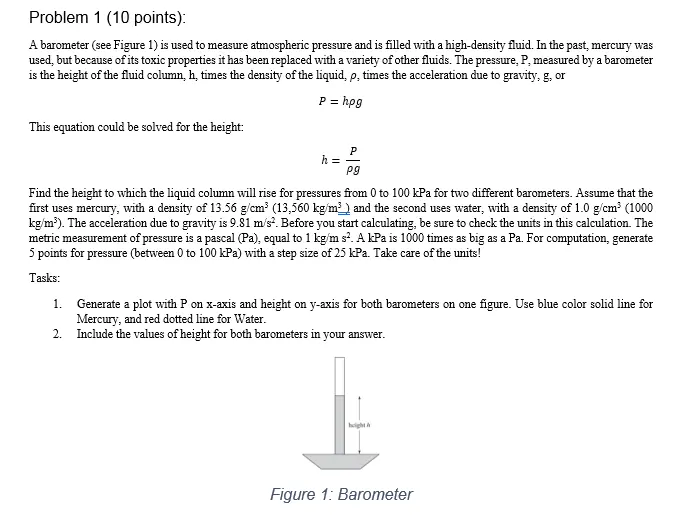
A barometer (see Figure 1) is used to measure atmospheric pressure and is filled with a high-density fluid. In the past, mercury was
used, but because of its toxic properties it has been replaced with a variety of other fluids. The pressure, P, measured by a barometer
is the height of the fluid column, h, times the density of the liquid, p, times the acceleration due to gravity, g, or
This equation could be solved for the height:
P = hpg
h =
P
pg
Find the height to which the liquid column will rise for pressures from 0 to 100 kPa for two different barometers. Assume that the
first uses mercury, with a density of 13.56 g/cm³ (13,560 kg/m³ and the second uses water, with a density of 1.0 g/cm³ (1000
kg/m³). The acceleration due to gravity is 9.81 m/s². Before you start calculating, be sure to check the units in this calculation. The
metric measurement of pressure is a pascal (Pa), equal to 1 kg/m s². A kPa is 1000 times as big as a Pa. For computation, generate
5 points for pressure (between 0 to 100 kPa) with a step size of 25 kPa. Take care of the units!
Tasks:
1. Generate a plot with P on x-axis and height on y-axis for both barometers on one figure. Use blue color solid line for
Mercury, and red dotted line for Water.
2.
Include the values of height for both barometers in your answer.
height h
Figure 1: Barometer
check_circle الجواب — حل مفصل خطوة بخطوة
hourglass_top
🔒
الحل الكامل متاح للمشتركين
اشترك في أرشيف الأسئلة لعرض هذا الحل وآلاف الحلول المفصلة خطوة بخطوة من معلمين معتمدين.