تم الحل ✓
categoryالصيدلة
schoolبكالوريوس
event_available2026-07-15
السؤال
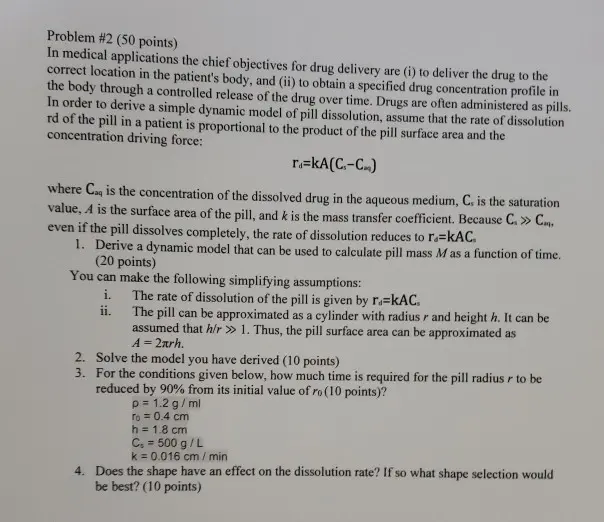
Transcribed Image Text:
Problem #2 (50 points)
In medical applications the chief objectives for drug delivery are (i) to deliver the drug to the
correct location in the patient's body, and (ii) to obtain a specified drug concentration profile in
the body through a controlled release of the drug over time. Drugs are often administered as pills.
In order to derive a simple dynamic model of pill dissolution, assume that the rate of dissolution
rd of the pill in a patient is proportional to the product of the pill surface area and the
concentration driving force:
r₁=KA(C.-C.)
where Ca is the concentration of the dissolved drug in the aqueous medium, C. is the saturation
value, A is the surface area of the pill, and k is the mass transfer coefficient. Because C. >> C.,
even if the pill dissolves completely, the rate of dissolution reduces to r.=KAC.
1. Derive a dynamic model that can be used to calculate pill mass M as a function of time.
(20 points)
You can make the following simplifying assumptions:
i. The rate of dissolution of the pill is given by r.=KAC.
ii.
The pill can be approximated as a cylinder with radius r and height h. It can be
assumed that h/r » 1. Thus, the pill surface area can be approximated as
A = 2xrh.
2. Solve the model you have derived (10 points)
3. For the conditions given below, how much time is required for the pill radius r to be
reduced by 90% from its initial value of ro (10 points)?
p = 1.2 g/ml
To = 0.4 cm
h = 1.8 cm
C. = 500 g/L
k = 0.016 cm/min
4. Does the shape have an effect on the dissolution rate? If so what shape selection would
be best? (10 points)
check_circle الجواب — حل مفصل خطوة بخطوة
hourglass_top
🔒
الحل الكامل متاح للمشتركين
اشترك في أرشيف الأسئلة لعرض هذا الحل وآلاف الحلول المفصلة خطوة بخطوة من معلمين معتمدين.