تم الحل ✓
categoryهندسة مدنية
schoolبكالوريوس
event_available2026-07-15
السؤال
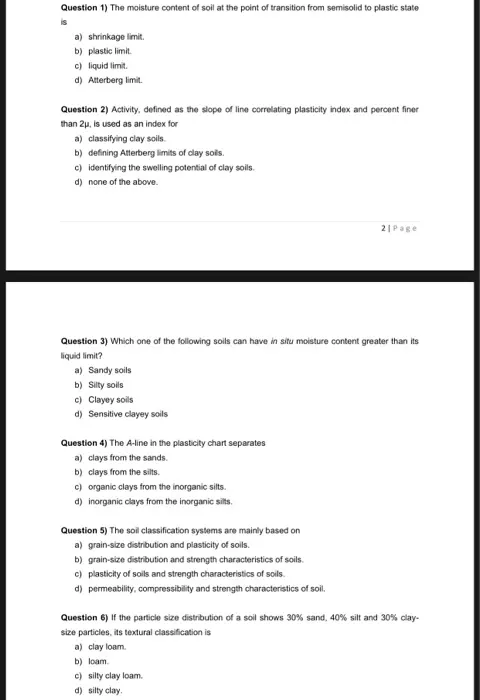
Transcribed Image Text:
Question 1) The moisture content of soil at the point of transition from semisolid to plastic state
is
a) shrinkage limit.
b) plastic limit.
c) liquid limit.
d) Atterberg limit.
Question 2) Activity, defined as the slope of line correlating plasticity index and percent finer
than 2p, is used as an index for
a) classifying clay soils.
b) defining Atterberg limits of clay soils.
c) identifying the swelling potential of clay soils.
d) none of the above.
21 Page
Question 3) Which one of the following soils can have in situ moisture content greater than its
liquid limit?
a) Sandy soils
b) Silty soils
c) Clayey soils
d) Sensitive clayey soils
Question 4) The A-line in the plasticity chart separates
a) clays from the sands.
b) clays from the silts.
c) organic clays from the inorganic silts.
d) inorganic clays from the inorganic silts.
Question 5) The soil classification systems are mainly based on
a) grain-size distribution and plasticity of soils.
b) grain-size distribution and strength characteristics of soils.
c) plasticity of soils and strength characteristics of soils.
d) permeability, compressibility and strength characteristics of soil.
Question 6) If the particle size distribution of a soil shows 30% sand, 40% silt and 30% clay-
size particles, its textural classification is
a) clay loam.
b) loam.
c) silty clay loam.
d) silty clay.
Question 7) In general, the quality of performance of a soil as a subgrade material
a) is directly proportional to the group index.
b) is inversely proportional to the group index.
c) is inversely proportional to square of the group index.
d) does not depend on the group index.
Question 8) According to the AASHTO soil classification system, granular materials have
a) 35% or less passing through 75 μm sieve.
b) 50% or less passing through 75 μm sieve.
c) more than 35% passing through 75 μm sieve.
d) more than 50% passing through 75 μm sieve.
Question 9) The symbol O is used in USCS for
a) organic silts and clays.
b) organic soils.
c) peat.
d) none of the above.
Question 10) Dual symbols in USCS are required for
a) sands with 5 to 12% fines.
b) gravels with 5 to 12% fines.
c) both (a) and (b).
d) none of the above.
31 Page
check_circle الجواب — حل مفصل خطوة بخطوة
hourglass_top
🔒
الحل الكامل متاح للمشتركين
اشترك في أرشيف الأسئلة لعرض هذا الحل وآلاف الحلول المفصلة خطوة بخطوة من معلمين معتمدين.