تم الحل ✓
categoryفيزياء
schoolبكالوريوس
event_available2026-07-15
السؤال
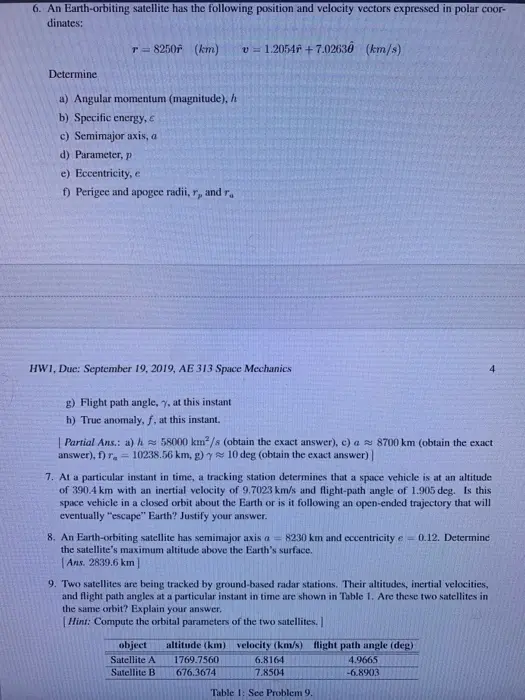
Transcribed Image Text:
6. An Earth-orbiting satellite has the following position and velocity vectors expressed in polar coor-
dinates:
T=8250 (km) v = 1.2054++ 7.02630 (km/s)
Determine
a) Angular momentum (magnitude), h
b) Specific energy, e
c) Semimajor axis, a
d) Parameter, p
e) Eccentricity, e
f) Perigee and apogee radii, r, and ra
HW1, Due: September 19, 2019, AE 313 Space Mechanics
g) Flight path angle, y, at this instant
h) True anomaly, f, at this instant.
Partial Ans.: a) h58000 km2/s (obtain the exact answer), c) a 8700 km (obtain the exact
answer), f) r =10238.56 km, g) y 10 deg (obtain the exact answer)]
7. At a particular instant in time, a tracking station determines that a space vehicle is at an altitude
of 390.4 km with an inertial velocity of 9.7023 km/s and flight-path angle of 1.905 deg. Is this
space vehicle in a closed orbit about the Earth or is it following an open-ended trajectory that will
eventually "escape" Earth? Justify your answer.
8. An Earth-orbiting satellite has semimajor axis a = 8230 km and eccentricity e=0.12. Determine
the satellite's maximum altitude above the Earth's surface.
[Ans. 2839.6 km]
9. Two satellites are being tracked by ground-based radar stations. Their altitudes, inertial velocities,
and flight path angles at a particular instant in time are shown in Table 1. Are these two satellites in
the same orbit? Explain your answer.
Hint: Compute the orbital parameters of the two satellites.]
altitude (km) velocity (km/s) flight path angle (deg)
object
Satellite A
1769.7560
Satellite B
676.3674
6.8164
7.8504
4.9665
-6.8903
Table 1: See Problem 9.
| Partial Ans.: a) h≈ 58000 km2/s (obtain the exact answer), c) a 8700 km (obtain the exact
answer), f) ra 10238.56 km, g) y 10 deg (obtain the exact answer) |
7. At a particular instant in time, a tracking station determines that a space vehicle is at an altitude
of 390.4 km with an inertial velocity of 9.7023 km/s and flight-path angle of 1.905 deg. Is this
space vehicle in a closed orbit about the Earth or is it following an open-ended trajectory that will
eventually "escape" Earth? Justify your answer.
8. An Earth-orbiting satellite has semimajor axis a 8230 km and eccentricity e = 0.12. Determine
the satellite's maximum altitude above the Earth's surface.
[Ans. 2839.6 km
9. Two satellites are being tracked by ground-based radar stations. Their altitudes, inertial velocities,
and flight path angles at a particular instant in time are shown in Table 1. Are these two satellites in
the same orbit? Explain your answer.
Hint: Compute the orbital parameters of the two satellites.]
object
Satellite A
altitude (km) velocity (km/s) flight path angle (deg)
1769.7560
Satellite B
676.3674
6.8164
7.8504
4.9665
-6.8903
Table 1: See Problem 9.
10. The ratio of apoapsis and periapsis radii for a particular satellite orbit is ra/rp
eccentricity of the orbit.
Ans. e 0.2308]
1.6. Determine the
11. An Earth-orbiting satellite is at an altitude of 700 km with inertial velocity 7.3944 km/s and
flight path angle y 0. Is the satellite at perigee or apogee? Justify your answer.
check_circle الجواب — حل مفصل خطوة بخطوة
hourglass_top
🔒
الحل الكامل متاح للمشتركين
اشترك في أرشيف الأسئلة لعرض هذا الحل وآلاف الحلول المفصلة خطوة بخطوة من معلمين معتمدين.