تم الحل ✓
categoryالفيزياء
schoolبكالوريوس
event_available2026-07-15
السؤال
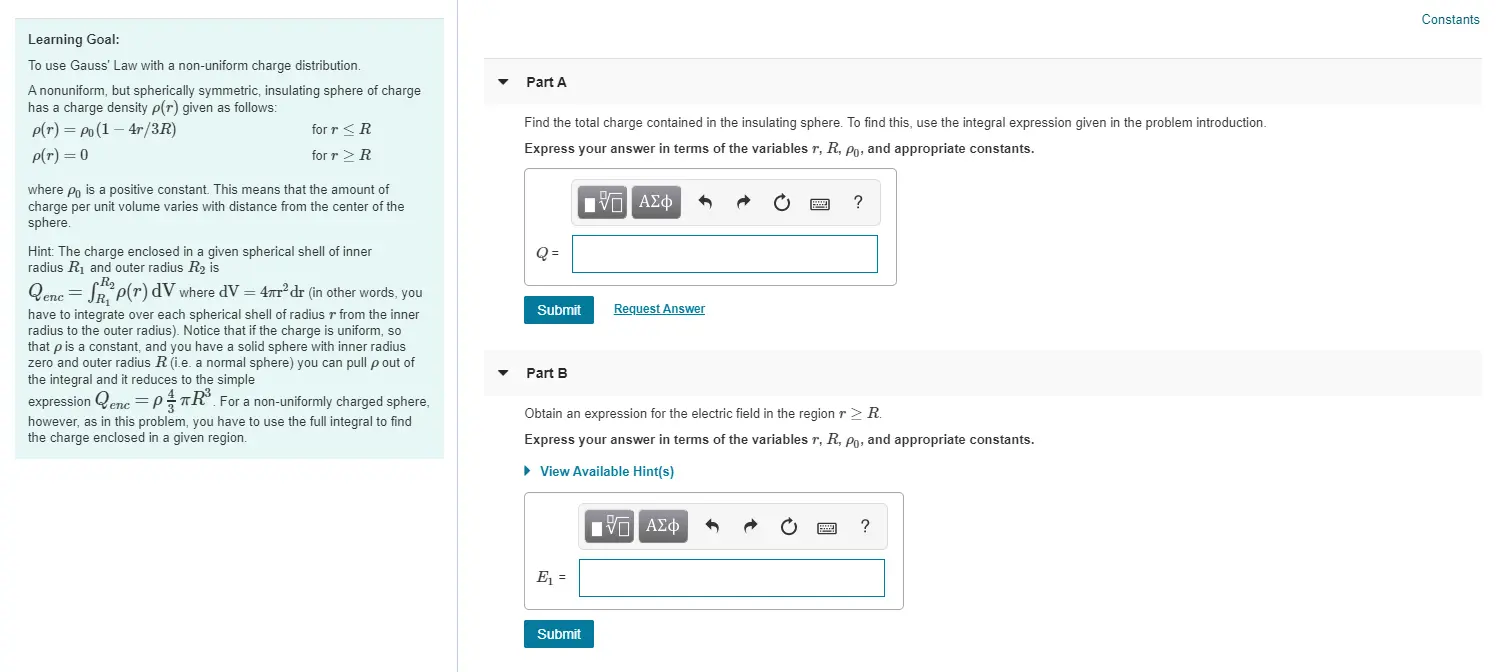
Transcribed Image Text:
Learning Goal:
To use Gauss' Law with a non-uniform charge distribution.
A nonuniform, but spherically symmetric, insulating sphere of charge
has a charge density p(r) given as follows:
P(r) Po(1-4r/3R)
P(T) = 0
for r≤R
for r > R
where p is a positive constant. This means that the amount of
charge per unit volume varies with distance from the center of the
sphere.
Part A
Find the total charge contained in the insulating sphere. To find this, use the integral expression given in the problem introduction.
Express your answer in terms of the variables r, R, po, and appropriate constants.
ΜΕ ΑΣΦ
Q=
2 P(r) dV where dV = 4πr² dr (in other words, you
Submit
Request Answer
Hint: The charge enclosed in a given spherical shell of inner
radius R₁ and outer radius R2 is
Qenc
have to integrate over each spherical shell of radius r from the inner
radius to the outer radius). Notice that if the charge is uniform, so
that p is a constant, and you have a solid sphere with inner radius
zero and outer radius R (i.e. a normal sphere) you can pull p out of
the integral and it reduces to the simple
expression Qenc PπR³. For a non-uniformly charged sphere,
however, as in this problem, you have to use the full integral to find
the charge enclosed in a given region.
Part B
?
Obtain an expression for the electric field in the region r > R.
Express your answer in terms of the variables r, R, po, and appropriate constants.
▸ View Available Hint(s)
ΜΕ ΑΣΦ
?
E₁ =
Submit
Constants
Learning Goal:
To use Gauss' Law with a non-uniform charge distribution.
A nonuniform, but spherically symmetric, insulating sphere of charge
has a charge density p(r) given as follows:
P(r) Po(1-4r/3R)
P(r) = 0
for r < R
for r > R
where p is a positive constant. This means that the amount of
charge per unit volume varies with distance from the center of the
sphere.
Hint: The charge enclosed in a given spherical shell of inner
radius R₁ and outer radius R₂ is
R₂
Qene = P(r) dV where dV = 4πr² dr (in other words, you
have to integrate over each spherical shell of radius r from the inner
radius to the outer radius). Notice that if the charge is uniform, so
that p is a constant, and you have a solid sphere with inner radius
zero and outer radius R (i.e. a normal sphere) you can pull p out of
the integral and it reduces to the simple
expression Qenc =PπR³. For a non-uniformly charged sphere,
however, as in this problem, you have to use the full integral to find
the charge enclosed in a given region.
Part C
Obtain an expression for the electric field in the region r < R.
Express your answer in terms of the variables r, R, Po, and appropriate constants.
▸ View Available Hint(s)
E₂ =
Submit
Part D
ΜΕ ΑΣΦ
Find the value of rat which the electric field is maximum.
?
Express your answer in terms of the variables r, R, Po, and appropriate constants.
▸ View Available Hint(s)
Η ΜΕ ΑΣΦ
?
T=
Submit
Constants
Learning Goal:
To use Gauss' Law with a non-uniform charge distribution.
A nonuniform, but spherically symmetric, insulating sphere of charge
has a charge density p(r) given as follows:
P(r) Po(1-4r/3R)
P(r) = 0
for r≤R
for r > R
where p is a positive constant. This means that the amount of
charge per unit volume varies with distance from the center of the
sphere.
Hint: The charge enclosed in a given spherical shell of inner
radius R₁ and outer radius R₂ is
R₂
Qenc = P(r) dV where dV = 4πr² dr (in other words, you
have to integrate over each spherical shell of radius r from the inner
radius to the outer radius). Notice that if the charge is uniform, so
that p is a constant, and you have a solid sphere with inner radius
zero and outer radius R (i.e. a normal sphere) you can pull p out of
the integral and it reduces to the simple
expression Qenc = PR³. For a non-uniformly charged sphere,
however, as in this problem, you have to use the full integral to find
the charge enclosed in a given region.
Part D
Find the value of r at which the electric field is maximum.
Express your answer in terms of the variables r, R, Po, and appropriate constants.
▸ View Available Hint(s)
T=
Submit
Part E
ΜΕ ΑΣΦ
Find the value of that maximum field.
?
Express your answer in terms of the variables r, R, Po, and appropriate constants.
Emax =
ΜΕ ΑΣΦ
?
Submit
Request Answer
Constants
check_circle الجواب — حل مفصل خطوة بخطوة
hourglass_top
🔒
الحل الكامل متاح للمشتركين
اشترك في أرشيف الأسئلة لعرض هذا الحل وآلاف الحلول المفصلة خطوة بخطوة من معلمين معتمدين.