تم الحل ✓
categoryالهندسة الميكانيكية
schoolبكالوريوس
event_available2026-07-15
السؤال
Transcribed Image Text:
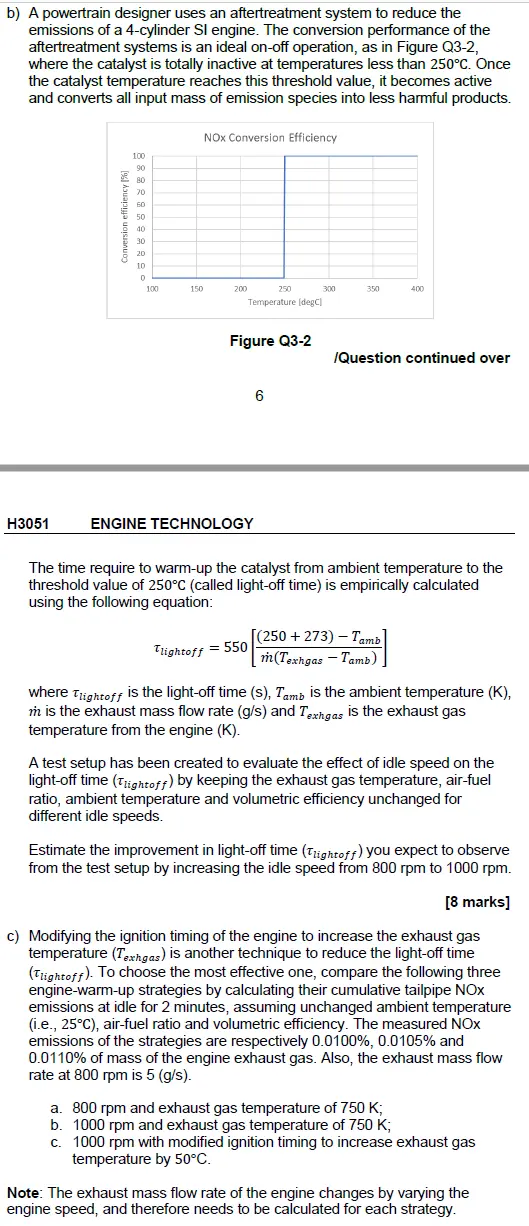
b) A powertrain designer uses an aftertreatment system to reduce the
emissions of a 4-cylinder SI engine. The conversion performance of the
aftertreatment systems is an ideal on-off operation, as in Figure Q3-2,
where the catalyst is totally inactive at temperatures less than 250°C. Once
the catalyst temperature reaches this threshold value, it becomes active
and converts all input mass of emission species into less harmful products.
100
NOx Conversion Efficiency
Conversion efficiency [%]
50
40
80
20
10
0
100
150
200
250
Temperature (degC]
350
400
Figure Q3-2
/Question continued over
6
H3051
ENGINE TECHNOLOGY
The time require to warm-up the catalyst from ambient temperature to the
threshold value of 250°C (called light-off time) is empirically calculated
using the following equation:
Tlightoff = 550
(250 +273) Tamb]
m(Texhgas - Tamb)
where Tlightoff is the light-off time (s), Tamb is the ambient temperature (K),
m is the exhaust mass flow rate (g/s) and Texhgas is the exhaust gas
temperature from the engine (K).
A test setup has been created to evaluate the effect of idle speed on the
light-off time (Tlightoff) by keeping the exhaust gas temperature, air-fuel
ratio, ambient temperature and volumetric efficiency unchanged for
different idle speeds.
Estimate the improvement in light-off time (Tlightoff) you expect to observe
from the test setup by increasing the idle speed from 800 rpm to 1000 rpm.
[8 marks]
c) Modifying the ignition timing of the engine to increase the exhaust gas
temperature (Texhgas) is another technique to reduce the light-off time
(Tlightoff). To choose the most effective one, compare the following three
engine-warm-up strategies by calculating their cumulative tailpipe NOx
emissions at idle for 2 minutes, assuming unchanged ambient temperature
(i.e., 25°C), air-fuel ratio and volumetric efficiency. The measured NOx
emissions of the strategies are respectively 0.0100%, 0.0105% and
0.0110% of mass of the engine exhaust gas. Also, the exhaust mass flow
rate at 800 rpm is 5 (g/s).
a. 800 rpm and exhaust gas temperature of 750 K;
b. 1000 rpm and exhaust gas temperature of 750 K;
c. 1000 rpm with modified ignition timing to increase exhaust gas
temperature by 50°C.
Note: The exhaust mass flow rate of the engine changes by varying the
engine speed, and therefore needs to be calculated for each strategy.
check_circle الجواب — حل مفصل خطوة بخطوة
hourglass_top
🔒
الحل الكامل متاح للمشتركين
اشترك في أرشيف الأسئلة لعرض هذا الحل وآلاف الحلول المفصلة خطوة بخطوة من معلمين معتمدين.