تم الحل ✓
categoryالهندسة الميكانيكية
schoolبكالوريوس
event_available2026-07-15
السؤال
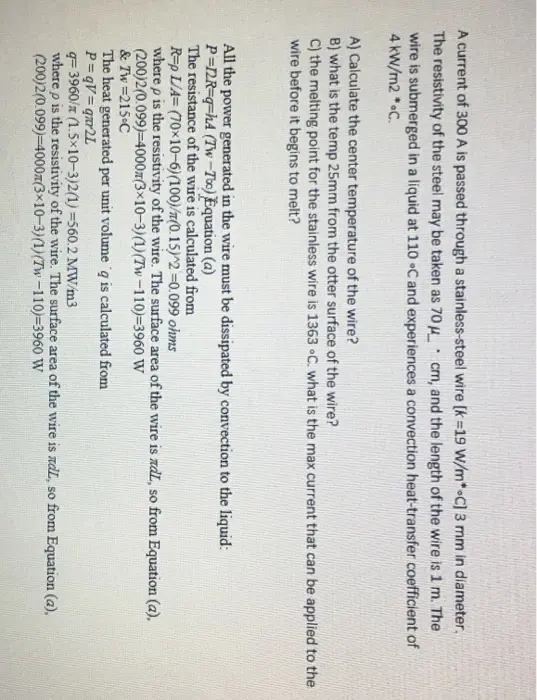
Transcribed Image Text:
A current of 300 A is passed through a stainless-steel wire [k =19 W/m* C] 3 mm in diameter.
The resistivity of the steel may be taken as 70 cm, and the length of the wire is 1 m. The
•
wire is submerged in a liquid at 110 °C and experiences a convection heat-transfer coefficient of
4 kW/m2 *.C.
A) Calculate the center temperature of the wire?
B) what is the temp 25mm from the otter surface of the wire?
C) the melting point for the stainless wire is 1363 °C. what is the max current that can be applied to the
wire before it begins to melt?
All the power generated in the wire must be dissipated by convection to the liquid:
P=12R-q-hA (Tw-Too) Equation (a)
The resistance of the wire is calculated from
R=p L/A= (70x10-6)(100)/(0.15)^2=0.099 ohms
where p is the resistivity of the wire. The surface area of the wire is лdL, so from Equation (a),
(200)2(0.099)-4000л(3×10⁻³)(1)(Tw-110)=3960 W
& Tw=215°C
The heat generated per unit volume q is calculated from
P=qV=qar2L
q=3960/x (1.5×10⁻³)2(1) =560.2 MW/m3
where p is the resistivity of the wire. The surface area of the wire is лdL, so from Equation (a),
(200)2(0.099)-4000л(3×10⁻³)(1)(Tw-110)=3960 W
check_circle الجواب — حل مفصل خطوة بخطوة
hourglass_top
🔒
الحل الكامل متاح للمشتركين
اشترك في أرشيف الأسئلة لعرض هذا الحل وآلاف الحلول المفصلة خطوة بخطوة من معلمين معتمدين.